The Valley’s school year is opening on a two-front assault. Chandler Unified and Apache Junction started classes on July 16, most districts follow between now and the first week of August, and Mesa Public Schools — the state’s largest district — opens July 31, per 12News and ABC15 reporting on Valley start dates. Those first days are landing inside a stretch of National Weather Service Extreme Heat Warnings, with Phoenix highs of 113 to 114 degrees and overnight lows holding near 90. Then last night a monsoon storm drove a 68 mph gust past Sky Harbor, hit Mesa at 53 mph, and knocked out power to roughly 13,000 customers, per azfamily reporting this morning. Somewhere in the middle of all that, at 3 p.m. today, several hundred thousand Arizona students walked out of air conditioning and stood on bare pavement waiting for a bus or a parent.
Districts have spent a decade getting serious about shading playgrounds and lunch courts, and the progress is real. But walk the perimeter of most Valley campuses and you’ll find the one zone every student passes through twice a day — the bus loading area, the parent pickup loop, the queuing sidewalks at the front doors — still sitting in full sun. This article makes the case that the arrival-and-dismissal zone is the next shade priority for Arizona schools, and walks through the heat exposure, the engineering, and the structure types that actually fit these sites.
The School Year Now Starts in the Hottest Week of the Year
Arizona runs some of the earliest school calendars in the country, and the trade-off is blunt: the first weeks of instruction now coincide with the statistical peak of Phoenix summer. This week’s Extreme Heat Warning — the National Weather Service’s highest heat alert tier — calls for 110-plus every day, and overnight lows between 85 and 90 mean neither campuses nor the hardscape around them cool off before the next morning’s arrival bell. Concrete and asphalt that never shed yesterday’s heat start accumulating today’s by 8 a.m.
The stakes are not abstract. Maricopa County recorded 430 heat-related deaths in 2025, and heat exhaustion in unprotected outdoor conditions at 114 degrees can develop in about half an hour — roughly the length of a slow dismissal. The Arizona Department of Health Services publishes heat-management recommendations for schools built around a daily heat index: limit outdoor time, move recess indoors, hydrate aggressively. That guidance works for recess because recess is optional and movable. It does nothing for the one outdoor interval that is neither.
Recess can move indoors. Dismissal cannot. Every student on campus funnels through the same few hundred square feet of pavement at the same fixed time — and that time is within an hour of the day’s peak heat.
The Dismissal Zone Is the Least-Shaded Place on Campus
The dismissal zone is also the most regulated outdoor space a school operates, which makes its bareness stranger. Arizona Administrative Code R13-13-104 requires buses to load and unload only in a designated area on school grounds, marked with a sign, restricted during loading to buses, passengers, and supervising staff, and laid out so buses never reverse. Districts obey all of it. The loading area is designated by rule, marked by sign, positioned by regulation — and shaded by nothing.
Parent pickup is the same picture with more idling engines. More Valley families drive their kids than ever, and dismissal apps and stacked car lines have made the process longer and more orderly at once — students wait in supervised queues on sidewalks and curb aprons until their vehicle reaches the front. The queue is a feature of the system. The sun exposure of the queue is an accident nobody designed and nobody owns.
The reason these zones stay bare is rarely indifference. It’s that they’re hard. A curb line can’t take posts where buses swing. A fire lane can’t be obstructed. Sight lines for drivers and staff have to survive. Those are engineering constraints, not reasons to do nothing — and they’re precisely the kind of constraint that separates a catalog kit from an engineered structure.
What 3 P.M. Pavement Does to Waiting Students
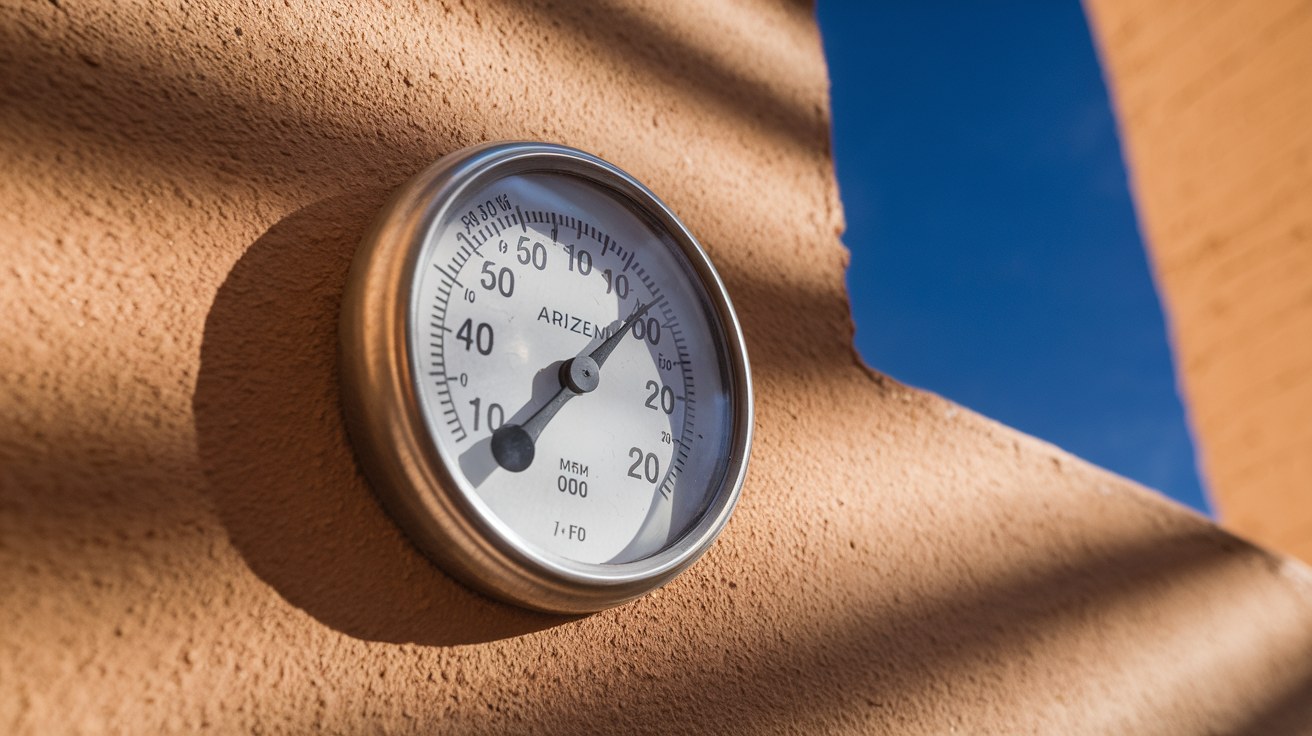
Dismissal timing is close to the daily maximum for surface temperature. Air temperature peaks in late afternoon, but hardscape leads the way: NASA JPL surface-temperature imaging of Phoenix during heat waves has recorded asphalt and concrete running 40 to 60 degrees above air temperature, which puts a 113-degree afternoon’s pavement into the 160-degree range. That is the surface radiating up at children standing in line — often wearing backpacks that block half their body’s ability to shed heat.
Quality shade changes the physics directly. Blocking direct solar load can drop the effective temperature a body experiences by 15 degrees or more, and shaded pavement routinely measures 30 to 40 degrees cooler than adjacent exposed surfaces — which also matters for the staff member standing post through the entire dismissal window, every day. The UV arithmetic runs parallel: Phoenix summer UV indexes sit in the extreme range during afternoon dismissal hours, and the Skin Cancer Foundation ties cumulative childhood exposure to lifetime skin cancer risk. We covered the fabric side of that equation in our guide to Arizona shade structure UV protection — the Commercial 340/95 HDPE we standardize on blocks up to 96 percent of UV while staying porous enough to vent heat rather than trap it.
Last Night’s 68 mph Gust Is Your Engineering Spec
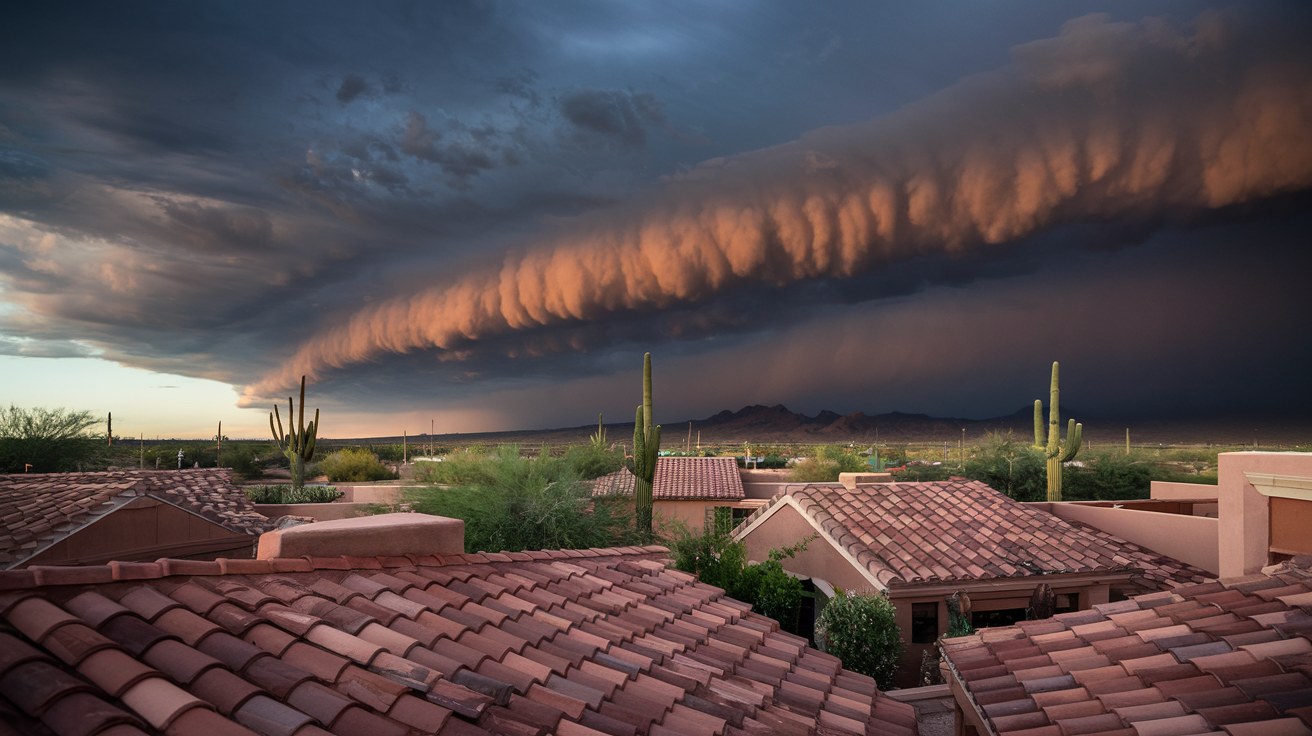
Here is where the second front of the season takes over. Anything a district builds over a bus lane or a pickup queue has to survive exactly the storm that rolled through the Valley last night — and the one on July 13 before it, and the ten more weeks of monsoon still on the calendar. A structure over a dismissal zone that fails at 68 mph doesn’t just cost fabric. It fails over the one place a campus concentrates every student, every parent vehicle, and every bus, on a fixed schedule the wind doesn’t consult.
That concentration is why the engineering conversation has to precede the aesthetic one. Sealed structural calculations for the site’s actual wind exposure, footing designs that account for soil and adjacent utilities, attachment hardware specified for cyclic gust loading rather than static load — these are the difference between a structure that sheds a monsoon outflow and one that becomes debris. We walk through what wind ratings mean, and how structures fail when ratings are guessed at, in monsoon-ready commercial shade structures in Arizona. For dismissal zones, add one more requirement to the list: engineered fabric-release and tensioning details that let the fabric come down for scheduled maintenance without a crane parked in the fire lane.
Matching the Structure to the Zone
Dismissal areas reward specific forms. Along bus curbs and pickup lanes, the constraint is post placement — nothing can sit where buses swing or doors open. A flat cantilevered structure puts its columns at the back of the sidewalk and reaches over the waiting line, leaving the curb face completely clear. Over queuing courtyards and plaza-style waiting areas, a hip structure covers the most square footage per dollar and handles the daily 3 p.m. crowd with the same geometry that has made it the workhorse of Arizona school sites. At building entries and administrative doors, building-mounted awnings shade the threshold where staff check students out and parents wait for office pickups. For designated parent-waiting areas, cabanas create defined, supervised shade without fencing. And for the campuses where nothing rectangular fits — angled fire lanes, mature trees, utility easements threading the site — custom-engineered structures and sculptural hypar forms exist precisely for irregular footprints.
The wrong answer is forcing a stock kit onto a constrained site. A vendor who sells one form will recommend that form regardless of where your buses swing. A shop that engineers the full range will match the structure to the zone — and can show you district references that prove it.
Funding It and Timing It
The money question has more answers than most facility directors expect. First, small grants exist: the American Academy of Dermatology’s Shade Structure Grant Program funds shade for schools and nonprofits serving children, and while individual awards are modest, they have seeded hundreds of school projects nationally. Second, this fits capital cycles: Maricopa County districts brought more than $2 billion in combined bond requests to voters in the last cycle, per 12News reporting, and dismissal-zone shade is a small line item inside safety and site-improvement categories that boards already fund. Third, existing steel may be an asset: if a campus has an older structure with tired fabric near the front of the site, a re-skin through our canopy replacement and repair team — fabricated by our in-house sewing crew on the original frame — typically runs about two-thirds the cost of full replacement and frees budget for new coverage where there is none.
Timing matters as much as money. The post-monsoon window from October through November is the best installation season of the year — storms done, temperatures workable, campuses in routine — and design, engineering, and permitting for an October build need to start now, not in September. Districts that spec in late summer install in fall. The ones that wait discuss it again next July. Our testimonials page includes the districts and boards that took the first path.
The Bottom Line
Arizona moved the school year into July, and July did not move. The first weeks of the 2026-27 calendar are running through Extreme Heat Warnings and an active monsoon that put a 68 mph gust through the Valley last night — and twice a day, every campus concentrates its entire population on a strip of unshaded pavement that hits 160 degrees. The playgrounds got shaded because someone decided they mattered. The dismissal zone is next, and the engineering, the structure types, and the funding paths all exist. If your bus loading area or pickup loop is still bare, contact Total Shade today — we’ve spent more than 25 years engineering shade that survives Arizona’s storms over the places Arizona’s kids stand.
Sources: Valley school start dates including Chandler Unified and Apache Junction on July 16 and Mesa Public Schools on July 31 (12News, ABC15 reporting); Extreme Heat Warning with 113-114 degree highs and overnight lows of 85-90 (National Weather Service Phoenix via KTAR and azfamily, July 2026); July 20-21 monsoon storm with 68 mph gust near Sky Harbor, 53 mph in Mesa, and roughly 13,000 customers without power (azfamily, July 21, 2026); 430 heat-related deaths in Maricopa County in 2025 and 30-minute heat exhaustion onset at 114 degrees (Maricopa County Department of Public Health via press reporting); school heat-management guidance (Arizona Department of Health Services, “Managing Extreme Heat: Recommendations for Schools”); bus loading area requirements (Arizona Administrative Code R13-13-104); Phoenix surface temperatures 40-60 degrees above air temperature (NASA JPL surface-temperature imaging); childhood UV exposure and lifetime risk (Skin Cancer Foundation); Shade Structure Grant Program (American Academy of Dermatology); $2 billion-plus in Maricopa County school bond requests (12News); Commercial 340/95 HDPE specification with up to 96% UV block, in-house sewing, re-skin economics at roughly two-thirds of replacement cost, and 25-plus years of Arizona experience from Total Shade specification sheets and project experience.
