or call (602) 265-0905 — no-obligation, on-site.
Shade Structure Products
Since 1998
Designing & building Arizona shade
In-House Fabrication
Built at our Phoenix shop
Engineered & Permit-Ready
Stamped drawings for AZ wind loads
Free On-Site Quote
No-obligation project assessment
Total Shade builds five families of commercial shade structure from our Phoenix shop at 2331 W. Holly St: tensioned-fabric forms, hip canopies, architectural pieces like awnings and cabanas, custom one-off frames, and re-cover work on existing steel. Choosing among them comes down to four questions: how the space is used, where posts can land, how much wind the site sees, and whether design review is in play. With 25+ years engineering powder-coated steel and knitted HDPE covers against Arizona’s UV and monsoon gusts, the goal here is to match a structure to a problem, not to a catalog. Each family below points to the specific product pages where the spec lives.
Start with the use, the post lines, and the wind
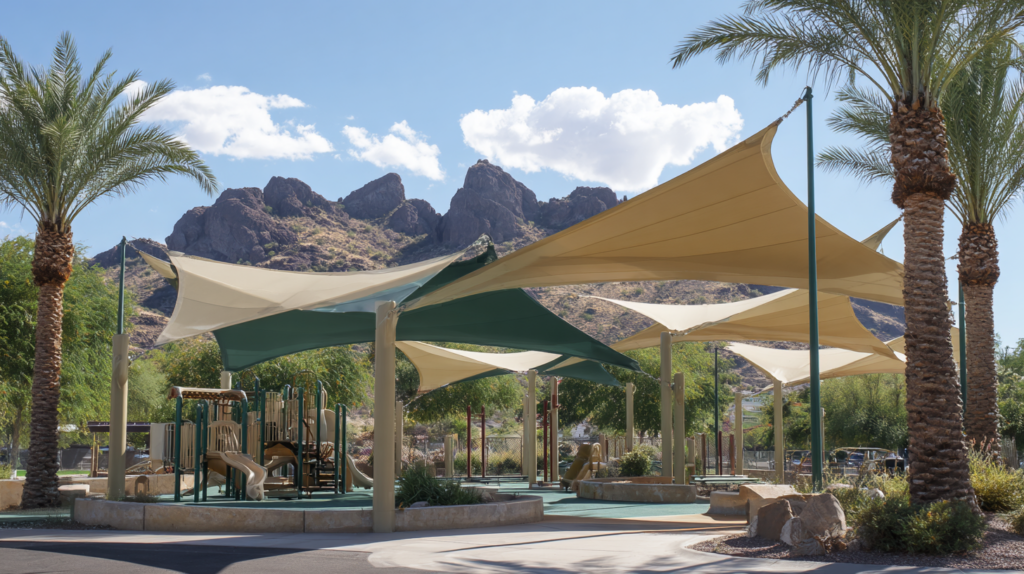
The right shade family is decided by the site, not by looks, and four variables settle most projects. First, the use: cars, kids, diners, and pool decks each demand different clearances and footprints. Second, where posts can land, because a parking lane that cannot tolerate a column between stalls rules out multi-post designs immediately. Third, the wind exposure, since an open lot facing a haboob path needs more steel than a courtyard tucked behind a building. Fourth, whether an HOA or municipal design review will judge the shape.
A quick way to read your own site: if you are shading cars and posts must stay at the perimeter, you are in cantilever territory; if you are shading a lunch court where columns are fine, hip structures cost less per shaded foot; if a resort or HOA wants an architectural line, tensioned fabric earns its premium. Most Valley demand falls into those three lanes, with awnings, cabanas, ramadas, and custom work filling the edges. The families below follow that logic.
Tensioned fabric, when the shape is part of the design
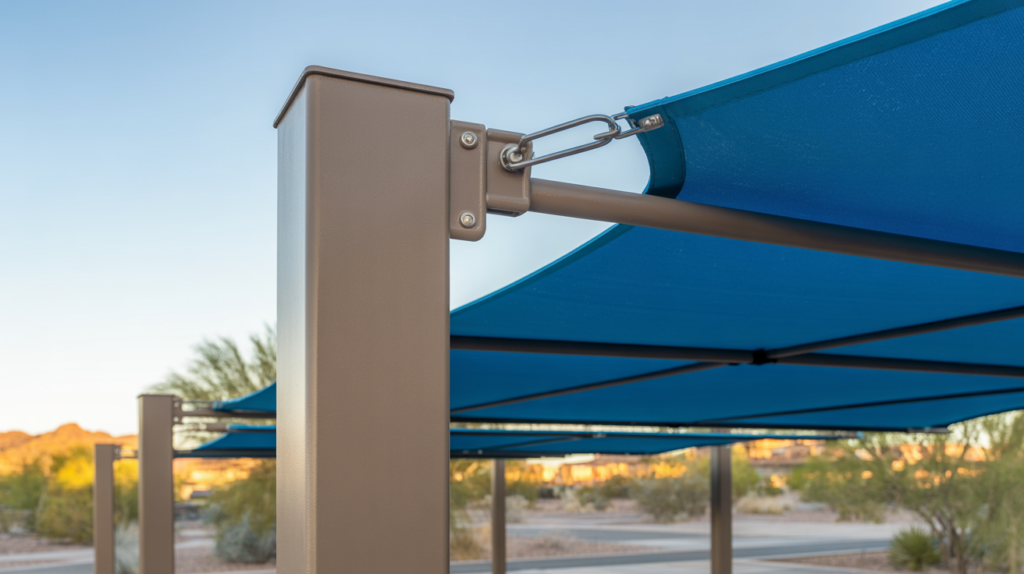
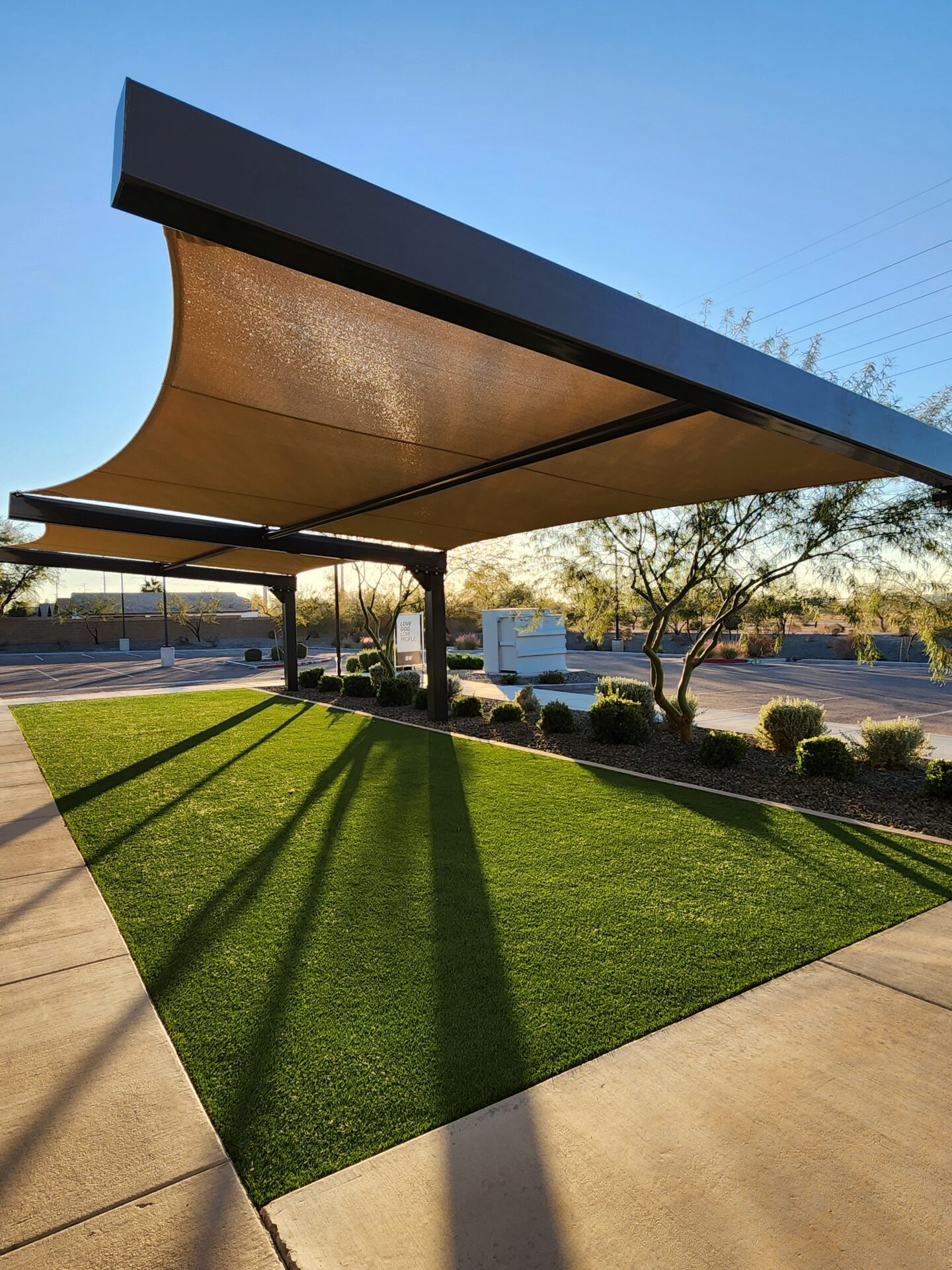
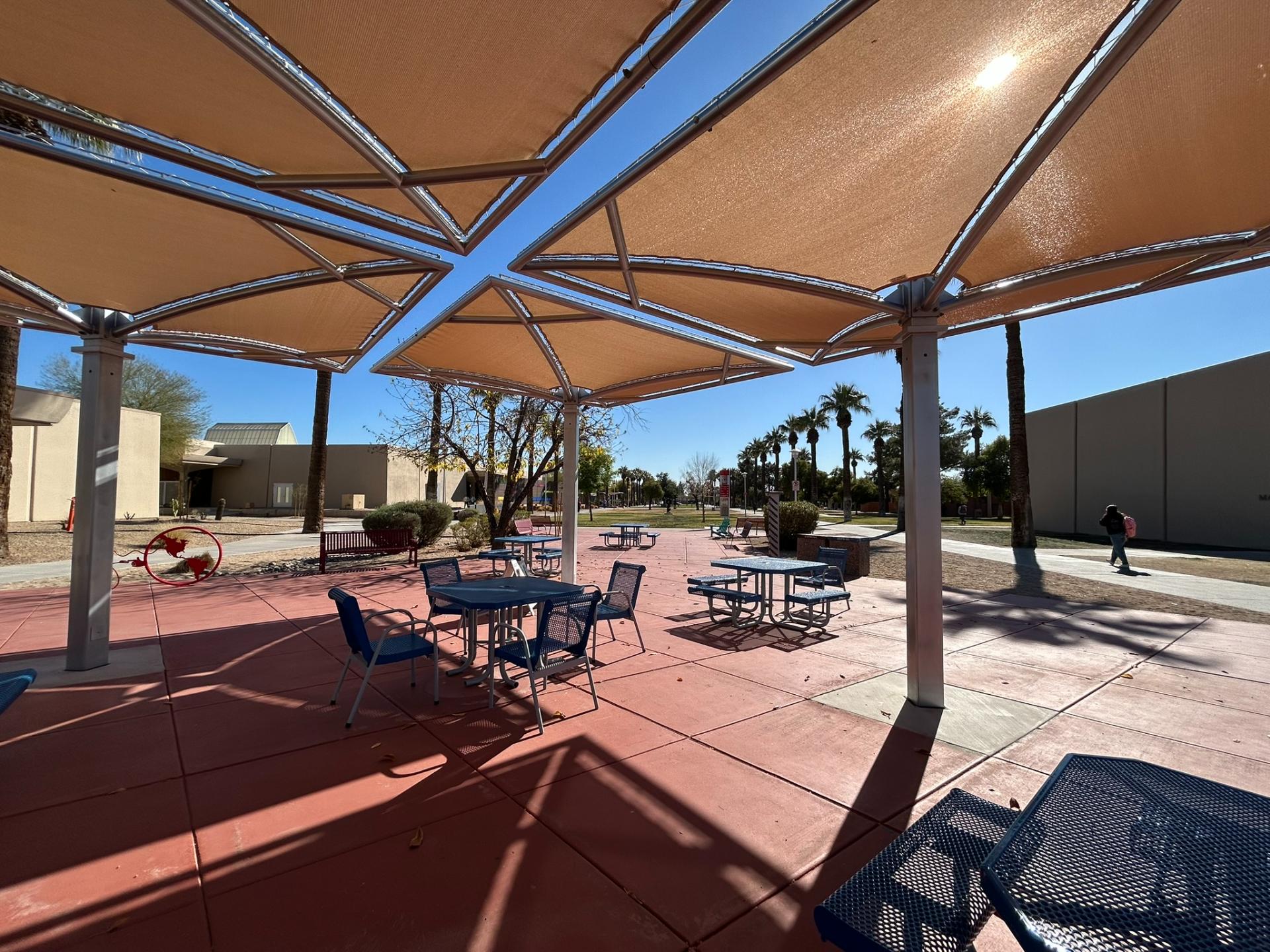
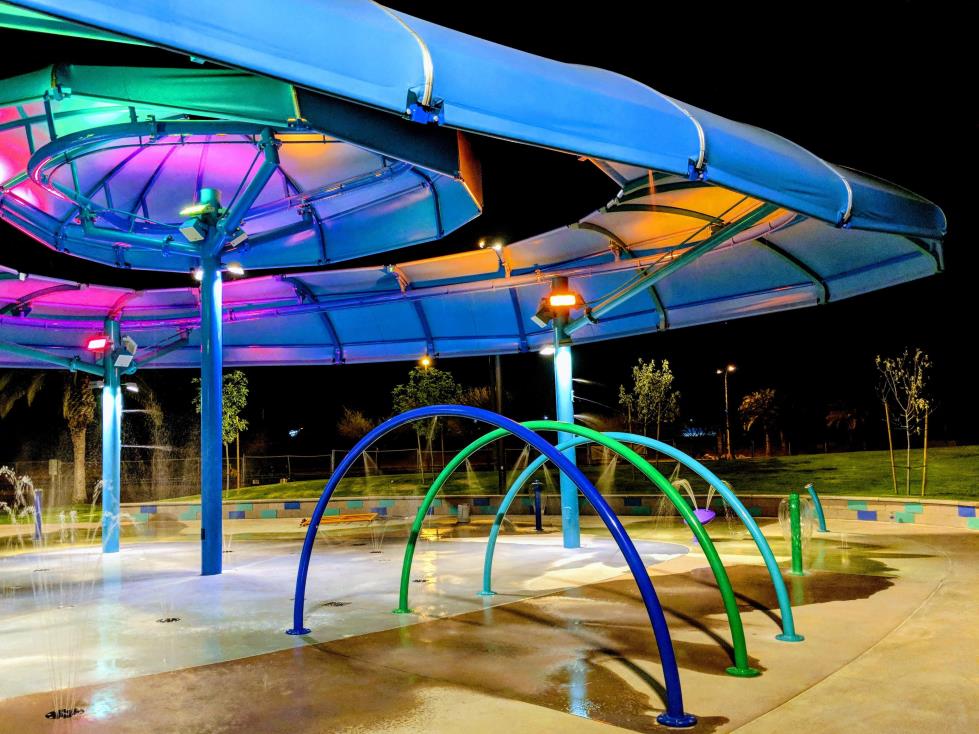
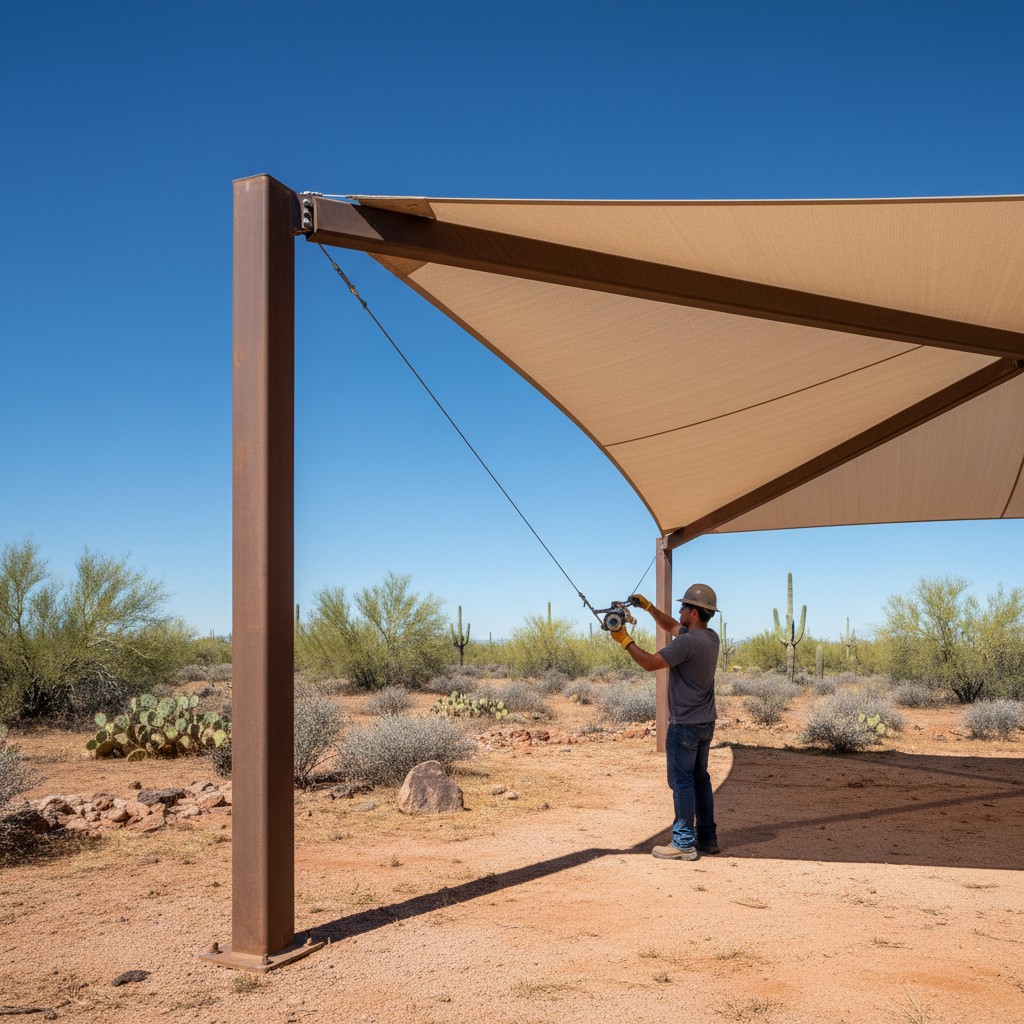
Tensioned-fabric structures stretch knitted HDPE over a steel frame into a curved, sculptural plane, and they win where the shade is meant to be seen. The hypar (hyperbolic-paraboloid) structure twists two high corners against two low ones, which both sheds wind and reads as architecture rather than a flat box; it is the go-to for entries, plazas, and HOA-reviewed common areas. The flat cantilevered structure carries its whole load on a single post line, so a bay shades roughly 16-20 ft of depth with no columns between parked cars.
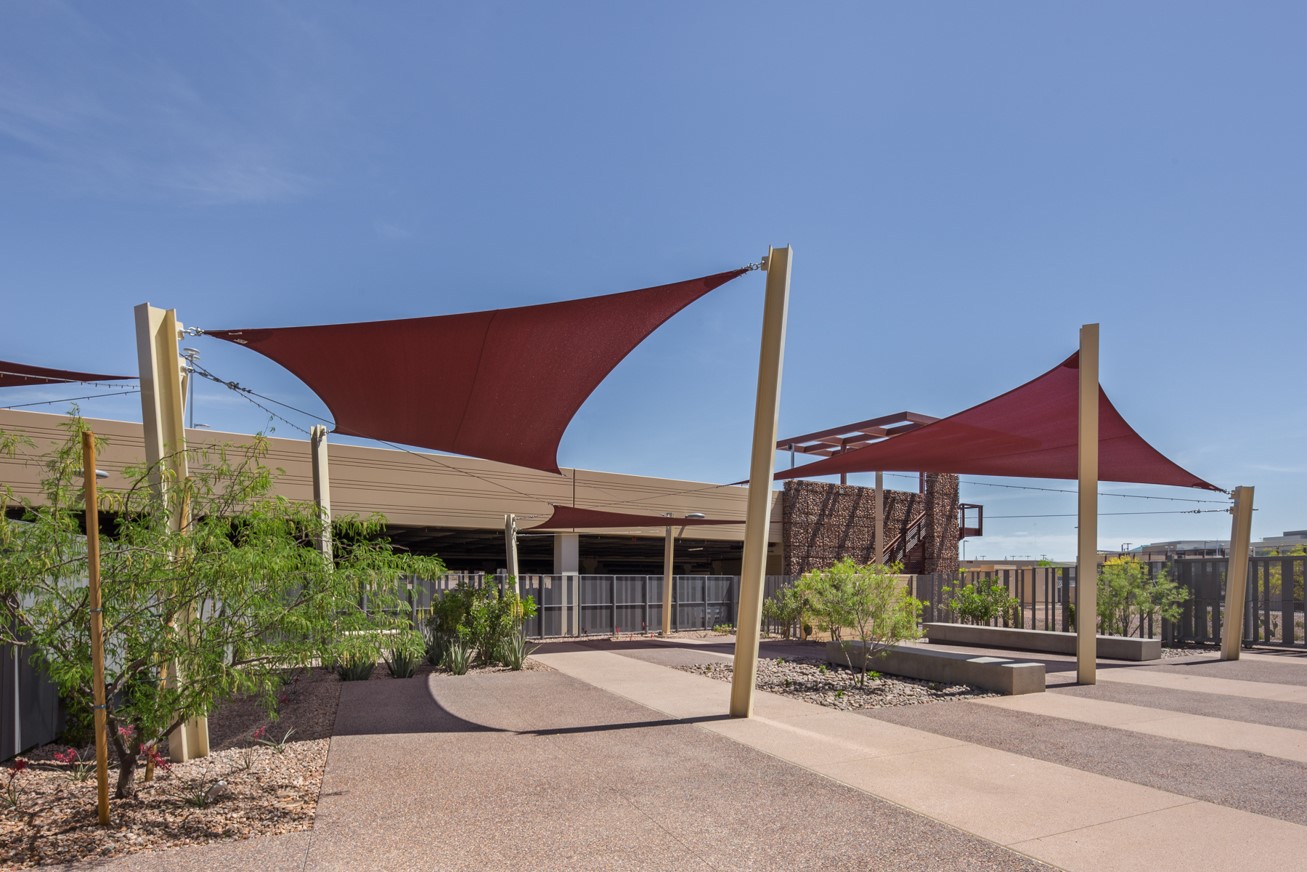
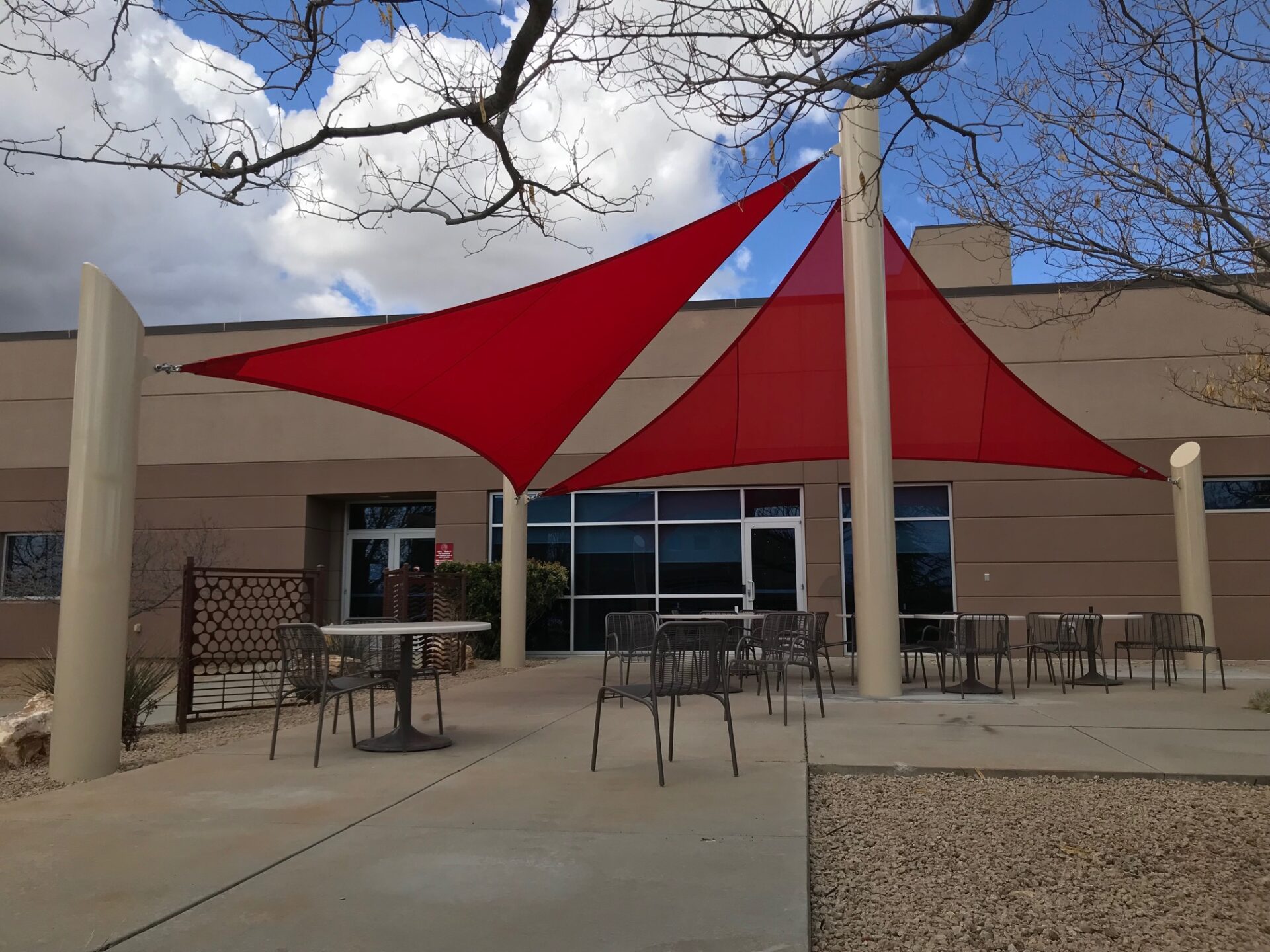
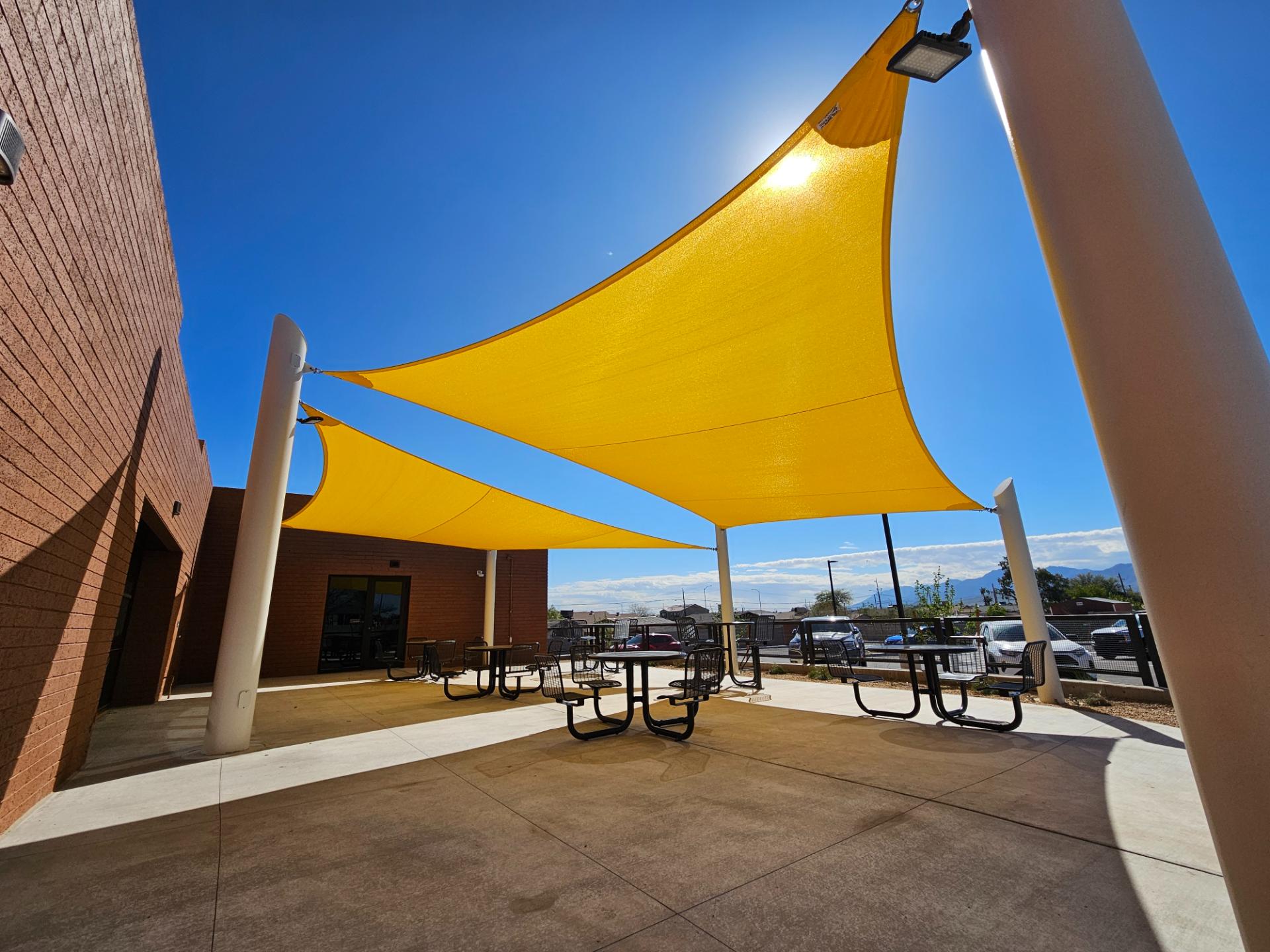
Shade sails are the lighter, lower-cost branch of the same family. A 3-point tensioned sail anchors to three masts for a clean triangular plane that drains and sheds wind well, while a 4-point sail covers a larger rectangle off four anchors for patios and play areas. Across all four, the cover blocks roughly 90-99% of UV depending on weave density. The trade-off worth naming: tensioned fabric must be re-tensioned after its first season as HDPE relaxes, or it will flap and wear at the seams.
Hip structures, the workhorse for large flat coverage
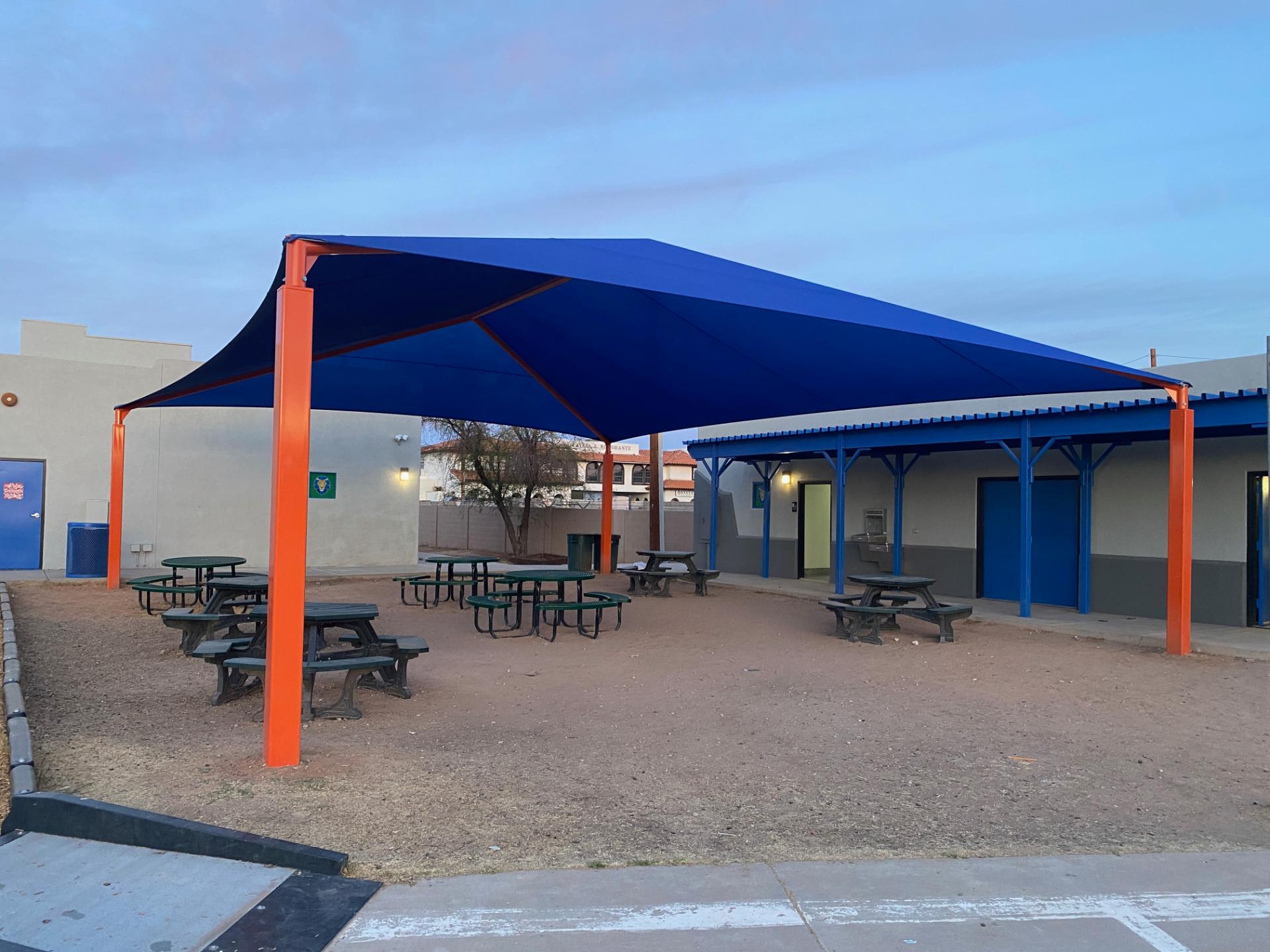
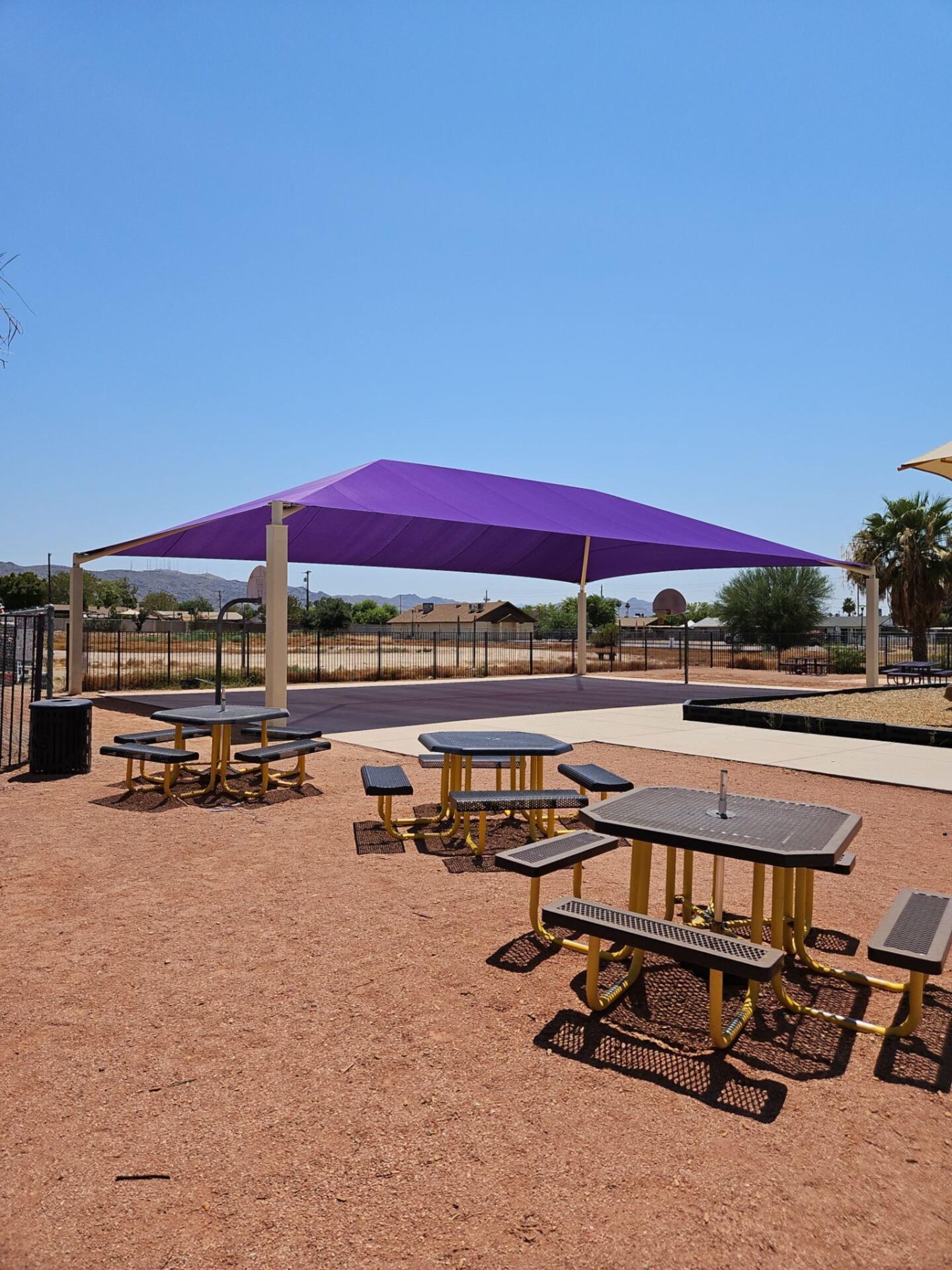
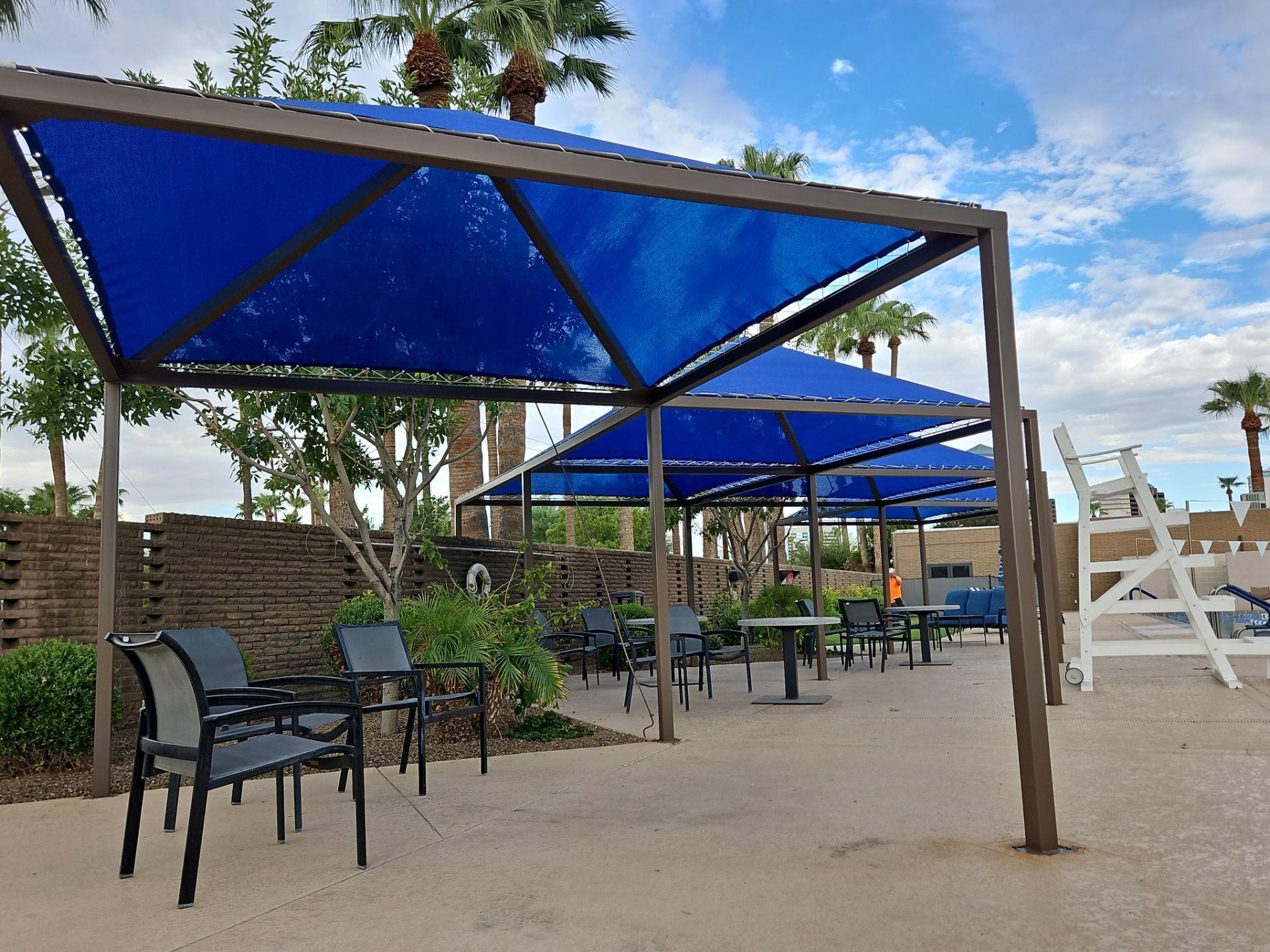
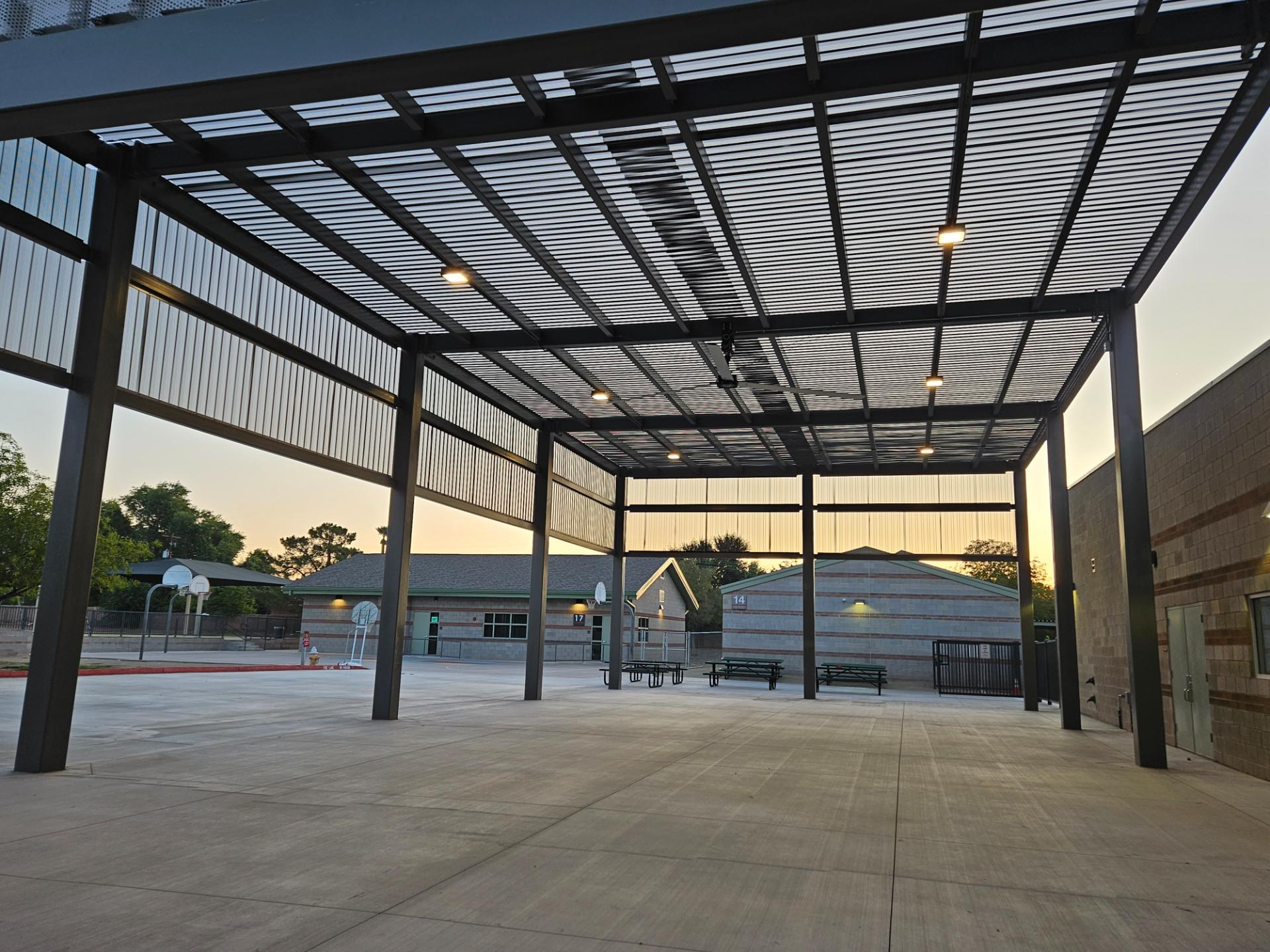
Hip structures are the most cost-effective way to shade a big rectangular footprint, which is why schools, parks, and municipal sites lean on them. A pitched four-sided roof drains rain and dust toward the perimeter and spreads its load across multiple posts, so the design clears tall vehicles and covers long runs over lunch courts, bleachers, and walkways. Because the posts carry the weight together rather than cantilevering off one line, a standard hip structure shades more square footage per dollar of steel than any tensioned form.
For longer clear spans and taller clearances, the MAX hip structure uses heavier members and deeper foundations to stretch the same geometry over wider bays, useful where a single canopy needs to cover a full court or a large vehicle drive-through. Both versions run powder-coated steel that behaves more like a baked-on finish than brushed paint, resisting the chalking that desert sun forces on cheaper coatings. The honest limit: hip designs need interior posts, so they are wrong for a parking aisle where a column between stalls is unacceptable.
Awnings, cabanas, umbrellas, and ramadas for the built edges
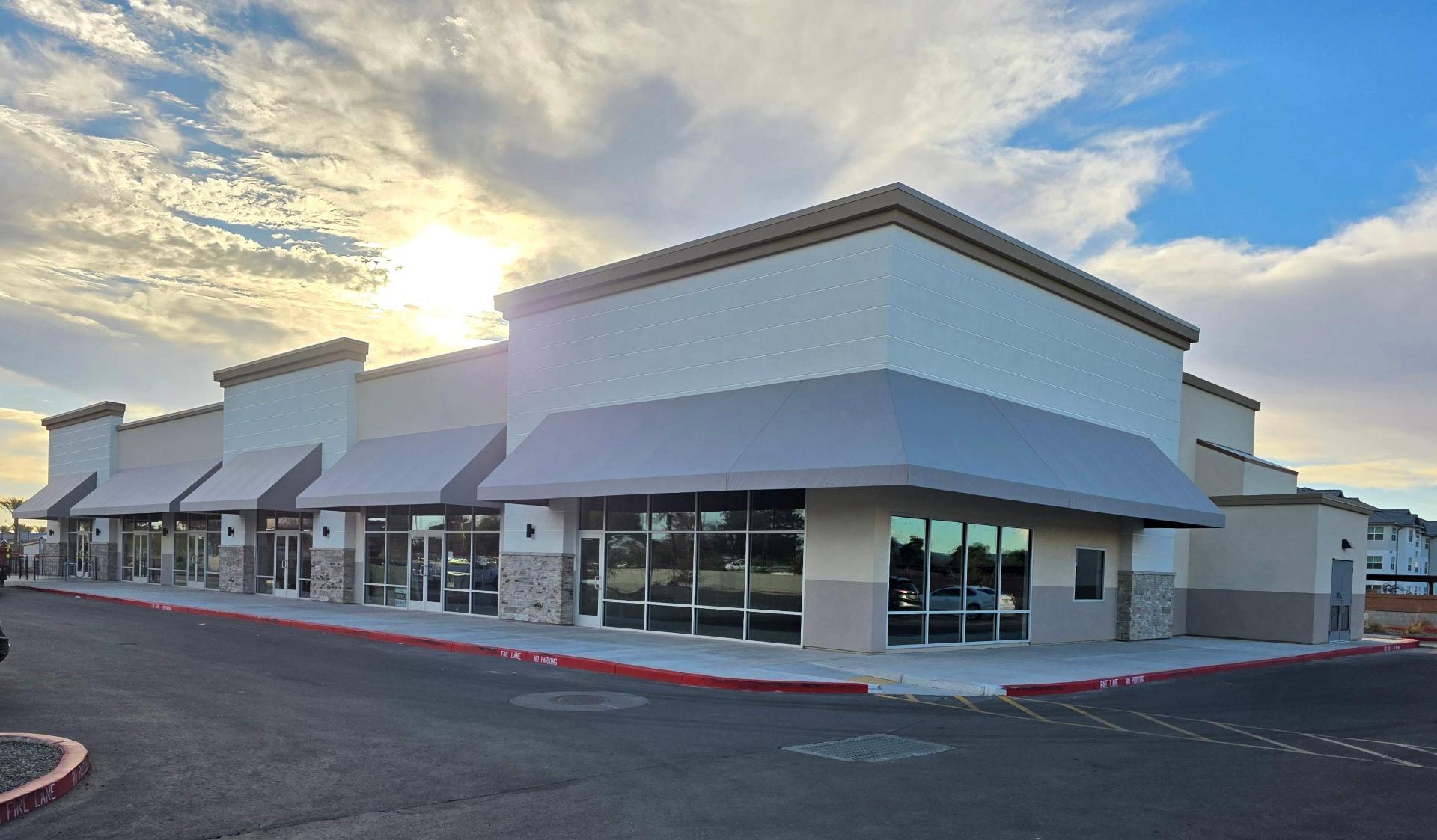
The architectural family handles the spots a large canopy cannot reach: entries, storefronts, pool decks, and gathering nodes. Awnings cover doorways, drive-up windows, and restaurant patios where a fabric or metal projection ties into the building wall. Cabanas give pool decks and resort lounges an enclosed-corner structure with privacy and posts at the four corners, and commercial umbrellas drop movable, single-post shade over tables and small clusters where a fixed canopy would be overkill.
When the brief calls for all-weather, solid-roof cover rather than fabric, ramadas answer it: a metal or wood roof over steel posts shields parks, picnic areas, and backyards from sun and rain alike. The line between these and the fabric families is mostly about scale and permanence. Umbrellas move and fold; cabanas and ramadas stake out a fixed room outdoors. None of them replaces a full parking-lot or lunch-court canopy, and trying to shade a 40-car aisle with umbrellas is the most common oversizing mistake we talk clients out of.
Custom builds and re-covers, when nothing standard fits
When a site fits no catalog default, a custom-built shade structure lets the frame follow the lot instead of forcing the lot to fit the frame. Building under one roof at 2331 W. Holly St is what makes that practical: when the same shop draws the engineering, cuts and welds the steel, and runs the install crew, a span change on the drawing reaches the saw the same week instead of bouncing between an out-of-state manufacturer and a local sub. That control is why a custom bay can be tuned to an odd stall count or a tight HOA setback without a six-week change order.
The other half of the line keeps existing structures alive. Knitted HDPE covers commonly carry 10-15 year warranties, and Arizona’s UV sits at the demanding end of that window, so a re-cover is honest budgeting rather than a defect. A canopy replacement and repair reuses the standing steel and swaps only the worn fabric, which keeps the cost far below a new structure and the old frame out of the landfill. If your posts are sound but the cover is faded or torn, that is the page to start on, not a teardown.
Materials and engineering shared across the whole line
Every family above runs the same two-material system: powder-coated structural steel for the frame, knitted HDPE for the cover. The fabric blocks roughly 90-99% of UV depending on weave density, which is what spares paint, dashboards, playground rubber, and patio furniture the fade and brittle-cracking bare Arizona sun forces in a single season. The steel side is sized to the site, not a generic spec.
What the engineering covers
- Wind sized for here. Maricopa County structures are engineered to Arizona building code and ASCE 7 wind loads, where Valley design wind speeds run roughly 90-115 mph; monsoon microbursts can punch past 60 mph in minutes.
- Foundations for caliche. Hard Valley ground often pushes caissons 6-10 ft deep before they grip, and that invisible work is the biggest reason an engineered canopy outlives a bargain one.
- Stamped, code-ready drawings. We provide the engineered, stamped plans; the city handles review and inspection.
The caveats are worth stating plainly. Fabric is a consumable, so plan a re-cover inside that 10-15 year window. Wind ratings have ceilings; an engineered design covers typical monsoon loads, not every freak gust on record. And dust is a real chore, so a rinse once or twice a year keeps grit from abrading the weave. Knowing those limits is what separates a structure that lasts 15 years from one that disappoints in 5. From here, the product grid below routes to the spec page for each family.
Our Complete Shade Structure Product Line
Not sure which shade structure fits your project?
Call (602) 265-0905 for a free assessment.
Frequently Asked Questions
How do I choose between a hip structure and a cantilever for a parking lot?
If your parking aisles cannot tolerate a column between stalls, choose a cantilever, which carries its load on a single post line so cars never thread between columns and shades roughly 16-20 ft of depth per bay. If posts can land inside the footprint, a hip structure covers the same area for less steel per shaded foot. The deciding factor is almost always where columns are allowed to sit.
What drives the cost of a commercial shade structure?
Cost tracks span, post count, foundation depth, and fabric grade, so structures are priced per project rather than off a per-square-foot chart. A design-led hypar or tensioned sail runs higher than a standard hip canopy of the same footprint, and caliche ground raises foundation cost where caissons run 6-10 ft deep. We quote after reviewing the site layout so the number reflects the actual structure.
What are commercial shade structures made of?
The frame is powder-coated structural steel and the cover is knitted HDPE shade fabric, which blocks roughly 90-99% of UV depending on weave density. The powder coat behaves more like a baked-on finish than brushed paint, resisting desert-sun chalking, while the HDPE cover is a replaceable layer carrying common 10-15 year warranties. Ramadas can swap the fabric cover for a solid metal or wood roof when all-weather coverage is the goal.
Which shade structures hold up best in Arizona monsoon wind?
Wind resistance comes from engineering, not the family name, so any structure sized to ASCE 7 loads handles typical monsoon gusts; Valley design wind speeds run roughly 90-115 mph and microbursts can exceed 60 mph. That said, curved tensioned forms like the hypar shed wind by shape, and hip roofs spread load across multiple posts. No design is rated for every freak gust on record, which is why foundation depth and steel gauge are sized to the site.
Can Total Shade build a custom shade structure for an unusual site?
Yes. When no standard family fits an odd footprint, stall count, or HOA setback, a custom-built structure lets the frame follow the lot. Because engineering, steel fabrication, and install all happen in-house at our Phoenix shop, a span or layout change reaches the saw the same week instead of routing through an out-of-state manufacturer. That keeps custom work from carrying the long lead times a remote factory usually adds.
Specialty & Site-Specific Structures
Beyond the core product line, Total Shade fabricates structures for specific sites and uses: