or call (602) 265-0905 — no-obligation, on-site.
Ramadas
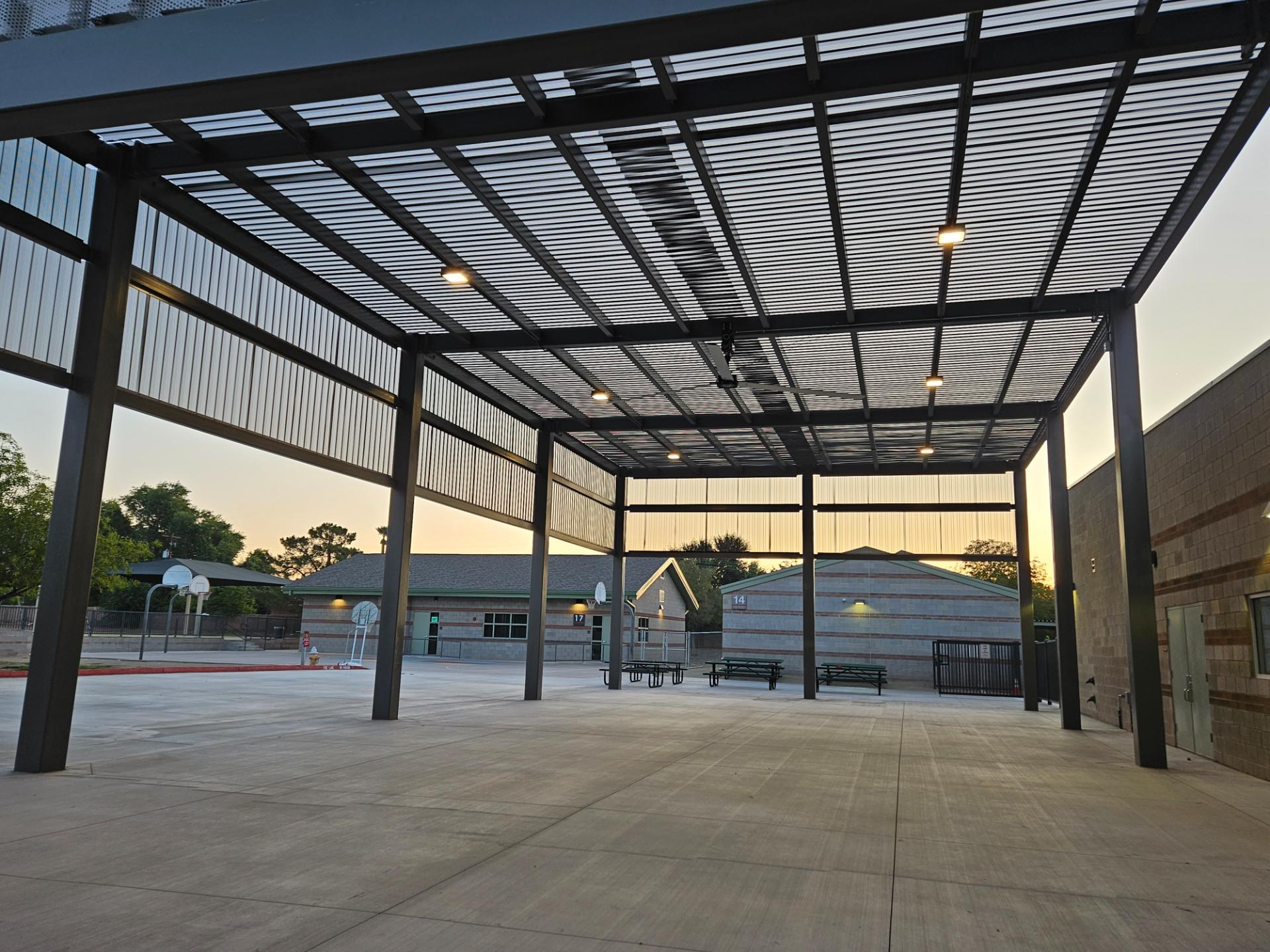
A ramada is a freestanding, open-sided shelter with a solid roof on steel or timber posts — the desert's permanent picnic-and-gathering structure. Unlike fabric canopies, its rigid roof blocks all direct sun and stands up to monsoon wind, which is why parks, schools, and HOAs use them over tables and courts.
Steel-framed, solid-roof shelters for parks, picnic areas, and HOA common spaces — the all-weather alternative to tensioned fabric.
Since 1998
Designing & building Arizona shade
In-House Fabrication
Built at our Phoenix shop
Engineered & Permit-Ready
Stamped drawings for AZ wind loads
Free On-Site Quote
No-obligation project assessment
A ramada is a steel-framed shade structure with a solid or slatted roof instead of stretched fabric, and it is the classic Southwest park-and-picnic shelter: posts at the corners, a pitched metal or slat roof overhead, and a footprint built for people to gather under it for decades. Where a tensioned-fabric canopy reads as a sculptural plane and re-covers every 10-15 years, a ramada reads as a small building and shrugs off sun, rain, and dust with a roof that does not relax or flap. Total Shade fabricates ramadas in steel at our Phoenix shop at 2331 W. Holly St, engineered to Maricopa County code, for parks departments, schools, HOAs, and trailheads across the Valley. The sections below cover where ramadas fit, what they are made of, how they compare to fabric and pergolas, and where they go wrong.
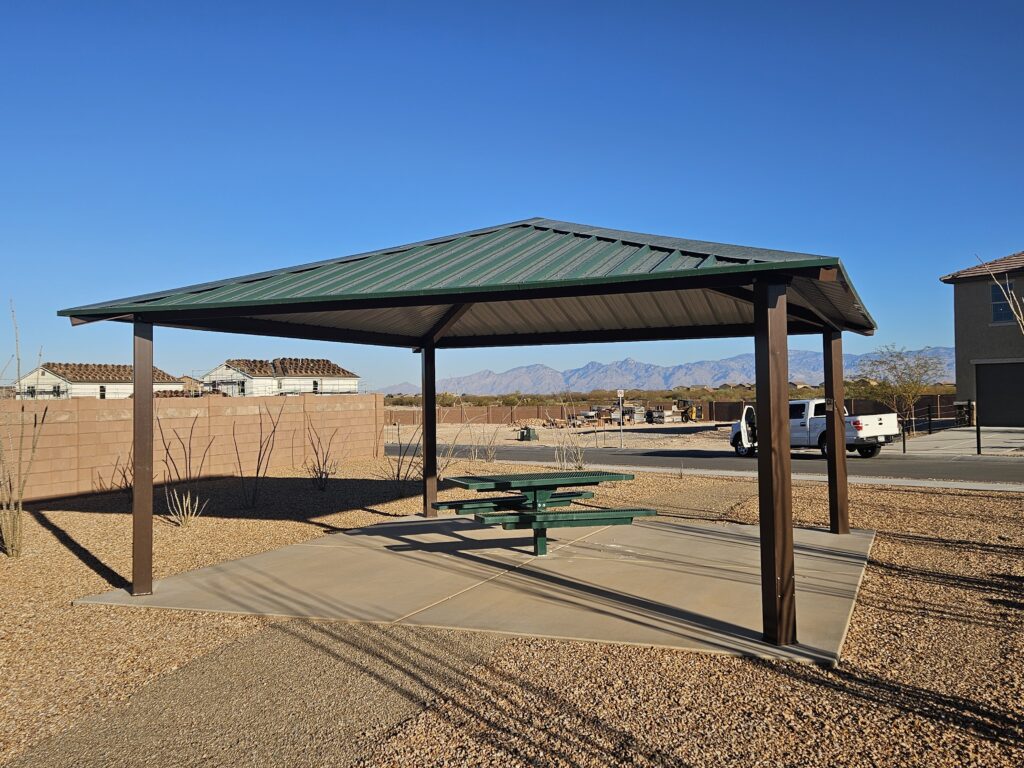
What a ramada is, and how it differs from a fabric structure
A ramada is a permanent shelter: steel posts carry a rigid, pitched roof — corrugated metal, standing-seam panel, or a slatted lattice — over an open-sided gathering space of roughly 12×12 ft up to 30×40 ft and beyond for double and triple units. The defining difference from a tensioned-fabric structure is the roof. Fabric structures stretch knitted HDPE across a frame, block roughly 90-99% of UV, and behave like a tuned membrane that must be re-tensioned and eventually re-covered. A ramada’s roof is structural and fixed, so it blocks 100% of direct sun under its deck, sheds monsoon rain rather than letting it drip through, and never needs re-tensioning.
That trade reverses the maintenance picture. Fabric is a consumable you plan to replace inside a 10-15 year window; a ramada roof is a 20-40 year asset closer to a building component than a textile. The cost reads differently too: a ramada carries more steel and a heavier roof, so it usually prices above a fabric canopy of the same footprint, but it removes the re-cover line from the budget entirely. Choosing between them is less about looks than about whether you want a membrane you maintain or a roof you forget.
Where ramadas fit best
Ramadas earn their place wherever people sit, eat, and linger in one spot for hours — and where rain protection matters as much as shade. Municipal parks and picnic areas are the archetype: a ramada over a concrete pad, picnic tables, and a grill turns a patch of grass into a reservable amenity that holds a birthday party through a surprise monsoon cell. The same logic drives demand at trailheads, where a single shelter marks the staging point and shields a kiosk and benches from 110-degree afternoon sun.
Schools and HOA common areas are the other heavy users. A ramada over an outdoor lunch nook, a pool-deck restroom approach, or a community-garden gathering point gives a fixed, all-weather room that a fabric canopy cannot — fabric drips, a metal roof does not. For pool decks and resort-style lounges that want enclosed corners and a more finished feel, a cabana is often the better call; for a wide-open run of shade over many tables, a clustered set of ramadas spaces out the structures. The deciding question is whether the crowd settles in one footprint or spreads across a lot.
Roofing, materials, and engineering
The frame is powder-coated structural steel, and the roof is where ramadas branch. A solid metal roof — corrugated or standing-seam panel — gives full rain coverage and a clean 100% sun block underneath; a slatted or lattice roof breaks up the sun while letting some light and air through, trading rain protection for a softer, more open feel. Both ride on the same engineered steel skeleton, so the choice is about how watertight the deck needs to be, not about strength.
What the steel and engineering cover
- Posts sized to span. A small single-unit ramada runs posts in the 4-6 inch range; larger spans and double units step up to 6-8 inch columns and heavier beams to carry the rigid roof load.
- Wind sized for the Valley. Maricopa County structures are engineered to Arizona building code and ASCE 7 wind loads, where design wind speeds run roughly 90-115 mph; monsoon microbursts can punch past 60 mph in minutes, and a solid roof catches more uplift than open fabric, so the steel and footings are sized accordingly.
- Foundations for caliche. Hard Valley ground often pushes footings 3-8 ft deep before they grip, and that buried work is the biggest reason an engineered ramada outlives a bargain kit.
- Powder-coat finish. The baked-on coating resists the chalking that desert sun forces on cheaper brushed paint, holding color far longer than a painted frame.
Because the engineering, steel cutting, welding, and install all run under one roof at our Phoenix shop, a span or post change on the drawing reaches the saw the same week rather than routing through an out-of-state manufacturer. That control is what makes an odd footprint or a tight setback practical without a six-week change order.
Ramada vs. fabric structure vs. pergola
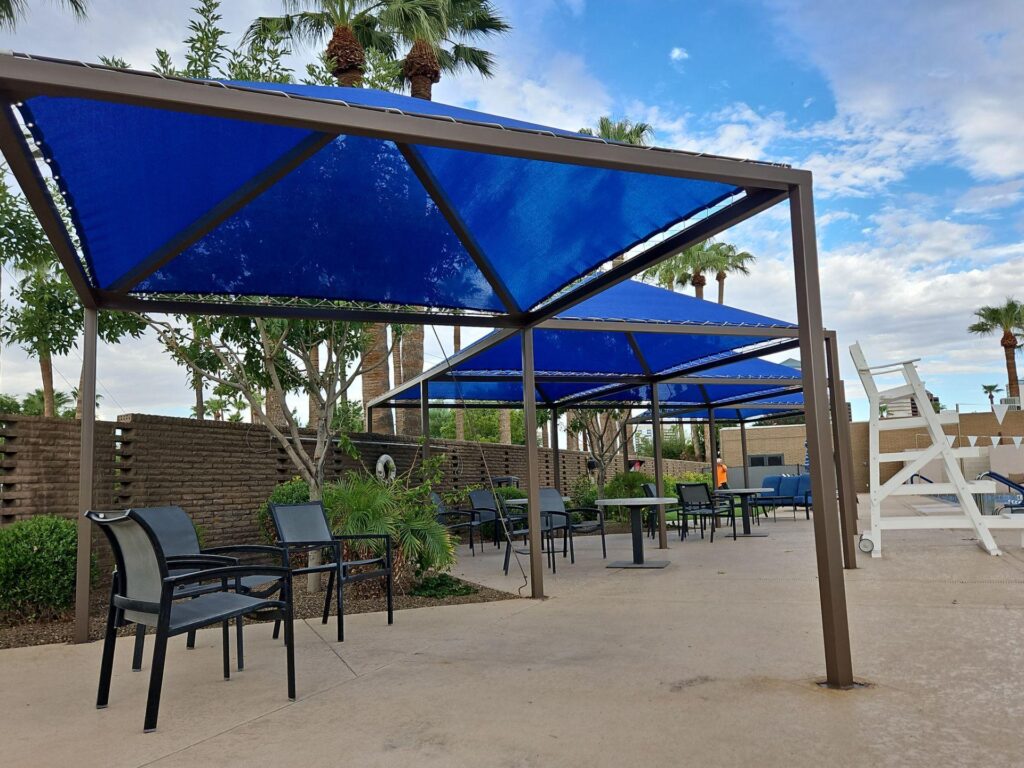
The three solve overlapping problems with different roofs, and naming the difference settles most decisions. A ramada behaves more like a small building than a canopy: a rigid, pitched roof on steel posts, full rain coverage, a 20-40 year lifespan, and no re-cover. A tensioned-fabric structure behaves more like a tuned membrane than a roof: a knitted-HDPE plane that blocks 90-99% of UV, sheds wind by its curved shape, prices below a ramada of the same size, but plans a re-cover inside 10-15 years.
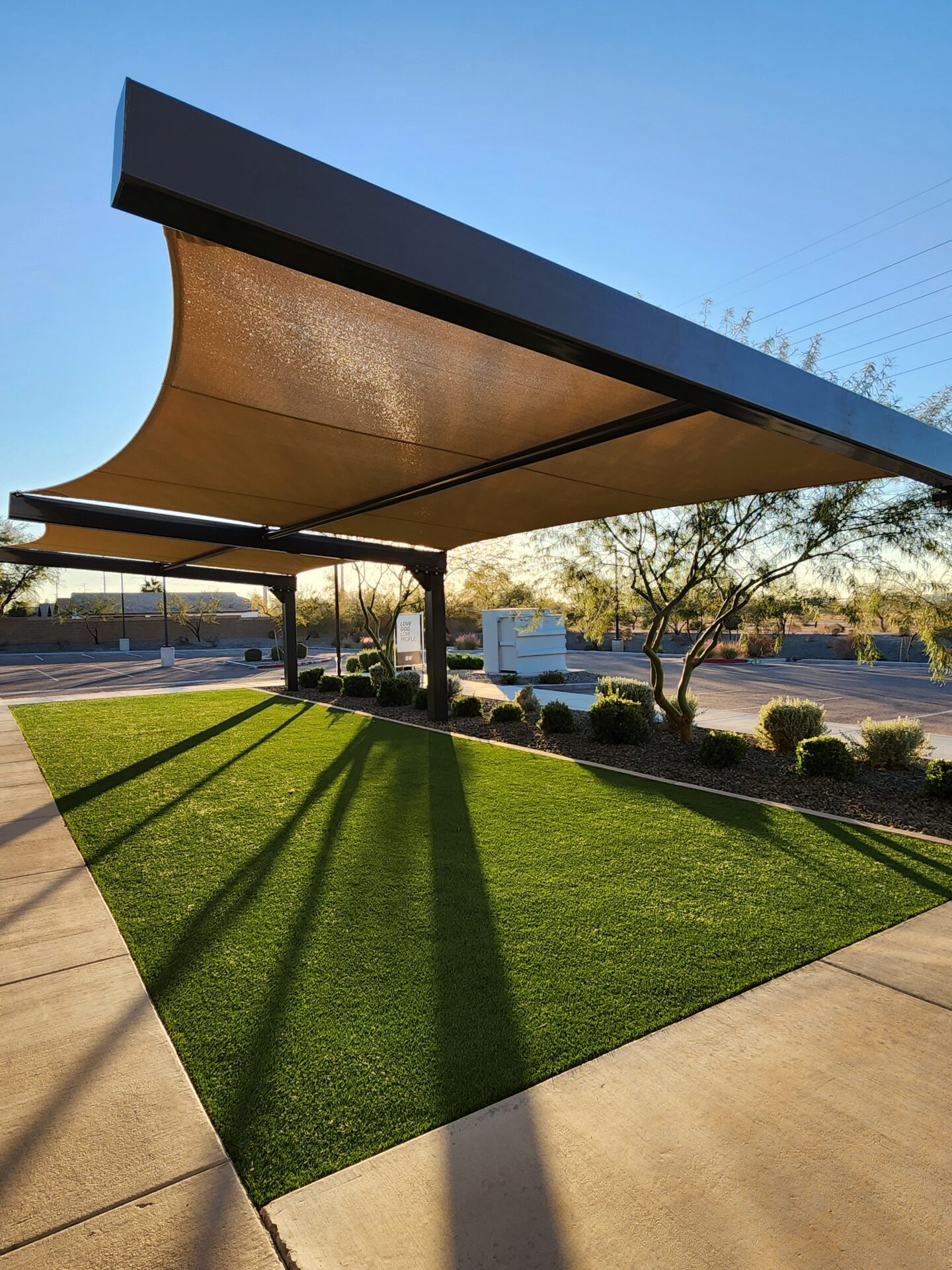
A pergola sits between them and leans decorative: an open slat or lattice roof, usually lighter steel or wood, that filters sun rather than blocking it and offers little rain protection — closer to a slatted ramada than to a fabric canopy, but lighter-duty. For a wide, columnless parking-lot run, none of the three is right; that is hip-structure or cantilever territory, where the goal is maximum shaded square footage over cars, not a fixed gathering room. Read your own brief this way: full rain cover and permanence point to a ramada; lower cost and a sculptural look point to fabric; filtered light over a patio points to a pergola; shading a lot points to a hip or cantilever canopy.
Design and permitting for parks and HOAs
Because a ramada is a permanent roofed structure, it is treated as a building in the eyes of the code, and permitting is more involved than a fabric canopy. We provide engineered, stamped drawings sized to the site’s wind and soil; the municipality handles plan review and inspection. For a city parks department, that usually means a structural-permit submittal with a foundation and roof-load package; for an HOA, it often adds an architectural-review step where the roof profile, color, and post style have to match the community’s standard before the building permit even starts.
Design decisions that matter at the parks-and-HOA scale: roof pitch and overhang (a steeper pitch sheds monsoon water faster but reads taller), accessibility clearances under the deck for tables and ADA routes, and whether the pad, grills, lighting, or electrical run inside the same permit. A custom-built structure is the right path when the footprint, roof line, or post layout has to follow an odd pad or match a specific architectural review — the frame follows the site rather than forcing the site to fit a catalog unit. Getting the review sequence right up front is what keeps a park shelter from stalling between an HOA board and a city counter.
Common mistakes and honest caveats
The most common ramada mistake is undersizing the footprint: a 12×12 ft shelter looks fine on a drawing and then crowds the moment a family sets two picnic tables and a cooler under it. Size to the crowd and the table count, not the lot’s spare corner. The second is orientation — a roof and posts placed without reading the afternoon sun angle can leave the seating in glare from the west by 4 p.m. even under a full roof, because low desert sun rakes in sideways.
The honest caveats are worth stating plainly. A solid roof blocks rain but also catches more wind uplift than open fabric, so the footings and steel must be engineered for it — a light kit is exactly the wrong call in microburst country. Wind ratings have ceilings; an engineered ramada covers typical monsoon loads, not every freak gust on record. Metal roofs are quiet to maintain but a heavy roof costs more in steel and foundation than a fabric canopy of the same size, so a ramada is the right answer only when permanence and rain cover justify the premium. And dust still accumulates on a flat deck, so a rinse once or twice a year keeps grit and debris off the roof and gutters. Knowing those limits up front is what separates a shelter that serves a park for 30 years from one that disappoints in 10.
Explore Our Full Shade Structure Line
Want this structure quoted for your property?
Call (602) 265-0905 for a free assessment.
Frequently Asked Questions
What is the difference between a ramada and a fabric shade structure?
A ramada has a rigid, pitched roof — metal panel or slatted lattice — on steel posts, so it blocks 100% of direct sun under its deck, sheds monsoon rain, and never needs re-tensioning or re-covering. A tensioned-fabric structure stretches knitted HDPE that blocks roughly 90-99% of UV, sheds wind by its curved shape, and plans a re-cover inside a 10-15 year window. The short version: a ramada is closer to a small building, fabric is closer to a tuned membrane.
How much does a ramada cost compared to a fabric canopy?
A ramada usually prices above a fabric canopy of the same footprint because it carries more steel and a heavier rigid roof, but it removes the re-cover line from the long-term budget entirely. Cost tracks footprint, post count, roof type, and foundation depth — a small single-unit shelter sits well below a 30×40 ft double unit — so ramadas are quoted per project rather than off a per-square-foot chart. We price after reviewing the pad layout, wind exposure, and soil so the number reflects the actual structure.
How long does a ramada last, and what maintenance does it need?
A steel-framed ramada with a powder-coated finish is a 20-40 year asset, far longer than a fabric cover’s 10-15 year service life, because the roof is structural rather than a consumable membrane. Maintenance is light: rinse the roof and gutters once or twice a year to clear desert dust and debris, and check the powder coat for chips. There is no re-tensioning and no re-cover, which is the main reason parks and HOAs choose a ramada over fabric for high-use gathering spots.
Do ramadas require a building permit in Maricopa County?
Yes — because a ramada is a permanent roofed structure, it is treated as a building and typically needs a structural permit with a foundation and roof-load package. We provide the engineered, stamped drawings sized to ASCE 7 wind loads (roughly 90-115 mph design speeds in the Valley) and site soil; the city or county handles plan review and inspection. HOA projects often add an architectural-review step for roof profile, color, and post style before the building permit begins.
Can a ramada handle Arizona monsoon wind?
Yes, when it is engineered for the site. A solid roof catches more uplift than open fabric, so the steel posts and footings are sized to Arizona building code and ASCE 7 wind loads, with footings often set 3-8 ft deep in caliche before they grip. Valley design wind speeds run roughly 90-115 mph and microbursts can exceed 60 mph. No structure is rated for every freak gust on record, which is exactly why a light DIY kit is the wrong call and an engineered ramada is not.