The National Weather Service put metro Phoenix under an Extreme Heat Warning from Thursday morning through Monday night — 115 degrees today, 116 on Saturday, five straight days at 110-plus with overnight lows holding in the upper 80s and low 90s, per KTAR and azfamily reporting. The city closed its most popular hiking trails from 8 a.m. to 5 p.m. for the duration. But the number that should have every facility manager’s attention isn’t the high. It’s the humidity riding along with it. Monsoon moisture has pushed Valley dew points into the upper 60s this week, and forecasters expect heat index values of 111 to 113 degrees even on days when cloud cover knocks the actual air temperature down to 106. Phoenix’s one traditional consolation — “at least it’s a dry heat” — is off the table until the monsoon leaves in September.
That matters commercially because most outdoor cooling strategies in this market were designed for dry heat, and exactly one of them keeps working when the air turns muggy. This article walks through what humid extreme heat does to misters and evaporative cooling, why engineered shade is the control that doesn’t degrade, and how the humidity question should change the way you spec fabric across the full range of commercial structures.
A Humid Heat Warning Is a Different Animal
Phoenix earned its dry-heat reputation honestly. For most of the year, relative humidity in the afternoon sits in the single digits or teens, sweat evaporates the instant it forms, and the body’s own cooling system runs at full efficiency. The monsoon rewrites that arrangement every July. When a surge of tropical moisture moves up from the Gulf of California, dew points that normally sit in the 30s and 40s climb past 65 — the National Weather Service’s threshold for air that feels distinctly muggy — and the same air temperature starts doing measurably more damage to the human body.
The mechanism is simple physics. Sweat cools you only when it evaporates, and evaporation slows as the air fills with water vapor. That’s why the heat index exists: at a dew point of 68, this past Wednesday’s 96-degree afternoon felt like 100, per azfamily’s weather desk, and the same moisture math is what turns Monday’s forecast 106 into a heat index of 111 to 113. KJZZ’s reporting on the science this month put it plainly — humid heat stresses the body harder at lower air temperatures, which is why heat-safety researchers treat a humid 106 as more dangerous than a dry 112.
For anyone responsible for an outdoor commercial space, the takeaway is blunt. The margin of safety you thought you had in dry heat shrinks when monsoon moisture arrives — and it shrinks at precisely the time of year when air temperatures peak.
When the Dew Point Climbs, Evaporative Cooling Walks Off the Job
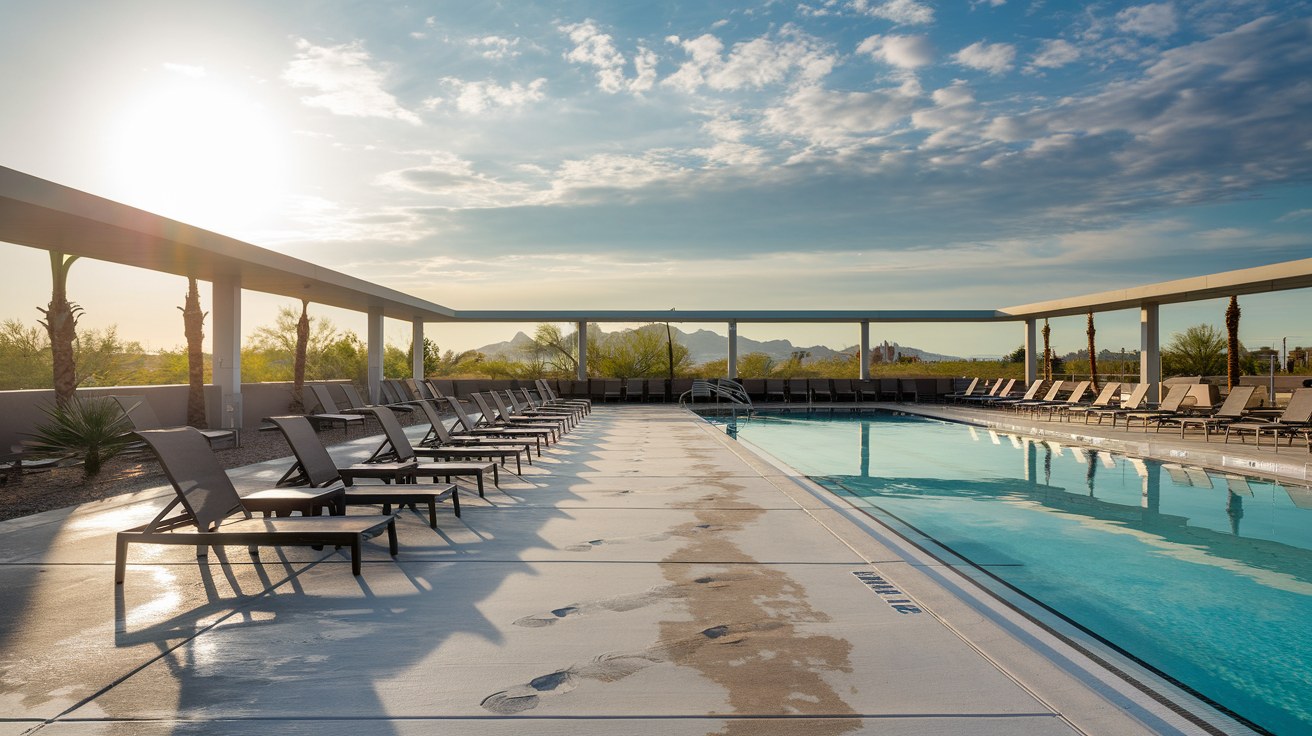
The Valley’s favorite outdoor cooling technologies are all bets on dry air. Misting systems, evaporative “swamp” coolers, and fan-and-mist combinations cool by forcing water to evaporate, which works spectacularly when the air is thirsty — industry specifications put the effect at up to 30 degrees of cooling when relative humidity sits below 40 percent. Push humidity toward 50 percent and beyond, and the effect collapses. The air simply can’t absorb much more water, so the mist stops evaporating and starts landing. Restaurant operators know the failure mode well: patios that feel refreshed in June feel like a warm greenhouse in late July, with damp furniture and no meaningful temperature drop.
This is not an argument against misters — for eight or nine months of the year they earn their keep. It’s an argument against making them the load-bearing element of a heat strategy, because the monsoon guarantees that several of the hottest weeks on the Arizona calendar will also be the most humid. The 2025 season put five days at 115 or above with 23 nights that never broke 90 at Sky Harbor; 2026 is tracking the same combination.
Shade has no such dependency. Blocking solar radiation works identically at 10 percent humidity and 60 percent humidity, because it intervenes before heat reaches the body rather than trying to remove it afterward. That distinction — prevention versus removal — is the whole case for engineered shade as the foundation of a commercial heat plan, with evaporative systems layered on top for the dry months when they actually function.
Shade Physics Don’t Care About Humidity
The research literature backs the intuition with numbers. A peer-reviewed spatial modeling study of wet bulb globe temperature — the composite heat-stress index that OSHA-oriented safety programs and athletic associations use because it accounts for sun, humidity, and wind together — found that cutting incident solar radiation by 90 percent lowers WBGT by 2 to 6 degrees Celsius, roughly 4 to 11 degrees Fahrenheit, and identified shade as the single most effective site-level control for restoring safe outdoor work capacity in hot climates. It’s worth noticing that the familiar heat index is defined for shaded conditions in the first place; the National Weather Service notes that standing in direct sun can add up to 15 degrees to the number. Shade doesn’t beat the heat index. Shade is how you get down to it.
Surface temperatures tell the same story. Unshaded asphalt and concrete in a Phoenix summer routinely run 40 to 60 degrees hotter than the air, which is how a 115-degree afternoon produces pavement in the 160-degree range — and that thermal mass keeps radiating through the 90-degree nights this warning is forecasting. Quality shade fabric intercepts that loading all day, which is why shaded hardscape measures 30 to 40 degrees cooler than exposed surfaces a few feet away. We’ve covered the energy side of this equation before — shaded surfaces and shaded walls measurably cut the cooling load on adjacent buildings — and the UV side — the Commercial 340/95 HDPE we standardize on blocks up to 96 percent of ultraviolet radiation, per the Skin Cancer Foundation’s case for engineered shade — in our guide to Arizona shade structure UV protection.
In Humid Heat, Breathability Is the Spec
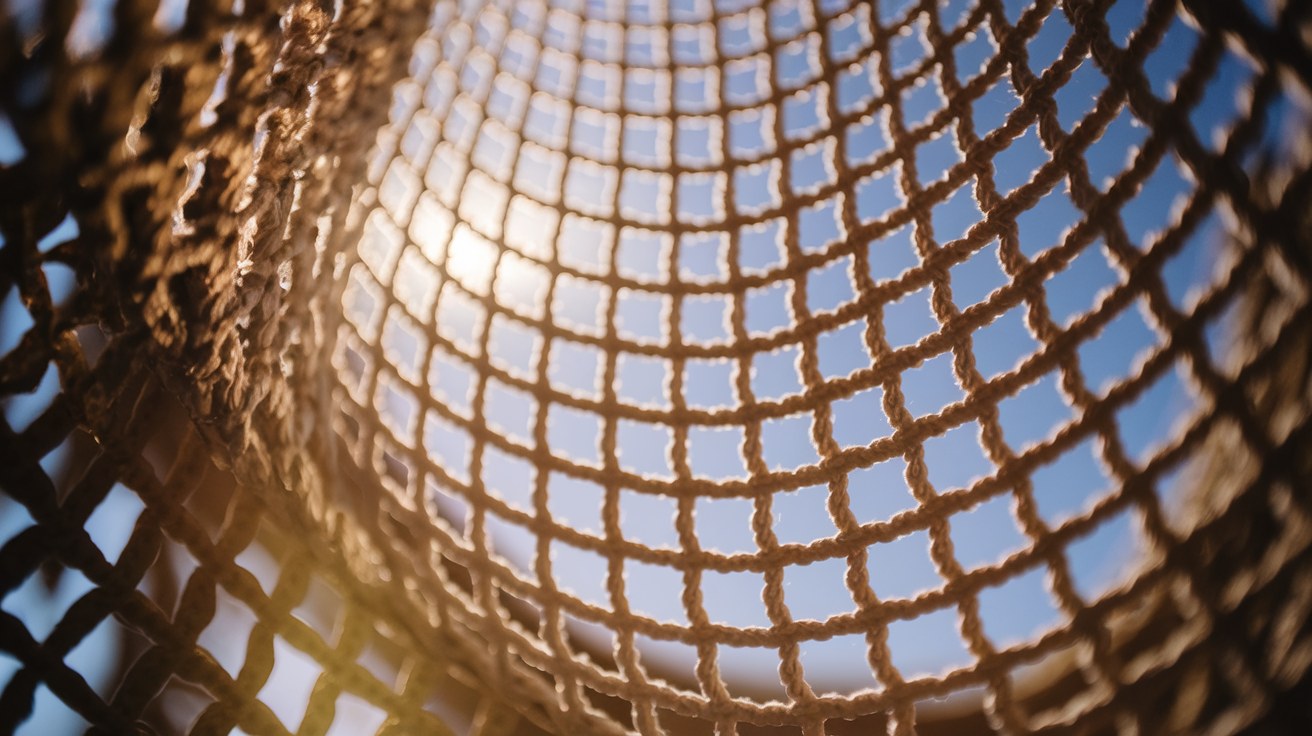
Here is where the humidity question should reshape an actual purchasing decision. Shade fabric comes in two broad families: knitted, porous HDPE mesh that breathes, and coated waterproof membranes that don’t. In dry heat the difference is modest. In humid heat it’s decisive. A porous knit vents the hot, moist air that accumulates under any covered space, so the microclimate under the fabric stays close to ambient shade temperature. A waterproof membrane traps that air layer — and in monsoon humidity, a sealed canopy over a crowded patio can turn into exactly the still, muggy pocket you built the structure to escape.
Our default specification, Commercial 340/95 HDPE, is a knitted mesh engineered for this climate: up to 96 percent UV block, enough porosity to bleed heat and to let monsoon gusts partially pass through the panel rather than loading it like a sail, and a 10-year limited fabric warranty behind it. When waterproof is the right call — covered dining that must stay open through monsoon rain, equipment protection, walkway cover — we work with Serge Ferrari, Polyfab, and Alnet membranes, and we design for the trade-off deliberately: steeper slopes to shed water, ventilation gaps engineered into the geometry, and wind engineering that accounts for the fabric’s solidity, which is the same load discipline we detailed in monsoon-ready commercial shade structures in Arizona. When an existing structure has the right steel but the wrong fabric, our in-house sewing team can fabricate a replacement panel on the original frame through our canopy replacement and repair service — typically about two-thirds the cost of a new structure, and the fastest way to fix a spec that’s trapping heat.
Where the Humid-Heat Gap Shows Up on Commercial Sites
Walk any commercial property during this warning and the exposure map draws itself. Restaurant and hospitality patios are the most obvious — misters underperforming, heat index over 110, revenue walking past the host stand — and they’re where building-mounted awnings and sculptural hypar structures earn their keep, holding usable outdoor seating through the muggy weeks. HOA and hotel pool decks concentrate people during the exact midday window the trail closures are designed to prevent, and cabanas put engineered shade where the loungers already are. Playgrounds and school sites layer humid heat on top of the surface-burn exposure we’ve written about before, and a hip structure remains the workhorse answer for large play areas and lunch courts. Employee zones — loading docks, drive-through service lanes, outdoor break areas, covered parking rows — are where WBGT-based safety programs bite hardest, and flat cantilevered structures reach over work areas while keeping columns out of the traffic path.
And for the sites that don’t fit a catalog drawing — irregular courtyards, structures attached to existing buildings, pool decks threaded with utilities — custom-engineered structures exist so the geometry serves the site instead of the other way around. The common thread: the shade keeps working on the humid days, which are now reliably the worst days.
The Bottom Line
This weekend’s Extreme Heat Warning is a preview of every late-July forecast Arizona is likely to see from here on: 110-plus air temperatures with monsoon moisture pushing the heat index past 111, nights that never cool off, and evaporative systems fading exactly when the load peaks. Shade is the one outdoor heat control that performs identically in dry June and muggy July — and specified correctly, with breathable HDPE where people gather and engineered waterproof membranes only where rain protection demands them, it turns unusable space back into usable space for the whole season. We’ve spent more than 25 years engineering structures for both halves of the Arizona summer, and the school districts, municipalities, and property managers on our testimonials page planned ahead of the humid weeks rather than through them. If your property’s heat plan quits when the dew point climbs, contact Total Shade today — the next humid stretch is already on the radar.
Sources: Extreme Heat Warning July 23–27 with 115–116 degree highs, overnight lows in the upper 80s to low 90s, Phoenix trail closures 8 a.m.–5 p.m., and Monday heat index values of 111–113 despite a forecast high near 106 (National Weather Service Phoenix via KTAR and azfamily, July 22–23, 2026); dew point 68 producing a heat index of 100 at 96 degrees on July 22 (azfamily); humid-heat physiology and why muggy air stresses the body at lower temperatures (KJZZ, July 17, 2026); evaporative cooling effectiveness of up to 30 degrees below 40 percent relative humidity and sharp decline above 50 percent (Premier Industries and industry evaporative-cooling specifications); 2025 Phoenix heat season with five days at 115+ and 23 nights at or above 90 at Sky Harbor (City of Phoenix 2026 Heat Response Plan); WBGT reduction of 2–6°C from removing 90 percent of incident solar radiation (Broad Scale Spatial Modelling of Wet Bulb Globe Temperature, PMC, 2023); heat index defined for shade with direct sun adding up to 15 degrees (National Weather Service); unshaded pavement 40–60 degrees above air temperature (NASA JPL surface-temperature imaging of Phoenix); UV protection case for engineered shade (Skin Cancer Foundation); Commercial 340/95 HDPE specification with up to 96% UV block, Serge Ferrari/Polyfab/Alnet membrane options, in-house sewing, re-skin economics at roughly two-thirds of replacement cost, 10-year limited fabric warranty, and 25-plus years of Arizona experience from Total Shade specification sheets and project experience.
