The National Weather Service has metro Phoenix under an Extreme Heat Warning from today through Thursday, July 9, with forecast highs of 112 to 116 degrees — hot enough to top the year’s previous peak of 112, a mark the city hit twice in June, per NWS Phoenix and azfamily reporting. Overnight lows will hold in the upper 80s to near 90, which means commercial buildings across the Valley get no recovery window: rooftop units that cycled down at midnight in May will run essentially around the clock this week. For every school, restaurant, office, and HOA clubhouse in the region, the hottest week of 2026 is also the most expensive week of 2026.
That expense is not fixed. A large share of a desert building’s cooling load walks in through its envelope — the windows, walls, entries, and outdoor equipment that sit in direct sun for fourteen hours a day — and exterior shade is the one capital improvement that intercepts that load before it becomes a compressor’s problem. We design and build that shade for a living, and the full range of forms is on our products overview. This article walks through what the heat actually costs a commercial property, where the load comes from, and what engineered shade measurably does to it.
The Cooling-Cost Squeeze on Arizona Commercial Properties
The rate environment is moving the wrong direction for anyone who owns or operates a building here. Arizona Public Service has a pending rate case that would raise average bills roughly 16 percent — an increase that, per Solar.com’s reporting on the filing, could begin showing up as soon as this summer. Utility-industry analyses this year project summer cooling bills in warm-climate states climbing more than 13 percent, well ahead of the roughly 8.5 percent national average. And those figures describe the energy charge, which for a commercial account is only half the story.
The other half is demand. SRP’s commercial price plans carry a summer demand charge of $14.50 per kilowatt, billed against your single highest usage spike during peak hours — 2 p.m. to 8 p.m. on weekdays, per SRP’s published rate schedules. Those hours map almost exactly onto the hottest stretch of a Phoenix afternoon, when solar gain through west-facing glass peaks and every rooftop unit on the building is calling for full capacity at once. A building that spikes hard at 4 p.m. on the worst day of July pays for that spike all month. This is the quiet math behind an Extreme Heat Warning: the warning lasts three days, but the demand charge it sets lasts thirty.
That structure changes what shade is worth. An improvement that shaves load specifically during the 2-to-8 window is not saving you cents per kilowatt-hour — it is pulling down the single number that drives the largest line on the bill.
Where the Heat Actually Gets In
Cooling load in a desert commercial building is not mysterious. Solar radiation strikes the envelope, some of it transmits through glazing as direct gain, some of it soaks into walls and roof surfaces and re-radiates inward for hours, and the mechanical system pays for all of it. Glass is the most porous point of entry. The U.S. Department of Energy’s guidance on windows identifies solar heat gain through glazing as a primary driver of cooling energy in hot climates — and west-facing glass is the worst offender, because its peak exposure lands in late afternoon, exactly when outdoor temperatures and demand-charge windows peak together.
The instinctive fix — interior blinds — mostly fails the physics. Once solar radiation passes through the glass, it is inside the conditioned space; a blind absorbs it and re-radiates the heat into the room. Interior treatments dress the symptom. Exterior shade removes the cause, stopping the radiation before it ever reaches the glazing. That single distinction, outside versus inside the glass, is worth more than any upgrade to the blinds themselves.
The numbers on exterior shading are unambiguous. Window awnings can reduce solar heat gain by up to 65 percent on south-facing windows and 77 percent on west-facing windows, according to the Department of Energy. Paired with air conditioning, awnings can lower cooling costs by as much as 25 percent, and University of Minnesota research measured 20 to 30 percent annual cooling-energy reductions from awnings over unshaded windows in hot climates. In a city staring at 116 degrees this week, those are not rounding errors — they are the difference between a rooftop unit that keeps up and one that runs flat-out and still loses ground.
What Engineered Exterior Shade Does That Blinds Cannot
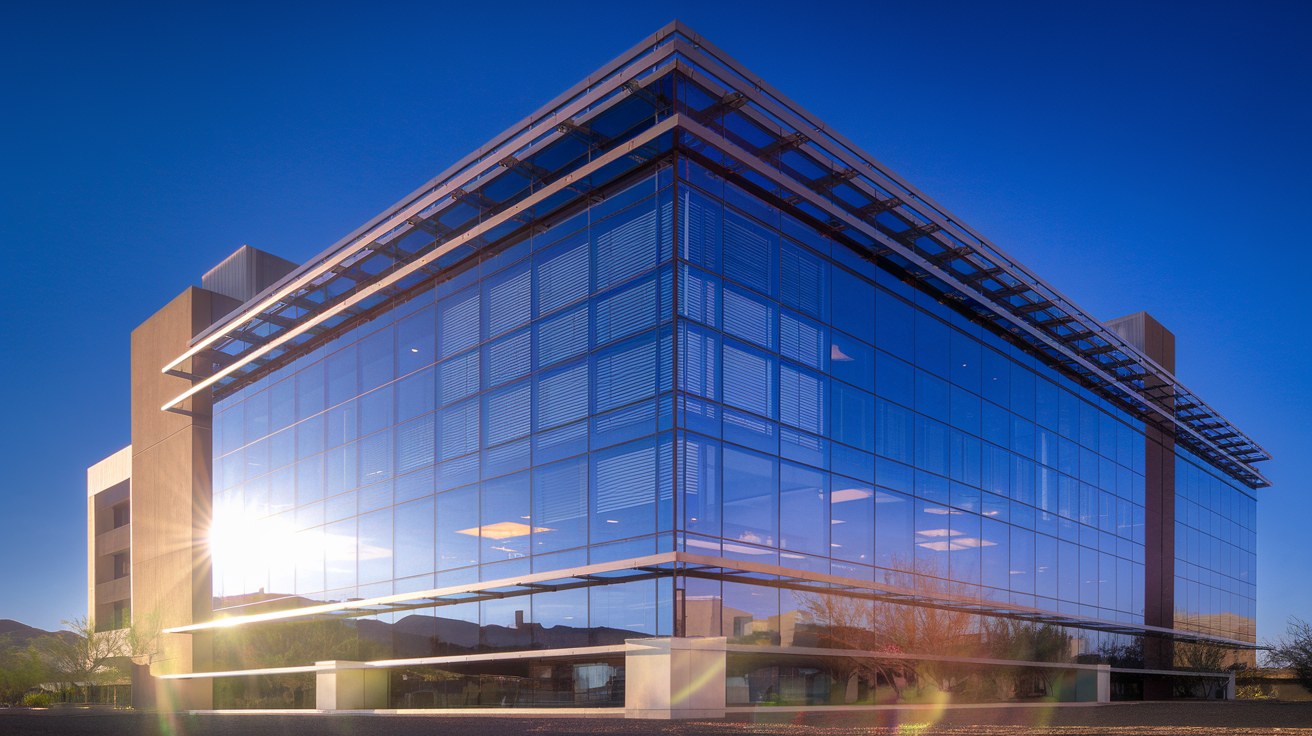
Applying those numbers to a real Arizona building is a design exercise, and form follows the facade. A run of commercial awnings over south- and west-facing glass is the most direct translation of the DOE data — fixed, engineered, fabricated to the window geometry, intercepting radiation at the exact orientation where the load is worst. Where the building needs deeper coverage — an entry plaza, a drive aisle, a bank of offices behind a full-height curtain wall — a flat cantilevered structure throws shade from a single post line and keeps the walkway or glazing clear of columns. For larger outdoor zones that feed heat back at the building — courtyards, seating areas, pool decks — a hip structure or a sculptural hypar covers the ground plane itself, cutting the re-radiated load along with the direct one.
Fabric selection is where the engineering gets specific. We standardize on Commercial 340/95 HDPE, a knitted high-density polyethylene that blocks up to 96 percent of UV, and the same density that stops ultraviolet stops the broader solar spectrum that becomes heat. Shaded surfaces in this climate routinely run 20 to 30 degrees cooler than identical surfaces in direct sun — a delta we covered in depth, along with the fabric science, in our article on Arizona shade structure UV protection. For projects that need something the standard knit does not offer — waterproof membranes over outdoor dining, fire-rated fabric near an egress, translucent panels where daylight matters — we also spec Polyfab, Alnet, and Serge Ferrari materials to match the property’s requirements.
The Loads Nobody Budgets For
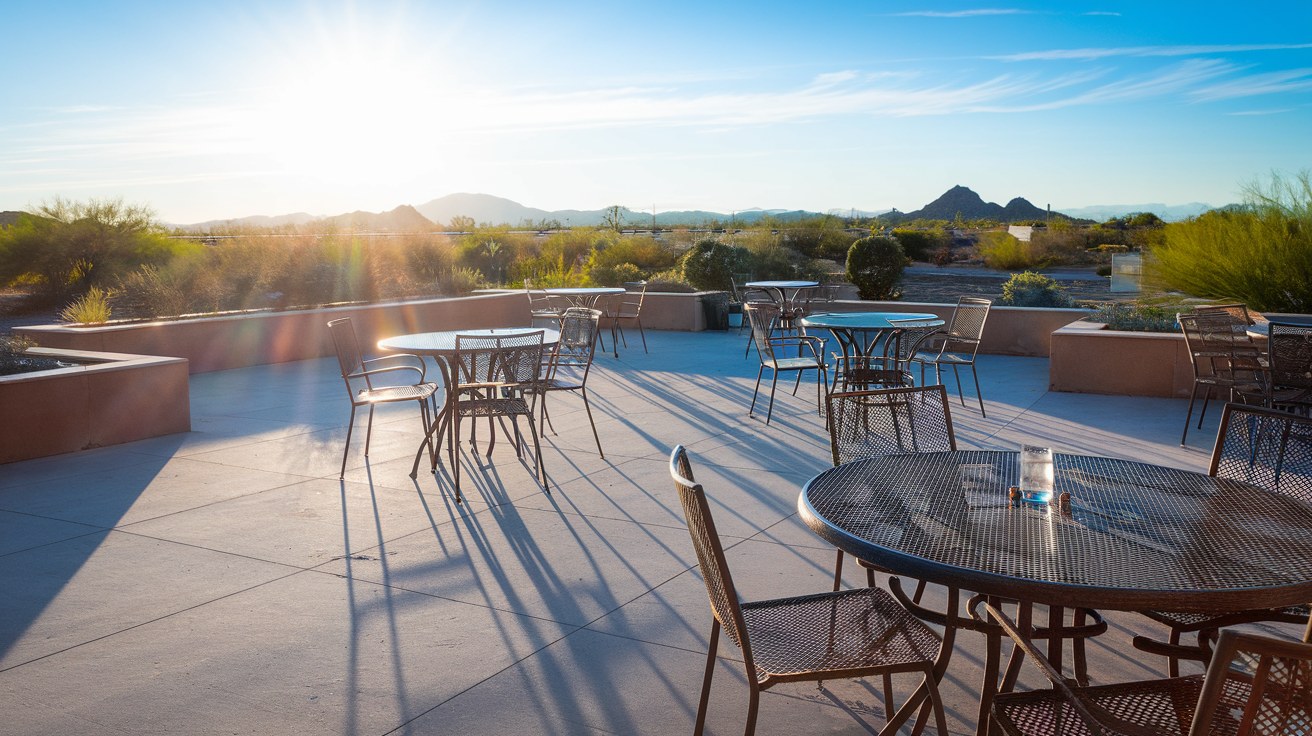
Walk a commercial site during an extreme heat event and the envelope is only part of what is baking. Outdoor break and dining areas sit empty from May to September, which for a restaurant is idle revenue-generating floor space and for an employer is a break policy that quietly moved indoors. A shaded cabana or canopy brings that square footage back into service through the exact months Phoenix now spends under heat warnings — this year’s first stretch of 110-plus arrived in mid-June and the forecast keeps delivering more.
There is also the equipment itself. Condensing units and rooftop mechanical equipment reject heat less efficiently as ambient temperature climbs, and gear parked in direct sun on a 116-degree afternoon is working against a microclimate meaningfully hotter than the official reading. Properties with irregular footprints — equipment yards, odd rooflines, structures that must tie into an existing building without disturbing it — are precisely where an off-the-shelf canopy fails and a custom structure engineered to the site earns its cost. After 25-plus years of building these across the Valley, the pattern is consistent: the shade projects with the fastest payback are usually the ones covering load nobody had assigned a dollar figure to. The property managers and facility directors we have done this for say as much in our testimonials.
Buying Shade in July Means Engineering for the Monsoon
There is a catch to shopping for shade during a heat emergency, and it arrives on an outflow boundary. The National Weather Service’s 2026 Arizona Monsoon Outlook leans above normal for precipitation in Phoenix and Tucson, with a hotter-than-normal season overall — and while the first weeks of July have started dry, forecasters expect the pattern to build later this month, per NWS and abc15 reporting. The same structure that cuts your demand charge in July has to stand in a 60 mph outflow in August. A canopy bought purely on cooling math and engineered to no particular wind standard does not save money; it becomes debris, a claim, and a re-procurement.
The fix is to buy engineering, not just fabric. A commercial structure should be designed and stamped to the wind load your jurisdiction’s code requires and installed by a crew certified for the work — ours is OSHA-certified and has put up hundreds of structures in desert conditions. We laid out what storm-worthy design actually involves in our guide to monsoon-ready commercial shade structures in Arizona. Lifecycle economics belong in the same calculation: our fabric carries a ten-year limited warranty, and because we sew in-house, a structure can be re-skinned on its original frame through our canopy replacement and repair service — typically about two-thirds the cost of full replacement — so the cooling savings compound across decades instead of resetting with each storm cycle.
The Bottom Line
This week is the year’s clearest audit of what unshaded sun costs a commercial property: 112 to 116 degrees, no overnight relief, rooftop units running through a 2-to-8 demand window priced at $14.50 per kilowatt, and rates headed upward from there. Exterior shade attacks that bill at its source — up to 77 percent of solar heat gain stopped at west-facing glass, cooling costs down as much as 25 percent, surfaces 20 to 30 degrees cooler — and it does so during exactly the hours the utility bills hardest. The properties that treat shade as cooling infrastructure, engineered for the monsoon that follows the heat, will spend less every July for the next twenty years. If you manage a commercial property, school, restaurant, or HOA and want a straight assessment of where your building is taking on heat — and a stamped, storm-rated structure to stop it — contact Total Shade today for a site evaluation and an honest read on the numbers.
Sources: Extreme Heat Warning for metro Phoenix, July 7–9, 2026, with forecast highs of 112–116°F, overnight lows in the upper 80s to 90°F, and the prior 2026 peak of 112°F on June 16 and 26 (National Weather Service Phoenix via azfamily, KJZZ); APS pending rate case seeking a roughly 16% average bill increase, potentially effective as soon as July 2026 (Solar.com rate-case reporting); projected 13%+ summer cooling-bill increases in warm-climate states versus an ~8.5% national average (utility-industry summer cooling-cost analyses, 2026); SRP summer commercial demand charge of $14.50/kW with 2–8 p.m. weekday peak hours (SRP published rate schedules); window awnings reducing solar heat gain up to 65% on south-facing and 77% on west-facing windows, and awnings with air conditioning lowering cooling costs up to 25% (U.S. Department of Energy); 20–30% annual cooling-energy reduction from awnings in hot climates (University of Minnesota awning energy study); shaded surfaces running 20–30°F cooler than surfaces in direct sun (Arizona State University heat research); 2026 Arizona Monsoon Outlook leaning above normal for Phoenix and Tucson precipitation with a hotter-than-normal season and a dry early-July start (NWS 2026 Arizona Monsoon Outlook, abc15); Commercial 340/95 HDPE specification (up to 96% UV block), ten-year limited fabric warranty, and re-skin economics from Total Shade specification sheets and project experience.
