Some Arizona districts bring students back in less than two weeks. Chandler Unified reopens July 15, and a wave of Valley districts follow through late July into early August — with the reference first day for the 2026-27 calendar landing on July 27, according to statewide school-calendar listings. The problem is what the thermometer is doing on those same days. Phoenix Julys run an average high of 107 degrees, with daily highs this month forecast between 102 and 111, per AccuWeather. Recess starts the week the heat peaks.
Most of the attention goes to air temperature — the heat-index charts county health officials send to principals each morning, the recess restrictions, the indoor-alternative policies. Those matter. But the hazard that actually sends children to the Arizona Burn Center is not the air. It is the surface. A slide, a piece of turf, a rubber safety mat, or a metal climber sitting in direct July sun becomes hot enough to cause a contact burn in seconds — and shade is the one intervention that measurably brings those numbers down. Districts scoping summer capital work should be looking at their play surfaces, not just their picnic tables. The full range of structures that can cover a schoolyard is on our products overview, but the case for covering the play zone starts with the temperatures themselves.
The Hazard Is the Surface, Not Just the Air
When a schoolyard sits unshaded through a Phoenix afternoon, its surfaces do not settle at air temperature — they climb well past it. Without shade, asphalt and gravel can register up to 25 degrees hotter than the surrounding air, and the play equipment children actually touch runs hotter still. The U.S. Consumer Product Safety Commission has warned for years that playground equipment, including plastic and rubber components, can cause thermal contact burns, and recommends a simple “touch test” before letting a child play. In the desert, that warning is not seasonal advice — it is a daily reality from May through September.
Children are the vulnerable population here for a specific physiological reason: their skin is thinner than an adult’s and more sensitive to heat, and the youngest of them may not have the reflexes to pull away from a hot surface fast enough to avoid injury. Banner University Medical Center’s burn program treats close to 100 pediatric patients a year for second- and third-degree burns that happened after only seconds of contact with hot outdoor surfaces, according to Arizona Burn Center reporting. That is the stake behind a shade decision that too often gets treated as a comfort upgrade. It is a safety intervention.
The Numbers a Schoolyard Actually Reaches
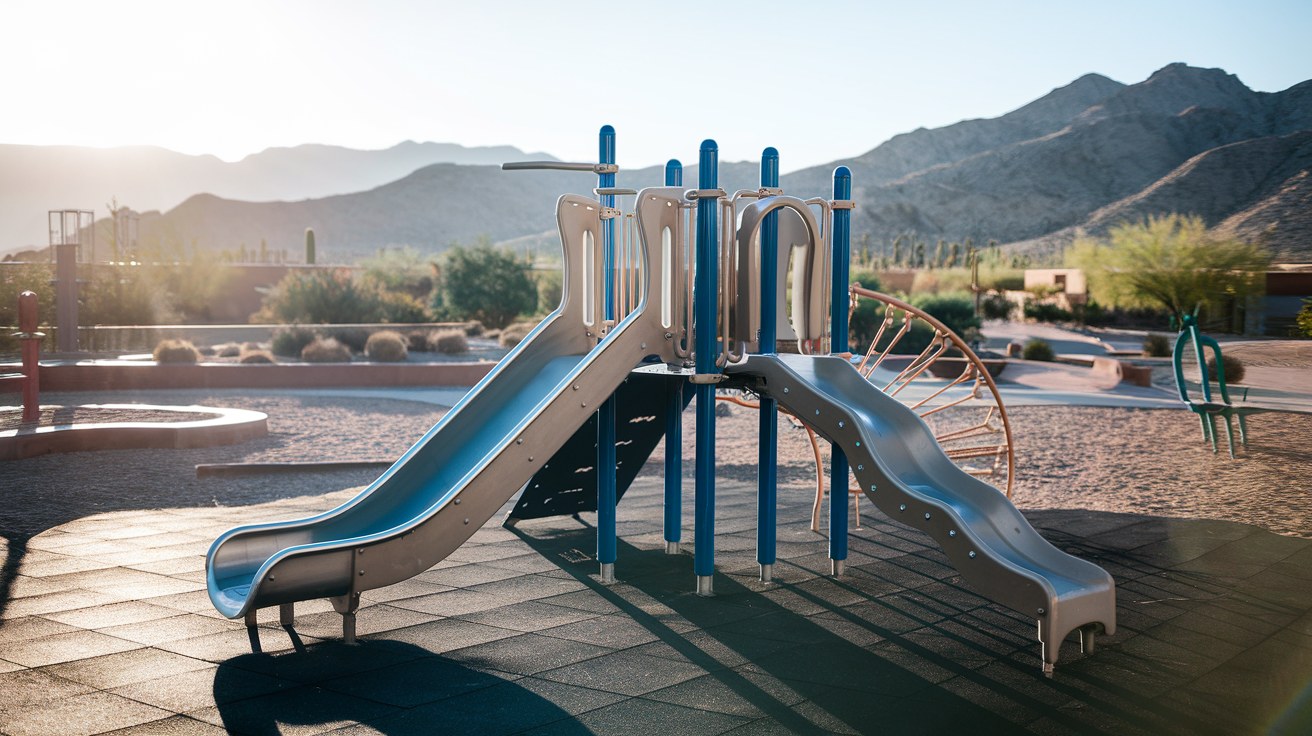
The specific surface temperatures are worth stating plainly, because they are higher than most people expect. In 100-degree weather with no shade, a slide can heat to 160 degrees, and burn-program clinicians have documented playground equipment as hot as 250 degrees, per Arizona Burn Center and Associated Press reporting. Contact burns can occur in seconds once a surface reaches roughly 180 degrees. Research on play-surface materials puts the burn threshold for plastics at about 118 degrees for a sustained ten-minute contact — a number that unshaded equipment blows past by mid-morning.
The surfacing underfoot is no safer. Artificial turf, increasingly common on Arizona schoolyards as districts cut irrigation, reaches 150 to 180 degrees in direct summer sun and, according to Arizona State University research, can run as hot as or hotter than asphalt and concrete. Rubber safety matting — installed specifically to cushion falls — can hit 188 degrees, soaking up heat precisely where small children land. Put those numbers together and the picture is clear: a modern schoolyard is a field of surfaces, most of them engineered for safety in one dimension, all of them capable of a burn injury in another. Shade is what reconciles the two.
What Shade Does to Those Numbers
Shade is not a marginal improvement here — it is a large, measurable one. Studies of playground equipment find that a shade canopy can cut surface temperatures by up to 20 degrees, and shaded areas overall run 20 to 30 degrees cooler than surfaces in direct sun. The single most useful figure comes from the burn clinicians themselves: that same slide that reaches 160 degrees in unshaded 100-degree weather comes down to 111 degrees under a covering. That is the difference between a surface that burns on contact and one a child can use.
Two findings matter for how districts should spend. First, Arizona State University research has found that artificial shade — a fabric structure — and natural tree shade are essentially equally effective at reducing surface temperatures in a hot, dry climate. A district does not have to wait a decade for trees to mature to get the cooling benefit; an engineered structure delivers it the day it is installed, and delivers it on a footprint and schedule the district controls. Second, the cooling comes from blocking solar energy before it loads the surface, which means fabric selection is not cosmetic. We standardize on Commercial 340/95 HDPE, a high-density polyethylene knit that blocks up to 96% of UV, and the density of that block is directly tied to how much heat never reaches the slide. The fabric science behind that is worth understanding before you spec a structure, and we cover it in our piece on Arizona shade structure UV protection.
Shade the Play Surfaces, Not Just the Picnic Tables
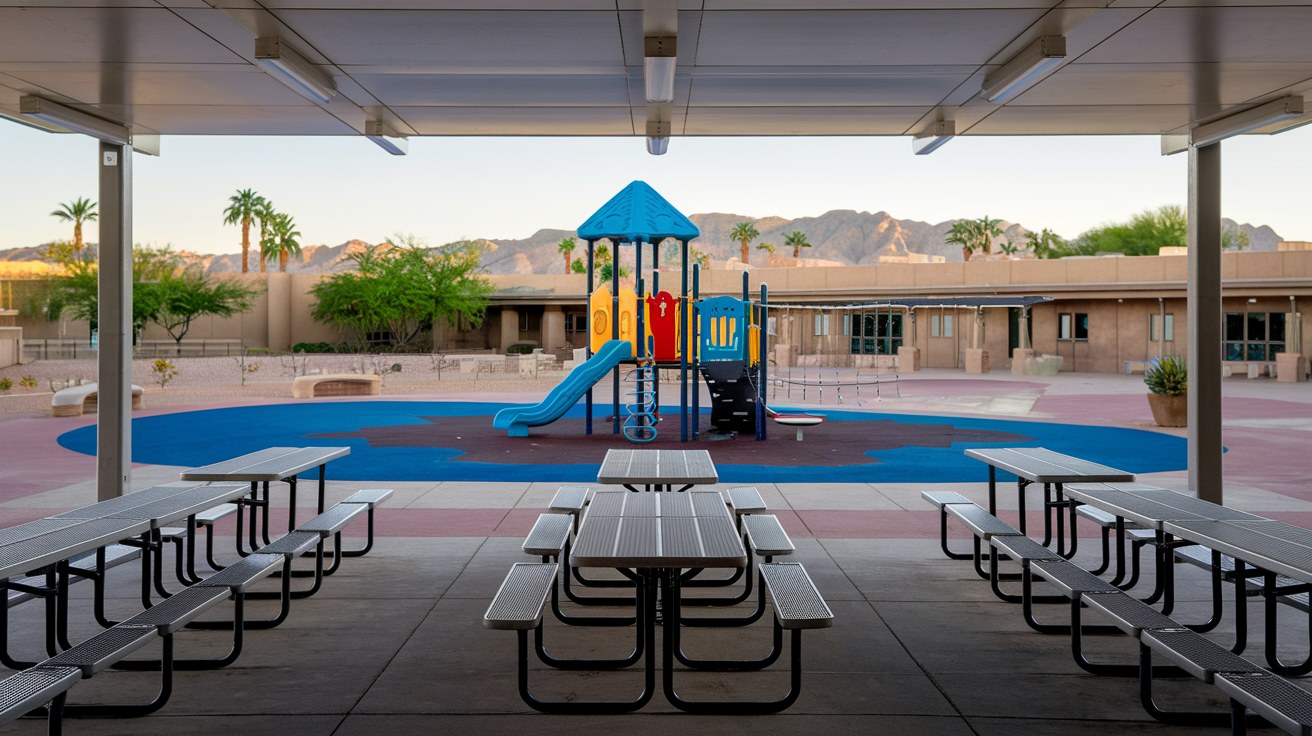
The most common shade-planning mistake we see on school campuses is covering the wrong ground. Budgets tend to land on lunch ramadas and bleacher seating — visible, easy to justify — while the playground equipment, the turf field, and the rubber-matted play area stay fully exposed. Those are exactly the surfaces that burn. A district getting serious about surface temperature should shade where children make sustained contact with hot material, and that usually means the play structure itself.
Form follows the site. A hip structure covers the most open ground per dollar and works well over a broad play field or a cluster of equipment. Where posts cannot land inside a fall zone or a run of turf, a flat cantilever throws coverage from the edge and keeps the play surface clear of obstructions. And because playgrounds are rarely rectangular and often need the shade tied into existing equipment or an odd footprint, this is frequently a job for a custom structure engineered around the site rather than an off-the-shelf square dropped onto ground it does not fit. For gathering and transition areas — bus loading, entry plazas, seating adjacent to the play zone — tensioned and building-attached forms like a hypar, a cabana, or an awning extend the protected area without crowding the equipment. The goal is continuous protection across the surfaces children actually touch, not a single canopy over the tables.
Protecting Kids Without Losing the Structure to the Monsoon
Shade over a schoolyard has to do two jobs at once in Arizona: knock down surface temperature all summer and survive the storms that arrive in the middle of that summer. The 2026 monsoon outlook from the National Weather Service leans above normal for precipitation across Phoenix and Tucson, with a warmer-than-average season overall — which means the same structures cooling those play surfaces in July will be taking outflow winds in July and August. A canopy that lowers a slide from 160 to 111 degrees is worth nothing if it becomes airborne debris in the first haboob.
That is why the engineering matters as much as the coverage. A schoolyard structure should be designed to the wind load your jurisdiction’s building code requires and installed by a crew certified for the lift and rigging work — we field an OSHA-certified installation crew for exactly that reason, and the engineering standards behind a storm-worthy canopy are laid out in our guide to monsoon-ready commercial shade structures in Arizona. Durability also has a budget dimension districts should weigh: a structure built for canopy replacement and repair lets you re-skin the fabric on the existing frame years down the road for roughly two-thirds the cost of a full new structure, so the cooling you install this summer keeps working through the next decade. Districts that want to see how these hold up on real Arizona campuses can review our testimonials.
The Bottom Line
The calendar and the thermometer are about to collide again. Students return in mid-to-late July, the heat is forecast warmer than average, and the surfaces waiting for them — slides at 160 degrees, turf and rubber at 180 to 188, metal equipment documented as high as 250 — are hot enough to burn on contact in seconds. Shade is not a comfort line item on this problem; it is the measurable fix, bringing a burning slide down to a temperature a child can use and doing it the day it goes up. The districts that shade their play surfaces this summer, with fabric that blocks the UV and engineering that survives the monsoon, are the ones whose playgrounds stay open and safe when the heat peaks. If you are a school, district, or municipality planning capital work and want a straight assessment of which surfaces on your site need covering — and a structure engineered to protect them through Arizona’s worst — contact Total Shade today for a site walk, stamped engineering, and an honest read on what your play areas actually need.
Sources: Arizona 2026-27 school start dates, including Chandler Unified (July 15) and a late-July statewide reference first day (abc15, us-school-calendar.com); Phoenix July average high of 107°F and forecast highs of 102–111°F (AccuWeather); playground surface and equipment temperatures — slide reaching 160°F unshaded in 100°F weather and 111°F under cover, equipment documented up to 250°F, contact burns in seconds at ~180°F, and ~100 pediatric burn patients treated annually (Arizona Burn Center / Banner University Medical Center via KX/AP, KOLD); plastic burn threshold near 118°F for sustained contact and artificial-turf temperatures of 150–180°F (ScienceDirect play-surface research, Arizona State University); rubber matting reaching 188°F and CPSC thermal-burn “touch test” guidance (Associated Press, U.S. Consumer Product Safety Commission); shade reducing equipment temperature by up to 20°F and shaded areas running 20–30°F cooler, with artificial and tree shade equally effective in hot-dry climates (ProPlaygrounds, ScienceDirect, ASU SHaDE Lab); 2026 Arizona Monsoon Outlook leaning above normal for Phoenix and Tucson with a warmer-than-average season (NWS Arizona Monsoon Outlook, abc15); Commercial 340/95 HDPE specification (up to 96% UV block) from manufacturer specification sheets; fabric re-skin economics from Total Shade project experience.
