The Extreme Heat Warning that has held metro Phoenix at 112 to 116 degrees all week expires today, and what replaces it is the other half of an Arizona summer. Per the National Weather Service and azfamily’s First Alert forecasters, the monsoon is set to ramp up this weekend — gusty outflow winds and blowing dust reaching the Valley as early as Saturday, rain chances climbing Sunday and holding into next week as incoming moisture knocks highs back to 110 and below. After a bone-dry June and a first week of July spent under heat warnings, this weekend is the 2026 season’s first real storm cycle. For every commercial shade structure in the Valley, it is also the first real test.
Most of those structures will pass. Some will not — and what happens in the hours and days after an outflow hits determines whether a damaged canopy becomes a quick repair or a six-month headache of denied claims and re-procurement. We have spent 25-plus years building and rebuilding shade across Arizona, and the full range of what we engineer is on our products overview. This article is the playbook for the other side of the storm: what monsoon winds do to a shade structure, how to triage damage safely, how to document it so the insurance claim pays, and how to read the difference between a re-skin and a replacement.
The Season’s First Real Test Arrives This Weekend
The setup is textbook. Saturday’s storms are expected to fire over the high country and eastern Arizona first, sending outflow boundaries — the gust fronts that race ahead of collapsing thunderstorms — across the Valley floor with blowing dust even where no rain falls. By Sunday, per azfamily’s reporting, storm chances reach the metro itself and continue into early next week. And the season behind this weekend leans busy: the National Weather Service’s 2026 Arizona Monsoon Outlook puts Phoenix and Tucson above normal for precipitation with a hotter-than-normal season overall.
The wind numbers deserve respect. Ordinary monsoon outflows gust 35 to 60 mph across the Valley, and microbursts — concentrated downdrafts that slam into the ground and spread violently outward — routinely exceed that. Arizona’s Emergency Information Network notes microburst winds can approach 100 mph, the equivalent of an EF1 tornado. The recent history is concrete: a July 2024 microburst near 47th Avenue and Van Buren produced radar-estimated 70 to 80 mph winds and collapsed a warehouse, and an October 2025 Tempe microburst gusting to 90 mph tore roofs off buildings. A shade structure does not need a direct hit to be tested — the outflow forty miles from the storm core is enough.
What an Outflow Actually Does to a Shade Structure
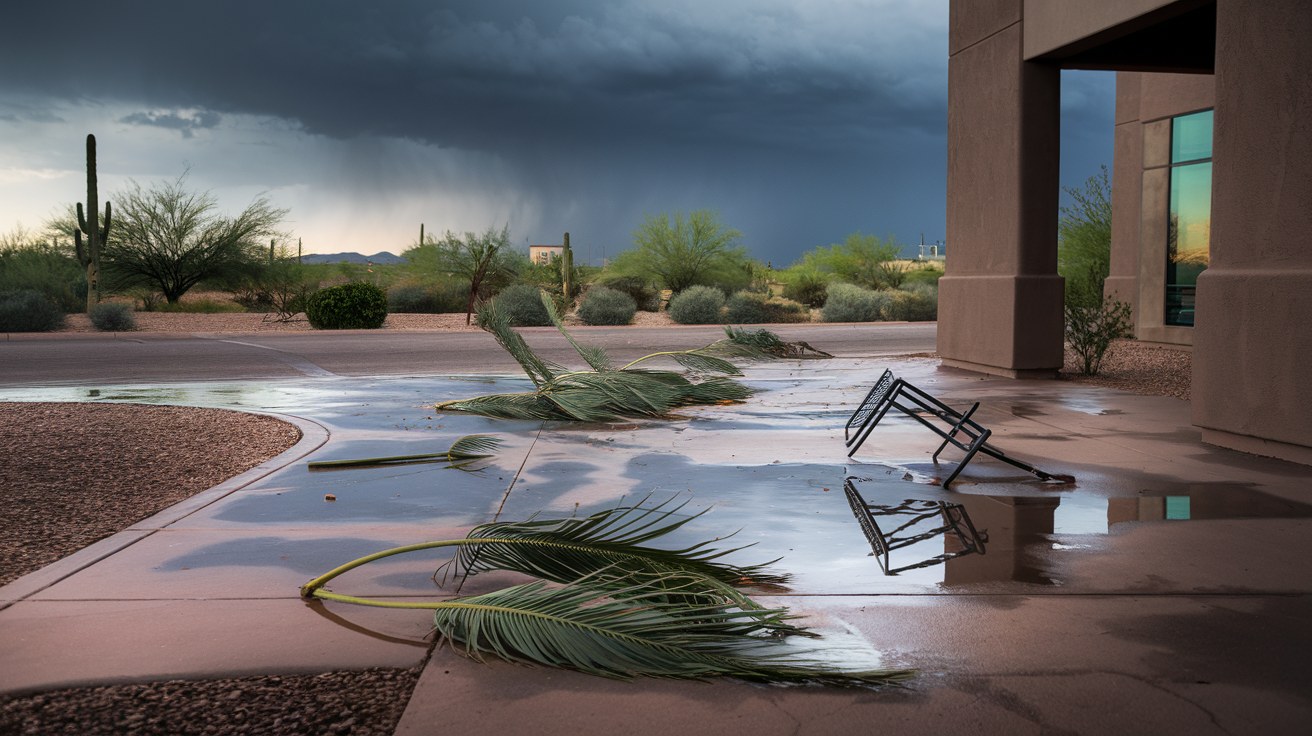
Wind damage to commercial shade follows patterns, and knowing them tells you where to look Sunday evening. Fabric fails first at its stress concentrations — corner attachments, seams under sustained load, and anywhere prior seasons of UV degradation thinned the material. A properly tensioned canopy sheds wind; a loose one flutters, and flutter is what turns a small stress tear into a panel-length rip in a single gust cycle. On a hip structure or a tensioned hypar, check the corners and the cable terminations. On a flat cantilevered structure, the unsupported edge takes the brunt, and the moment load runs back to a single post line and its footing.
Steel and foundations fail differently. Bent posts, cracked welds at connection plates, and concrete heaving at the footing all signal that the structure absorbed loads at or beyond its design rating — less obvious than torn fabric and more consequential, because a frame that has yielded is no longer the frame the engineer stamped. Hardware tells the story too: elongated bolt holes, stretched cables, and turnbuckles that rotated under load. Fixed awnings attached to buildings add one more failure point: the anchorage into the host wall, where wind load concentrates on a handful of fasteners.
The First 48 Hours: Triage Without Making Anything Worse
The first rule after a storm is that a damaged shade structure is a structural hazard, not a maintenance item. A partially detached fabric panel still under tension stores real energy — cutting a loaded cable or a taut corner strap can release it violently. Do not send maintenance staff onto the structure with ladders and box cutters. Cordon off the area beneath and downwind of the damage, especially over playgrounds, pool decks, patio seating, and parking. If a panel is flogging in residual wind, the safe intervention is to de-tension it at ground-level hardware — work for a trained crew. Ours is OSHA-certified and has spent decades doing exactly this kind of lift work in desert conditions.
Resist the urge to clean up. The instinct after a storm is to drag the torn fabric to the dumpster and get the site looking normal before Monday — and that instinct destroys evidence. Leave the damage in place until it is documented; if debris must be moved for safety, photograph it first, exactly where it landed. The second call should be to a commercial shade fabricator, not a general handyman. A shade structure is an engineered tension system, and a well-meaning patch that alters how load flows through the fabric can turn the next outflow into a much larger failure.
Documentation That Makes the Claim Pay
Insurance industry guidance on commercial wind claims is blunt: incomplete documentation is the leading cause of denials, and the insurer is not obligated to investigate beyond what you provide. The claim file built in the first 48 hours decides the outcome. Photograph everything with timestamps — smartphone metadata embeds date and location, and adjusters verify it. Shoot wide views, mid-range context, and close-ups of every failure point: torn seams, bent members, cracked footings, stretched hardware. Capture the debris field before anything moves.
Then tie the damage to the event. Pull the National Weather Service storm reports for your ZIP code and date — NWS Phoenix publishes event summaries with measured gusts, and that record converts “the canopy is torn” into “the canopy was damaged by a documented 65 mph outflow on July 12.” Commercial adjusters also frequently request proof of pre-storm condition; without it, insurers can attribute damage to deferred maintenance and deny the claim. This is where a maintenance file earns its keep: inspection records, fabric replacement dates, and the original engineering documents showing the design wind rating. With that stamped engineering on file, the conversation with the adjuster is about a storm that exceeded design load — not about whether the structure was sound to begin with.
Repair, Re-Skin, or Replace: Reading the Damage
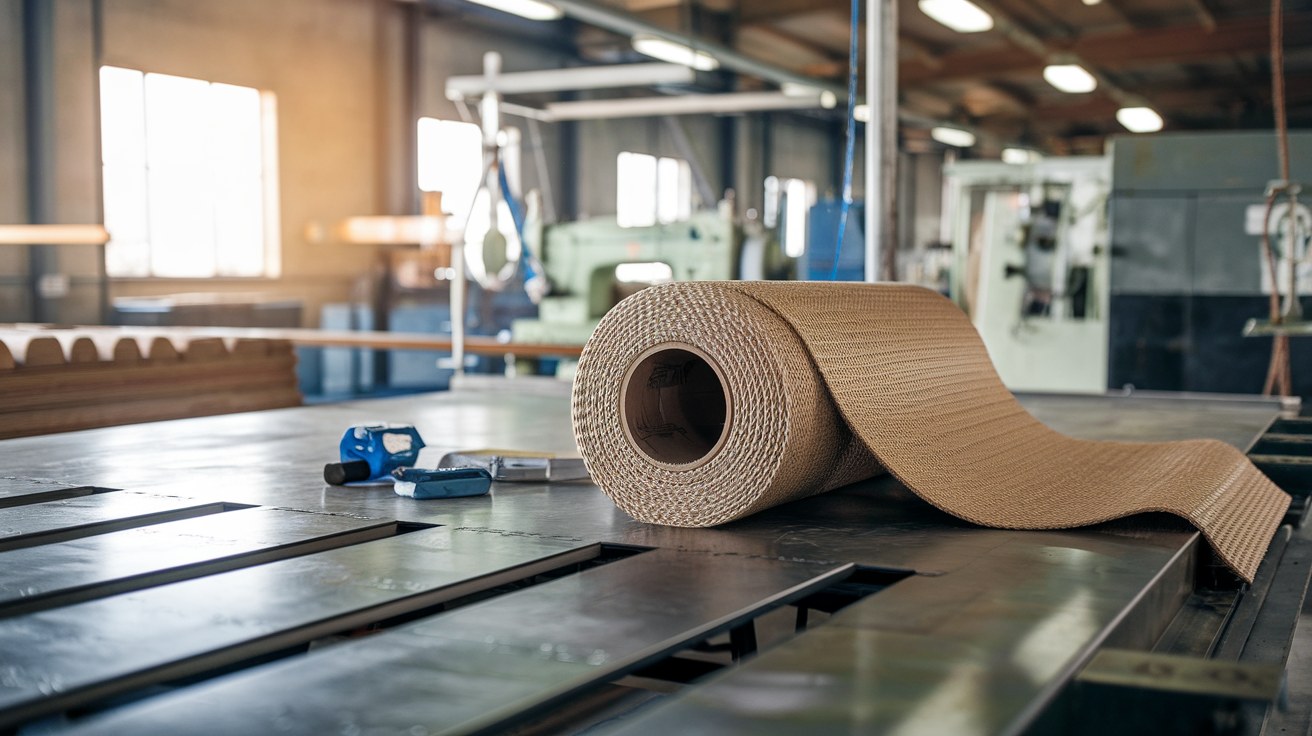
Once the site is safe and documented, the decision tree is simpler than most owners expect. If the frame is straight, the welds are intact, and the footings show no movement, fabric damage — even a total loss of the canopy — does not mean a total loss of the structure. Because we sew in-house, we can fabricate a replacement canopy on the original frame through our canopy replacement and repair service, typically at about two-thirds the cost of a full new structure. The replacement fabric is our standard Commercial 340/95 HDPE — up to 96 percent UV block, backed by a ten-year limited fabric warranty — and the fabric science behind that spec is covered in our article on Arizona shade structure UV protection.
If the steel yielded, the math changes. A bent post or a cracked weld means the structure needs an engineering assessment before anyone re-tensions fabric over it, and sometimes the honest answer is that replacement costs less than rehabilitating a compromised frame. That is also the moment to fix what the storm exposed: a structure that failed at 60 mph was under-engineered for this climate, and rebuilding to the same spec buys the same failure. Sites with complicating geometry — building attachments, playground equipment, cabana seating areas — are where a custom-engineered structure designed to the site and stamped to current code turns a recurring liability into a 20-year asset.
Getting Ahead of Sunday: Two Hours of Prevention
There is still a window before the storms arrive, and its highest-value use costs nothing but time. Walk every structure on the property today and photograph it — the same wide, mid, and close shots you would take after a storm. That baseline is the pre-storm condition evidence adjusters ask for, and it takes one person with a phone two hours. While you walk, look for the cheap fixes: slack fabric, frayed cable ends, missing hardware, and anything stored nearby that becomes a projectile at 60 mph. We covered the full inspection discipline in our guide to monsoon-ready commercial shade structures in Arizona — the short version is that most catastrophic fabric failures start as small, visible, fixable defects.
The other move is establishing the vendor relationship now. After a major outflow event, every fabricator in the Valley is triaging calls, and the properties that get on the schedule first are the ones already in the file — structure specs known, fabric records on hand, site history documented. The school districts, HOAs, and property managers in our testimonials largely started as exactly these calls. August is a bad month to be a stranger.
The Bottom Line
The 2026 monsoon stops being a forecast this weekend. Saturday brings the outflows, Sunday brings the storms, and the National Weather Service expects an above-normal season to follow. If a structure on your property fails, the difference between a fast recovery and a long one is discipline: secure the site without disturbing the evidence, document everything with timestamps, tie the damage to the NWS record, and let an engineer — not an adjuster’s assumption — decide whether the frame survived. And if the fabric is the only casualty, a re-skin on the original frame at roughly two-thirds the cost of replacement is an option most owners are never told about. If a storm finds your property this weekend — or you want the baseline inspection that makes the next claim defensible — contact Total Shade today for a post-storm assessment or a pre-season walkdown.
Sources: Monsoon set to ramp up this weekend with gusty outflows and blowing dust Saturday, Valley rain chances Sunday into next week, and highs falling to 110 and below as the Extreme Heat Warning expires Friday, July 10 (azfamily First Alert Weather, July 9–10, 2026; National Weather Service Phoenix); 2026 Arizona Monsoon Outlook leaning above normal for Phoenix and Tucson precipitation with a hotter-than-normal season (National Weather Service, May 21, 2026); typical monsoon outflow gusts of 35–60 mph with microbursts approaching 100 mph, the equivalent of an EF1 tornado (Arizona Emergency Information Network; ASU School of Geographical Sciences); July 2024 Phoenix microburst with radar-estimated 70–80 mph winds collapsing a warehouse near 47th Avenue and Van Buren, and October 2025 Tempe microburst with 90 mph gusts damaging roofs and cutting power to 22,000 (NWS Phoenix storm event summaries; local news reporting); incomplete documentation as the leading cause of commercial wind-claim denials, the role of timestamped photo metadata, and insurer requests for pre-storm condition evidence (commercial property insurance claim guidance, Insurance Claim Recovery Support and industry claim-documentation resources); Commercial 340/95 HDPE specification (up to 96% UV block), ten-year limited fabric warranty, in-house sewing, and re-skin economics at roughly two-thirds of replacement cost from Total Shade specification sheets and project experience.
