Thirteen days from now, on Monday, July 27, football practice opens at Arizona’s 2A and 3A schools, along with 8-man football and spiritline, per the Arizona Interscholastic Association’s 2026-27 calendar. The 4A through 6A programs and cross country follow on August 3, volleyball and girls flag football on August 10. Every one of those dates lands inside the hottest stretch of the Arizona year — the same stretch that held metro Phoenix under an Extreme Heat Warning at 112 to 116 degrees the first full week of July. The kids are coming back to the fields whether the fields are ready or not.
The readiness question is usually framed as policy: hydration protocols, acclimatization schedules, practice-time rules. Those matter, and we will get to them. But there is a physical-infrastructure half of the question that athletic directors and facility managers control directly, and mid-July is the last practical moment to assess it — the shade over sidelines, bleachers, dugouts, and every place athletes and spectators wait between whistles. We have spent 25-plus years building that infrastructure across Arizona, and the full range of what we engineer is on our products overview. This article maps where heat risk concentrates on an athletic site, what shade measurably does to the numbers that govern practice decisions, and what a two-week audit should cover.
August Is the Deadliest Month in High School Sports
The epidemiology is unambiguous. Roughly 9,000 U.S. high school athletes are treated for exertional heat illness every year, per CDC surveillance data, and the pattern concentrates hard: about two-thirds of time-loss heat illnesses occur in August, and roughly 70 percent occur in football, whose heat-illness rate runs more than eleven times all other sports combined, per epidemiological studies published in the American Journal of Preventive Medicine. The Korey Stringer Institute at the University of Connecticut, the national research center on athlete heat safety, reports that about 65 percent of exertional heat stroke deaths in American football have occurred during August.
Arizona runs that month hotter than any state in the country, and the AIA calendar puts the acclimatization window — the one-to-two-week period when athletes’ bodies are still adapting and risk peaks — squarely in late July and early August. The Arizona Department of Health Services’ extreme-heat guidance for schools identifies temperatures above 101 degrees as the highest attributable-risk band for outdoor activity. Metro Phoenix will not see a forecast high below that number for weeks. This is the context every athletic facility in the Valley operates in for the next sixty days, and it is why the physical environment of the practice field deserves the same scrutiny as the practice plan.
Where Heat Risk Concentrates on an Athletic Site
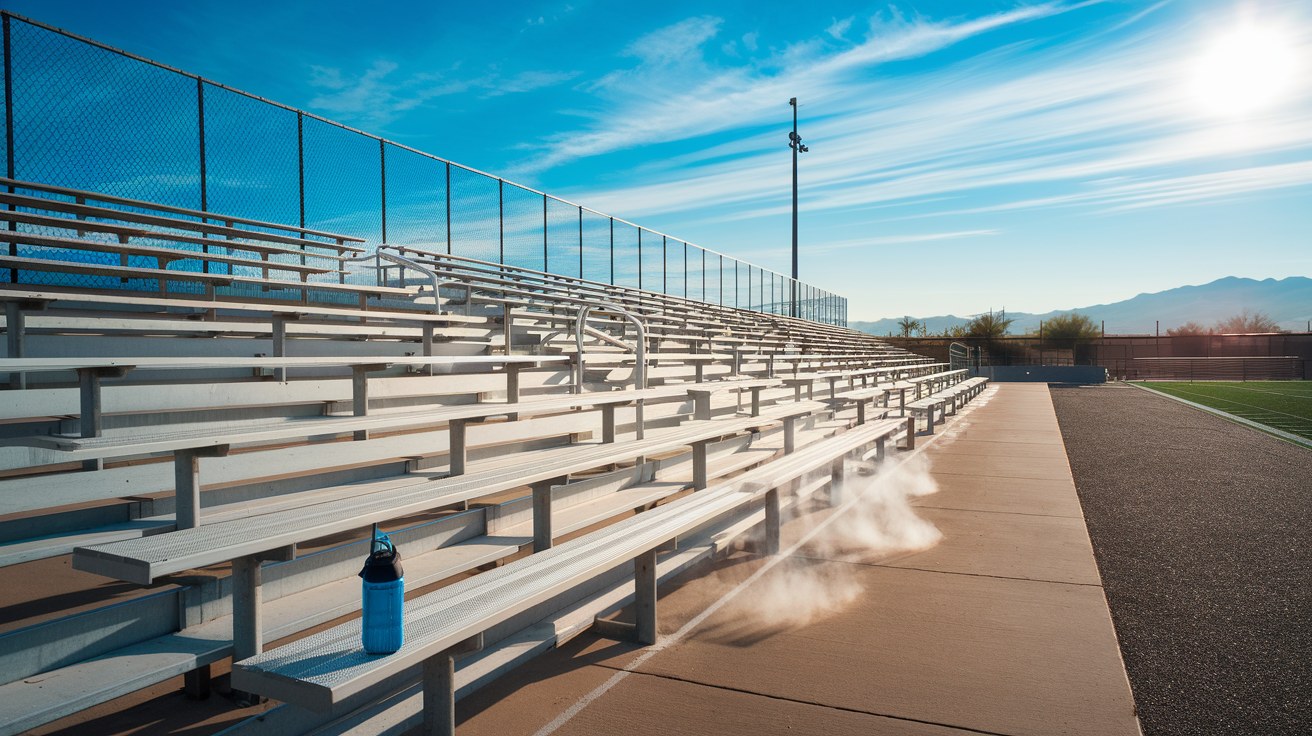
Walk a typical Arizona high school athletic complex at 4 p.m. in early August and the risk map draws itself. The field is the obvious center — synthetic turf surface temperatures in full summer sun have been measured above 160 degrees by university turf-research programs, including Penn State’s Center for Sports Surface Research — but the field is also where policy already concentrates: acclimatization rules, water breaks, athletic trainers watching for symptoms.
The under-managed heat is everywhere else. Sidelines and team areas, where players stand in pads between reps with zero overhead cover. Aluminum bleachers, which absorb radiant heat all day and hold it into the evening — in full sun they are not seating, they are a griddle with a view, and they are where parents, younger siblings, and band members sit for hours. Bus loading zones and staging areas where whole teams wait on hot concrete. Concession lines and ticket queues at the season’s first home games in late August, when kickoff temperatures in the Valley routinely exceed 100 degrees. On multi-field parks and municipal sports complexes, add the walkways between fields and the tournament check-in areas where families camp for entire Saturdays. None of these spaces run a wet bulb globe temperature protocol. All of them accumulate the same heat dose.
What Shade Does to the Number That Governs Practice
Wet bulb globe temperature — WBGT — is the metric that increasingly decides whether practice happens. Unlike air temperature, WBGT integrates ambient heat, humidity, wind, and direct solar radiation, which is why the Korey Stringer Institute calls it the best available measure of environmental heat stress for athletes. Only 18 states and the District of Columbia currently require a WBGT reading before practice, per the institute’s policy rankings — Arizona relies on AIA and district-level heat protocols instead — but the physics apply everywhere whether or not a meter is present.
Shade is the one WBGT input a facility can engineer. Hydration addresses the athlete; shade addresses the environment, removing the direct radiant load that drives the globe-temperature component of the reading. Field measurements consistently show shaded WBGT running several degrees below in-sun readings on the same site at the same hour — and on the activity-modification charts that heat protocols use, a few degrees of WBGT is frequently the difference between a full practice and a shortened one, or between pads and helmets-only. A quality fabric does more than block light: our standard Commercial 340/95 HDPE blocks up to 96 percent of UV while its open knit lets heat convect through rather than trapping it, a distinction we cover in detail in our article on Arizona shade structure UV protection. A WBGT meter tells you when to cancel practice. Shade is part of what keeps you from having to.
Shading the Sideline, the Stands, and Everything Between
Athletic sites reward matching the structure form to the space, because the constraints differ at every station. Team and sideline areas need shade without posts where players run — which is exactly the problem a flat cantilevered structure solves, carrying the canopy from a single post line set safely behind the bench. Bleachers and grandstands typically call for a hip structure sized to the seating footprint, the same workhorse form that shades playgrounds and lunch courts across the state. Smaller stations — trainer’s tables, scorer’s tables, dugouts, batting-cage waiting areas — suit cabanas that define a protected zone without walling it off. Entry plazas and concession courtyards, where a district wants the facility to look like an investment, are where a sculptural hypar structure earns its keep, and building-mounted awnings handle ticket windows and concession service lines without new foundations.
The honest fit is rarely a catalog item. Bleacher geometries vary, sightlines cannot be blocked, field clearances are regulated, and existing electrical and irrigation runs constrain where footings can go. That is custom-structure work — engineering the shade to the site rather than forcing the site around a standard frame. The school districts and municipalities in our testimonials mostly started with exactly this kind of constrained-site problem.
Last Night Was the Reminder: Every Field Structure Is a Wind Structure
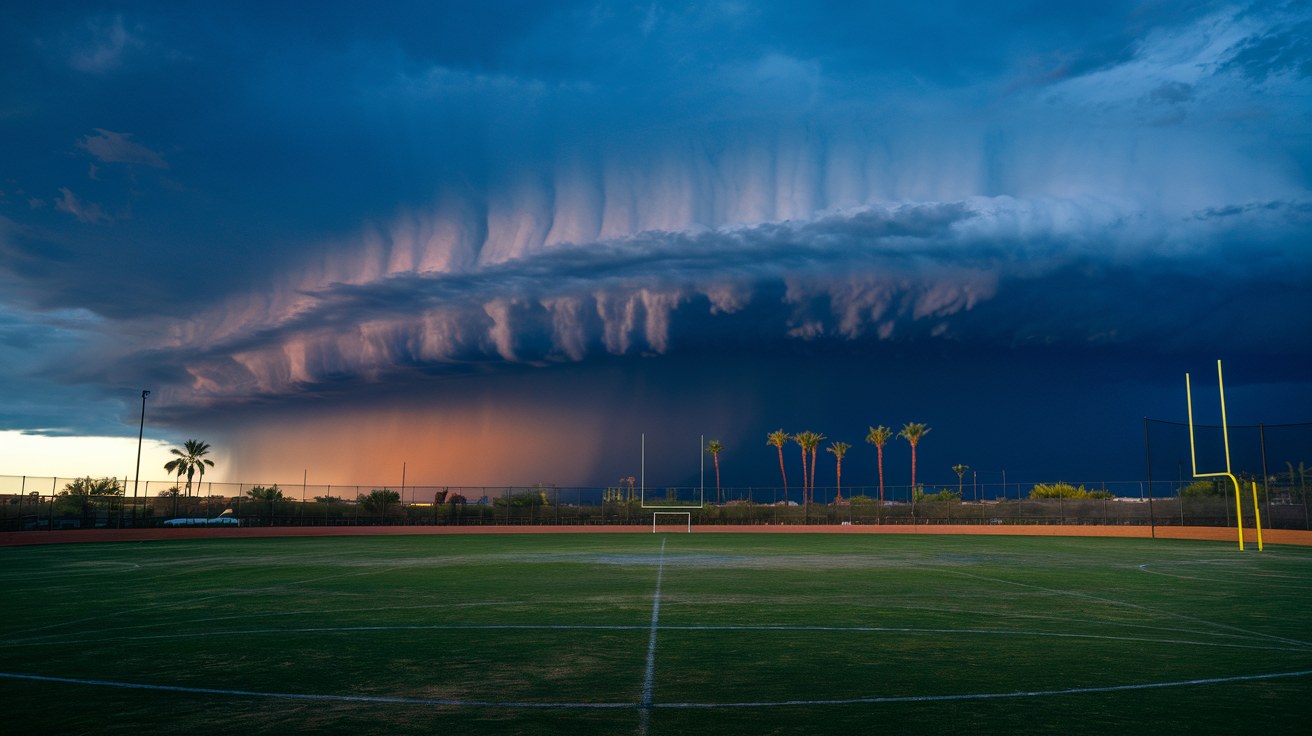
Anything built beside an open field also has to survive what arrived Monday evening. The storm that swept the Valley on July 13 gusted to 50 mph, tore parts of a roof off a Glendale mobile-home park, snapped trees in Scottsdale, knocked out power to roughly 20,000 customers, and forced a ground stop at Sky Harbor — and the National Weather Service’s 2026 outlook calls for an above-normal monsoon still ahead. Athletic fields are among the most wind-exposed sites we build on: flat, open, unbroken by buildings, with nothing to slow an outflow boundary between the storm core and your bleachers.
That exposure has two design consequences. First, structures on fields need engineering to the site’s actual wind loads — stamped calculations, not a vendor’s brochure claim — a discipline we walk through in our guide to monsoon-ready commercial shade structures in Arizona. Second, existing structures need a pre-season look. A canopy that sailed through last summer may be carrying UV-thinned fabric, slack tension, or elongated bolt holes into this one, and fabric damage caught in July is a repair; the same defect discovered under an August outflow is a liability. If the frame is sound and only the fabric has aged out, our in-house sewing team can fabricate a replacement on the original steel through our canopy replacement and repair service — typically about two-thirds the cost of a new structure, backed by the same ten-year limited fabric warranty.
The Two-Week Audit
The window between today and the first whistle is enough to do this properly. First, walk the site at practice hour — 6 a.m. and 4 p.m., not 10 a.m. — and map where athletes, staff, and spectators actually stand, wait, and sit, and which of those stations has overhead protection. Second, inspect what you already own: fabric condition, tension, hardware, and footings on every existing structure, photographed and filed before the monsoon peaks. Third, rank the gaps by exposure time — a sideline used three hours a day beats a walkway crossed in thirty seconds. Fourth, get the priority gaps into the capital conversation now. Fall is when districts assemble next year’s project lists and bond packages — Scottsdale Unified’s $375 million November bond is one of several on Arizona ballots this year — and a shade line item with a site assessment behind it survives budget review far better than a vague intention. A structure specified this fall installs next summer, before the 2027 acclimatization window opens.
The Bottom Line
The AIA calendar is fixed: July 27, then August 3, then August 10. The heat those dates land in is equally fixed. What is not fixed is how much of an athletic site’s day-to-day heat dose — on the sideline, in the stands, at the staging areas policy never reaches — gets removed by infrastructure that works every hour of every practice without anyone remembering to deploy it. Shade will not replace acclimatization protocols or athletic trainers, and no one should pretend it does. It is the piece of heat safety you build once and stop managing. If your fields, stands, or spectator areas are going into this season uncovered — or you want a pre-season inspection of the structures you already have — contact Total Shade today for a site assessment.
Sources: 2026-27 AIA fall sports calendar — 2A-3A and 8-man football and spiritline practice opening July 27, 4A-6A football and cross country August 3, volleyball and girls flag football August 10 (Arizona Interscholastic Association Quick Glance Calendar, updated May 2026); approximately 9,000 U.S. high school athletes treated annually for exertional heat illness (CDC, Heat Illness Among High School Athletes surveillance); roughly two-thirds of time-loss heat illnesses occurring in August and about 70 percent in football, with football’s rate 11.4 times all other sports combined (American Journal of Preventive Medicine, Epidemiology of Exertional Heat Illness Among U.S. High School Athletes); approximately 65 percent of football exertional heat stroke deaths occurring in August, WBGT as the best measure of environmental heat stress, and 18 states plus D.C. requiring WBGT readings before practice (Korey Stringer Institute, University of Connecticut; Associated Press reporting); temperatures above 101°F as the highest-risk band for outdoor school activity (Arizona Department of Health Services, Managing Extreme Heat Recommendations for Schools); synthetic turf surface temperatures above 160°F in full sun (Penn State Center for Sports Surface Research and related university turf research); July 13, 2026 Valley storm with 50 mph gusts, structural damage in Glendale, roughly 20,000 customers without power, and a Sky Harbor ground stop (azfamily, KTAR, ABC15 reporting, July 13-14, 2026); above-normal 2026 monsoon outlook (National Weather Service, May 21, 2026); Scottsdale Unified School District $375 million November 2026 bond proposal (12News); Commercial 340/95 HDPE specification (up to 96% UV block), ten-year limited fabric warranty, in-house sewing, and re-skin economics at roughly two-thirds of replacement cost from Total Shade specification sheets and project experience.
