Phoenix spent this week under back-to-back Extreme Heat Warnings, with highs forecast at 110 to 114 degrees and the Valley running six to eight degrees above normal — the kind of stretch that follows the hottest spring on record for the city. At the same time, the 2026 monsoon is opening near its climatological norm in the last week of June, and the National Weather Service leans above normal for both Phoenix and Tucson. For anyone scoping a shade project right now — a school district facility director, a parks manager, an HOA board, a restaurant operator — those two facts set the whole assignment. The shade has to beat a UV index that averages 12.5 in July, and it has to survive a haboob that can throw a 50-to-70 mph wall of wind with minutes of warning.
The decision that determines whether a structure does both is one most buyers skip past: the form. Hip, cantilever, fabric sail, sculptural hypar, cabana, awning — these are not just styles in a catalog. Each form shades a different footprint, behaves differently in wind, and costs differently to build and maintain. Picking the wrong one is how a project ends up over budget, under-shaded, or torn off its posts in August. This guide walks through the major forms we build, what each does best, and how to match one to your site. The full range is on our products overview, but the right choice starts with understanding why form comes first.
Why Form Is the First Decision, Not the Last
Before you compare forms, it helps to know what shade is actually buying you, because that determines how much coverage you need and where. Shade does far more than block glare. Research from Arizona State University’s SHaDE Lab found that mean radiant temperature — the “feels like” heat load a body absorbs from sun and hot surfaces — can exceed 150 degrees Fahrenheit in direct Phoenix sun and drop under 100 degrees in good shade, a swing of more than 50 degrees. On the ground, the contrast is just as stark: surface-temperature studies have clocked unshaded playground and pavement surfaces well past 150 degrees while shaded surfaces sit dozens of degrees cooler. That is the difference between a space people use and a space that sits empty all summer.
Form is what delivers that benefit to the right place. A playground needs continuous overhead coverage with no posts in the fall zone. A bus loading lane needs a long, clean run with nothing to drive around. A restaurant patio needs coverage that reads as architecture, not infrastructure. The same square footage of fabric solves those three problems very differently, and the wind question rides along with every one of them. A structure rated for 90 mph wind loads survives an Arizona storm; a structure that was specified for looks alone becomes scrap metal and a liability claim. We cover the engineering side of that in depth in our breakdown of monsoon-ready commercial shade structures in Arizona. Form is where shade performance and wind survival get decided at the same time.
Hip Structures: Maximum Coverage for Open Ground
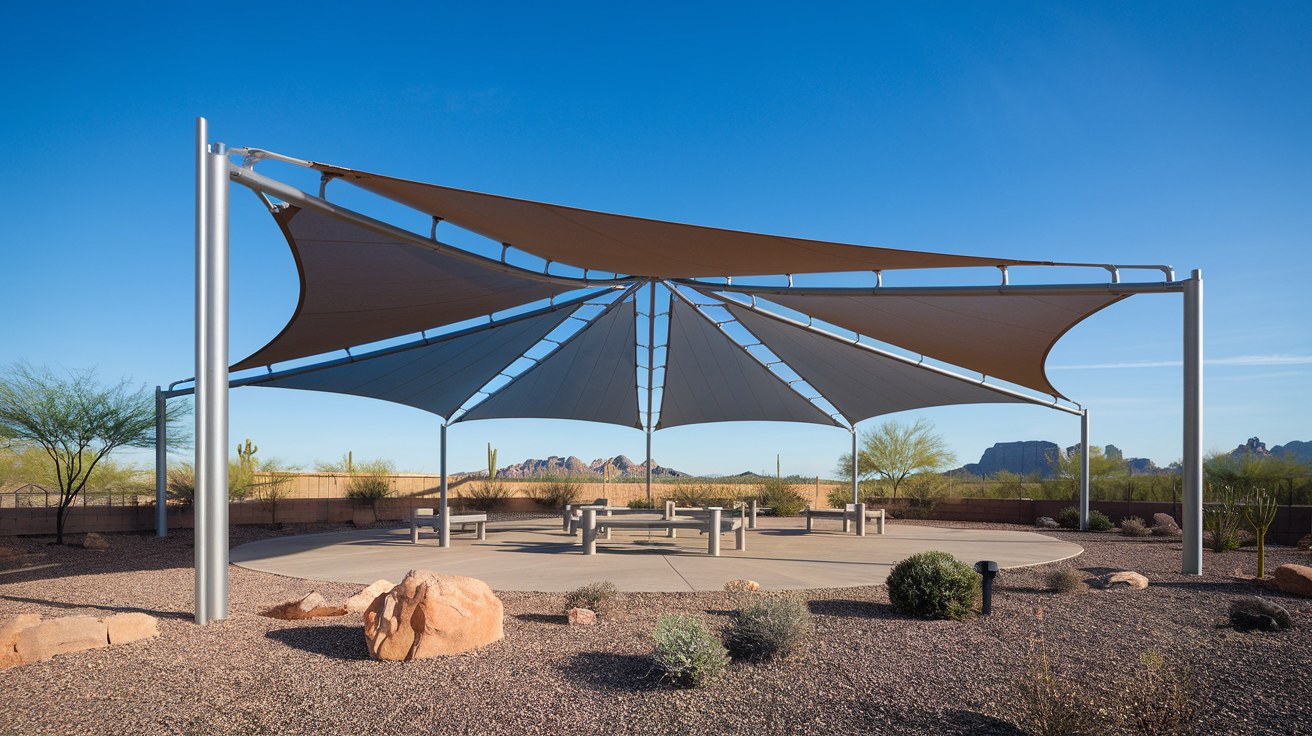
The hip structure is the workhorse of commercial shade in the desert, and for most large open areas it is the default for good reason. A hip structure uses four or more steel columns supporting a pitched, hip-roof-shaped canopy, and that multi-post geometry lets it span the largest footprints of any form. When a school needs to cover a full playground, a sport court, or an outdoor learning area, or when a park needs to shade a ramada-scale gathering space, the hip structure delivers the most shaded square footage per dollar. The pitch also helps the canopy shed wind and rain rather than catching them.
The trade-off is the posts. A hip structure plants columns on all sides and sometimes through the interior on very large spans, so it needs ground where those footings can go without interfering with how the space is used. On a playground that is rarely a problem — the perimeter posts sit outside the equipment — but on a tight patio or a narrow walkway, the post layout can be the deciding factor against it. When the footprint is large and the ground is open, though, nothing else competes on coverage or cost-per-square-foot. It is the first form we reach for on schools, parks, and municipal sites, and the projects behind that are on our testimonials page.
Flat Cantilevers: Clean Sightlines Where Posts Get in the Way
When the posts are the problem, the cantilever is usually the answer. A flat cantilevered structure carries its entire canopy from columns on one side only, extending the shade outward — commonly up to around 20 feet from the posts — with nothing underneath to drive around, walk into, or design against. That single-sided support is what makes the cantilever the right tool for bus loading zones, drive-up and pickup lanes, covered walkways, bleachers, and parking rows, where a clean, unobstructed span matters more than absolute coverage area.
Cantilevers ask more of the engineering than hip structures do, because all of the wind and dead load funnels into one line of columns and their footings. That is not a weakness — it is a reason to insist on a structure that is properly engineered and footed for the load, especially in a monsoon climate where the uplift on an unbalanced canopy is real. Done right, a cantilever in a parking lot does double duty: it cools the asphalt and the vehicles under it while keeping the lanes open, which is why covered parking and customer canopies are among the most common commercial requests we see. The form trades a little coverage efficiency for sightlines and access, and on the right site that trade is well worth making.
Fabric Sails and Sculptural Hypars: Coverage With Architecture
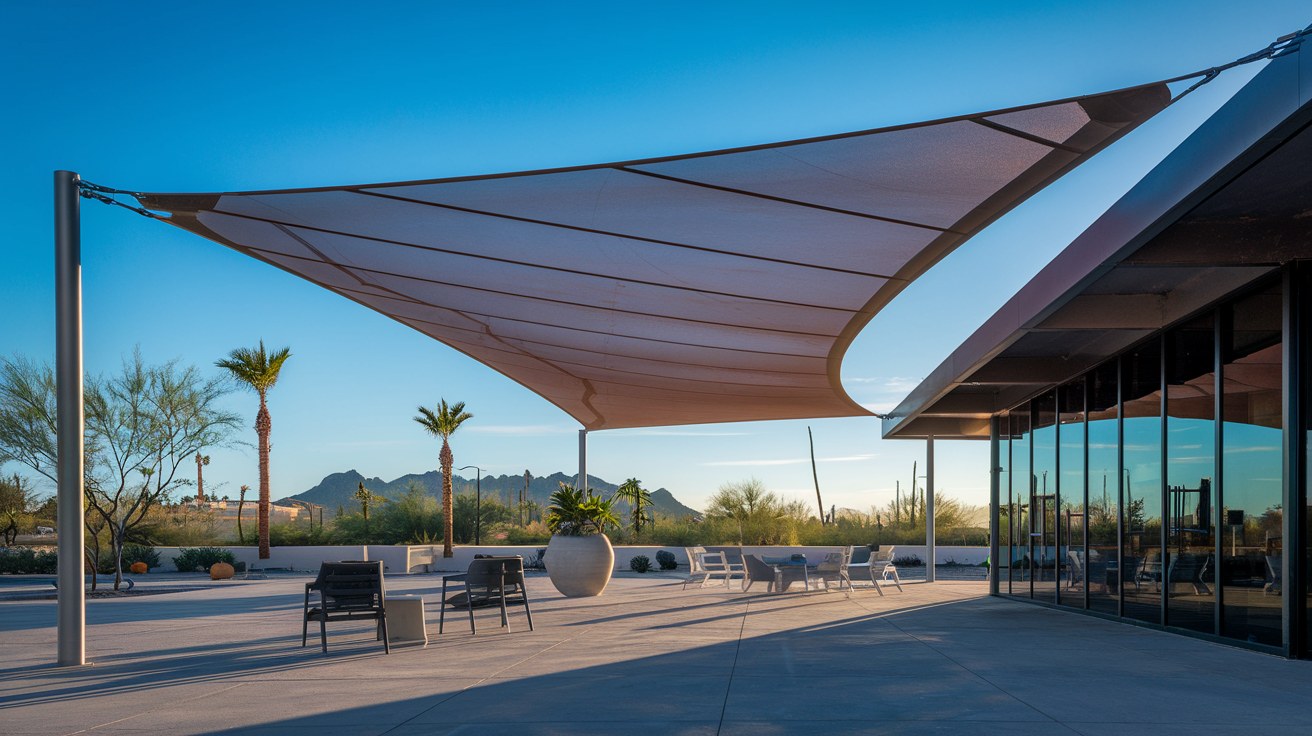
Sometimes the brief is not just “shade this area” but “shade this area and make it look like it belongs.” That is where tensioned fabric sails and sculptural hypar structures earn their place. A hypar shade structure — short for hyperbolic paraboloid — twists the fabric into a saddle shape, with high and low corners that create a striking, almost sail-like silhouette. Beyond the look, that geometry is functional: the warped surface stays under tension, sheds wind cleanly, and resists the pooling and flapping that plague a flat-tensioned membrane. Three-point and four-point sails work on the same principle at a smaller, more modular scale, good for layering coverage over entry plazas, pool decks, and seating clusters.
The same architectural logic extends to cabanas over a pool deck or HOA common area and to awnings that attach to a building face for restaurant patios and storefronts. These forms typically cover smaller footprints than a hip structure, and the sculptural ones can cost more per square foot because the engineering and fabrication are more involved. What you get in return is shade that reads as design — coverage that a board, a developer, or a hospitality brand is proud to put its name next to. Whichever fabric form you choose, the membrane still has to be specified for the desert: we standardize on Commercial 340/95 HDPE that blocks up to 96% of UV, and the fabric science behind that is in our piece on Arizona shade structure UV protection.
Matching Form to Site, Wind, and Budget
With the forms on the table, the selection comes down to four questions, and they are best answered in order. First, what are you shading and how big is it? A large open area points to a hip structure; a long narrow run with access needs points to a cantilever; a smaller signature space points to a sail, hypar, cabana, or awning. Second, where can the posts go? If the ground is open, you have every option; if it is constrained by traffic, equipment, or an adjacent building, the form shortlist narrows fast.
Third, what does the wind require? Every form we build is engineered for Arizona’s wind loads, but the more ambitious the geometry and the more it relies on a single support line, the more the engineering matters — which is exactly why specifying a vendor who stamps the calcs and footings is not optional in this climate. Fourth, what is the budget per shaded square foot, and over what lifespan? Hip structures tend to deliver the lowest cost per covered foot; sculptural forms cost more but buy architecture. None of this is one-size-fits-all, and plenty of Arizona sites are irregular enough — non-rectangular footprints, building tie-ins, integration with playground or seating equipment — that the answer is a custom structure that borrows from more than one form. The point of asking the four questions before you shop is that the form decision quietly sets your coverage, your cost, and your storm survival all at once.
The Bottom Line
The heat this week and the monsoon opening behind it are a reminder that an Arizona shade structure has two jobs that pull in different directions — it has to cool a space through the worst UV in the country and stay standing through the storms that follow. The form you choose is where both jobs get won or lost. Hip structures cover the most ground for the money, cantilevers keep sightlines and access clear, and sails, hypars, cabanas, and awnings deliver shade that doubles as architecture. The wrong form is expensive in every direction; the right one pays for itself in coverage, durability, and a space people actually use. If you are scoping a project and want a straight recommendation on which form fits your site, your wind exposure, and your budget, contact Total Shade today for a site assessment, stamped engineering, and an honest answer about the form that belongs over your ground.
Sources: NWS Phoenix late-June 2026 Extreme Heat Warnings and forecast highs of 110–114°F, six-to-eight degrees above normal (azfamily, KTAR), following Phoenix’s hottest spring on record (azfamily); Phoenix July UV Index average of 12.5 (historical UV records); 2026 Arizona Monsoon Outlook leaning above normal for Phoenix and Tucson with a late-June onset (NWS, FOX 10, abc15); ASU SHaDE Lab mean-radiant-temperature findings (>150°F in sun vs. <100°F in shade) and the “50 Grades of Shade” study in the Bulletin of the American Meteorological Society; surface-temperature contrasts on unshaded vs. shaded pavement and play surfaces (EPA Heat Islands, ASU/City of Phoenix cool-pavement research); commercial shade-structure form comparisons — hip-roof multi-post coverage, cantilever single-sided spans up to ~20 feet, and sail/hypar tensioned geometry — and 90 mph wind-load ratings from industry technical guides (Creative Shade Solutions, USA-SHADE, Landscape Structures); Commercial 340/95 HDPE specifications (up to 96% UV block) from manufacturer specification sheets.
