Phoenix spent the third week of June under back-to-back Extreme Heat Watches, with the lower deserts running six to ten degrees above normal and Major HeatRisk days stacking up — the same week the county confirmed its first heat death of the year. The sun doing that to people is also doing it to the shade fabric overhead, and it does it faster here than almost anywhere in the country. Phoenix averages a UV index of 12.5 in July and has touched 13.21, deep in the “extreme” category that other cities only brush. That radiation is exactly what breaks down a knitted polyethylene canopy, one molecular bond at a time.
For facility managers, HOA boards, and school district directors who bought shade structures five, eight, or ten years ago, that raises a question most never planned for: the steel will outlive all of us, but the fabric won’t, and at some point it has to come off and go back on. The good news is that replacing the fabric is usually a fraction of the cost of replacing the structure — if you catch it at the right time and you have the original frame to work with. We do this work in-house through canopy replacement and repair, and this piece lays out how long fabric really lasts in Arizona sun, what end-of-life actually looks like, and how to decide between re-skinning and starting over.
Why Phoenix Eats Shade Fabric Faster Than the Spec Sheet Says
Manufacturers publish fabric lifespans, and those numbers are honest — but they describe an average climate, not the Sonoran Desert. Commercial-grade HDPE shade cloth carries UV-stabilizer warranties of ten to fifteen years, and the fabric we standardize on, Commercial 340/95, blocks up to 96% of UV radiation when new. The catch is that the same fabric rated for eight years of service in a temperate city can give you closer to five in Phoenix, because UV dosage is cumulative and Phoenix delivers more of it, for more months, than nearly any market in the United States.
The degradation mechanism is straightforward. Ultraviolet radiation attacks both the pigment and the polymer chains in the yarn, and over years of exposure the fabric fades, grows brittle, and loses tensile and tear strength. A quality knitted HDPE starts life with anti-tear strength around 800 newtons and a long-term stretch rate under 2%; as the polymer breaks down, both of those numbers drift the wrong way. The fabric is still casting shadow and still looks roughly intact from the parking lot, which is exactly why so many structures quietly slip past their safe service life. The shadow is the easy part. The strength is what you’re actually paying for, and strength is invisible until the day it isn’t there. We walk through the fabric science in more depth in our piece on Arizona shade structure UV protection, but the short version is that the desert simply spends the fabric’s UV budget faster.
What End-of-Life Actually Looks Like
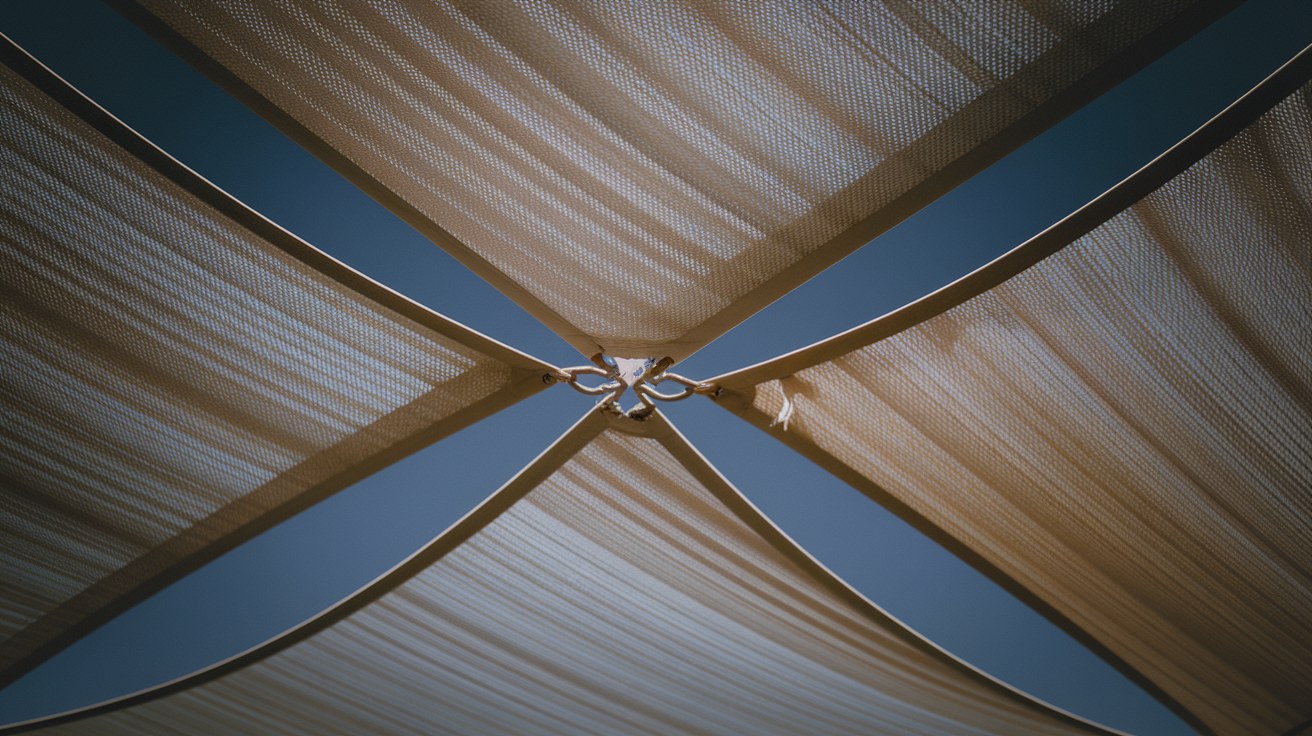
Fabric rarely fails all at once. It tells you it’s getting close, and the signs are consistent across hip structures, flat cantilevers, awnings, and sail forms alike. The first is color. A canopy that has gone chalky, blotchy, or noticeably lighter than it started is showing you pigment loss, and pigment loss tracks closely with the fiber embrittlement happening underneath it. Fade is not just cosmetic — it is the early warning that the yarn is weakening.
The second is shape. A fabric that has begun to sag, ripple, or pull loose at the corners has stretched past its design tension. Once a canopy loses tension it stops shedding wind and water cleanly; low spots collect debris and rainwater, and that added weight accelerates the stress on the fabric, the stitching, and the attachment hardware in a feedback loop that ends in a torn seam or a pulled fitting. The third sign is the obvious one: any tear, fray, or opening seam means water and wind are now getting into the assembly, and a small tear in a tensioned membrane becomes a large one quickly. When a structure shows two of these three at once — faded and sagging, or sagging and fraying — it is at end of life, not mid-life, and it should be evaluated before storm season rather than after.
Re-Skin or Replace: The Decision That Saves Two-Thirds
Here is the part most buyers don’t know they have a choice about. If the steel frame is sound — square, plumb, properly footed, and free of structural corrosion — the fabric is the only consumable in the system, and it can be replaced on the existing structure. Our in-house sewing team fabricates a new canopy to the original geometry and re-skins the frame, typically at roughly two-thirds the cost of a full new structure. Most school districts and HOA boards don’t learn that re-skinning is an option until someone tells them, and they budget for a full teardown they don’t need.
Replacement of the whole structure makes sense in a narrower set of cases: when the steel itself is corroded or has been compromised in a storm, when the original engineering no longer meets current wind-load code, or when the site’s use has changed and the footprint needs to change with it. Short of that, re-skinning is the better value by a wide margin, and it has a second advantage — a frame that has already stood for a decade in Arizona has proven its footings and its connections against real monsoons. Specifying the replacement fabric is also a chance to upgrade: we standardize on Commercial 340/95 HDPE but also work with Polyfab, Alnet, and Serge Ferrari when a project calls for a translucent, fire-rated, or waterproof membrane the original build didn’t have. The frame stays; the performance improves. Whether the structure is a cabana over a pool deck, a sculptural hypar over an entry plaza, or a custom structure tied into a building, the same logic holds: assess the steel first, then decide.
The Monsoon Moves the Clock Up
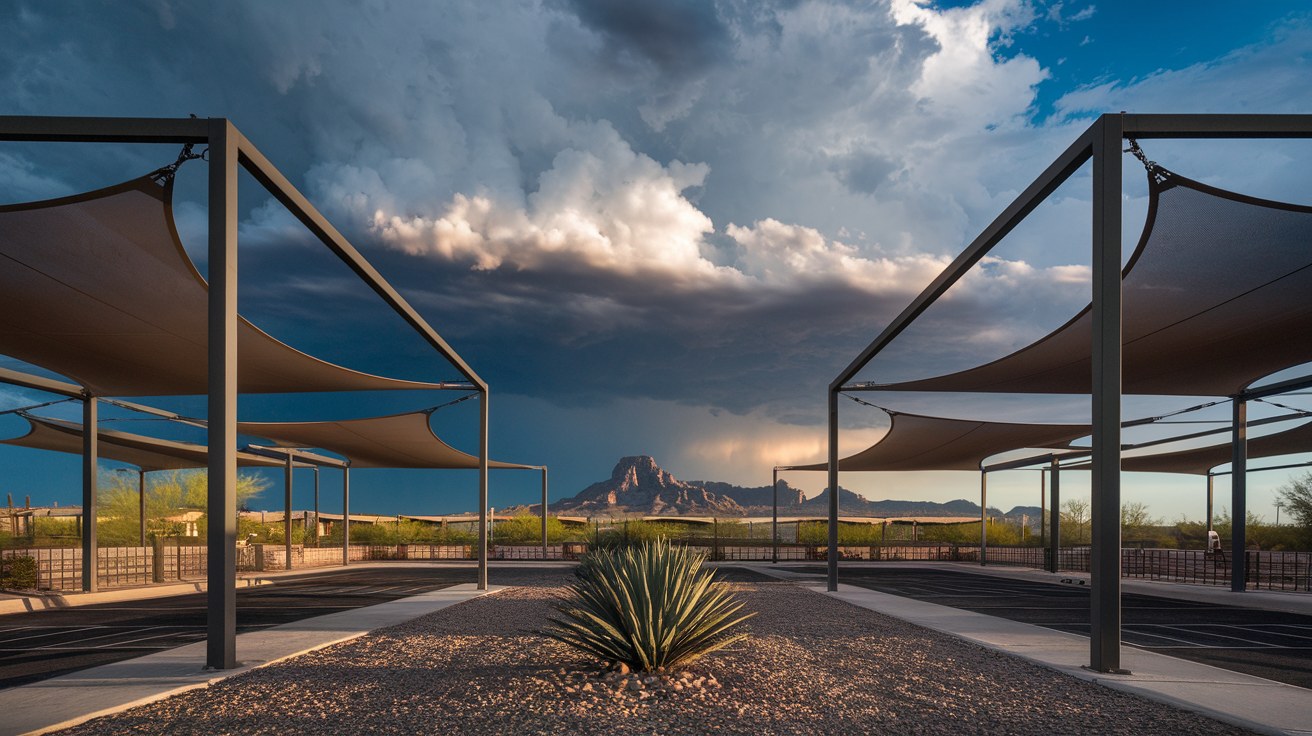
Timing matters, and the calendar is not on the side of aging fabric. The 2026 monsoon is opening near its climatological norm in the last week of June, and the National Weather Service outlook leans above normal for both Phoenix and Tucson, with the Climate Prediction Center favoring a hotter-than-usual season. The Valley is also debuting a new five-tier dust storm scale this year, backed by 22 sensors and 13 organizations, to officially rate the haboobs that have always been the season’s signature hazard.
For a canopy already weakened by UV, the monsoon is the stress test that turns “we’ll get to it next budget cycle” into an emergency. An outflow boundary off a collapsing thunderstorm can throw a 50-to-70 mph wall of wind with only minutes of warning, and that load lands on the fabric and the seams first. A new canopy rated for the structure’s design wind sheds that gust; a sun-spent canopy with a 2% stretch and a frayed corner is where the failure starts, and a piece of liberated fabric becomes both flying debris and a liability claim. This is the same engineering logic we laid out in our breakdown of monsoon-ready commercial shade structures in Arizona — and it is the reason an end-of-life inspection belongs in early summer, not in the wreckage after the first storm.
Building Fabric Replacement Into the Budget Before You’re Forced To
The buyers who handle this well treat the fabric as a planned mid-life expense, not a surprise. Over a twenty-year horizon, a well-built commercial structure will likely need its fabric replaced once, sometimes twice in the harshest exposures, and budgeting for a re-skin around year five to seven in Phoenix is realistic rather than pessimistic. Doing it on a schedule means you replace on your terms — quoted, scheduled in the off-season, and installed by an OSHA-certified crew during a window that doesn’t disrupt the site — instead of scrambling after a tear or a storm.
It also pays to read the warranty you already hold. Manufacturer warranties commonly cover the fabric for ten years against UV loss while covering steel for twenty, which tells you plainly which component the manufacturer expects to outlast the other. Knowing where your structure sits against that clock, and getting a straight assessment of whether the steel still has decades left in it, is the whole game. The range of forms we build and maintain across Arizona is on our products overview, and the projects behind them are on our testimonials page.
The Bottom Line
Arizona sun is the most demanding thing a shade canopy will ever face, and it spends fabric faster here than the spec sheets assume. That is not a reason to buy less shade — it is a reason to plan for the one consumable in the system and to know your options when its time comes. In most cases the steel is fine and the answer is a re-skin at roughly two-thirds the cost of a rebuild, fabricated in-house and installed before the monsoon tests what’s already up there. The worst version of this is finding out your fabric was at end of life when a haboob shows you. The better version is a planned inspection and a quote in hand. If your structures have a few Arizona summers on them and you want a straight assessment of whether to re-skin or replace, contact Total Shade today for an inspection, stamped engineering where it’s needed, and an honest answer about which one your budget should buy.
Sources: NWS Phoenix late-June 2026 Extreme Heat Watches and HeatRisk guidance, and Maricopa County’s first confirmed 2026 heat death (azfamily, Medical Daily); Phoenix UV Index data (July average 12.5; record 13.21 on July 7, 2020) via uvindex.today and historical UV records; commercial HDPE shade-fabric lifespan and warranty figures (10–15-year UV warranties; 5–10-year field life with shorter life in high-UV Phoenix vs. temperate climates) from Polyfab, Creative Shade Solutions, USA-SHADE, and Gale Pacific Commercial 95/340 specifications; fabric failure indicators and performance thresholds (~800N anti-tear, long-term stretch under 2%, UV block ≥95%) from manufacturer and industry technical guides; NWS 2026 Arizona Monsoon Outlook (above-normal lean for Phoenix and Tucson; late-June onset) and the new five-tier Phoenix dust-storm scale (22 sensors, 13 organizations) via FOX 10, KTAR, and abc15; ASU SHaDE Lab surface-temperature measurements and the Texas Tech Gilbert, Arizona playground study (189°F in sun vs. 116°F under shade sails); manufacturer specification sheets for Commercial 340/95 HDPE shade fabric.
