The pitch lands on a lot of desks this time of year, and it is persuasive: cover your parking lot with solar panels, generate power, and get shade as a bonus. The commercial solar-carport market is moving fast — analysts put it at roughly $1.29 billion in 2026, up from about $1.18 billion in 2025, on its way toward $2.6 billion by 2034. Schools, hospitals, municipalities, and HOAs across the Valley are all being courted. And the timing makes the appeal obvious: Phoenix just logged its hottest meteorological spring on record at an 80.2°F average, the monsoon opened June 15, and nine of the ten hottest Phoenix summers have happened since 2000. Everybody wants their parking lots, playgrounds, and gathering spaces covered, and they want it yesterday.
Here is the question that almost never gets asked before the contract gets signed: what problem are you actually solving? If the answer is “generate electricity,” a solar carport is a real tool. If the answer is “get people, cars, and surfaces out of the sun,” you are often buying a far more expensive structure than the job requires. Total Shade builds commercial fabric shade — hip structures, flat cantilevers, awnings, and custom structures — so we have a stake in this. But the honest engineering answer is that the two products solve different problems, and conflating them costs buyers real money. This piece lays out the cost math, the heat-and-coverage difference, the monsoon engineering both must pass, and when a solar carport genuinely earns its premium.
A Solar Carport Is a Shade Structure With a Job on Top
Strip away the marketing and a solar carport is a steel canopy — a shade structure — with a photovoltaic array, inverters, conduit, and a utility interconnection bolted to it. That distinction matters because it explains the price. Commercial solar carports run roughly $3.15 to $4.50 per watt installed in 2026, with commercial-scale bids landing around $3.24 per watt DC for systems in the 200-to-800-kilowatt range. Industry sources are consistent that carport-mounted solar costs two to three times more per kilowatt than the same panels on a rooftop, precisely because the steel canopy is an added cost the rooftop never pays.
In other words, the buyer is paying for a shade structure either way. With a solar carport, they are paying for that structure plus an electrical generation project layered on top — panels, racking, wiring, inverters, interconnection studies, and the permitting and utility timelines that come with grid-tied power. None of that is wasted money if you want the power. But if the goal was shade, you have funded an entire energy project to accomplish what a fabric structure does on its own.
The Cost Math Buyers Skip
When the deliverable is square feet of shade over a playground, a lunch area, a pool deck, or a row of parking, the metric that matters is dollars per shaded square foot — and that is where fabric wins decisively. A commercial fabric shade structure puts engineered steel and high-density polyethylene fabric over a large clear span at a fraction of the per-square-foot cost of a solar canopy, because there are no panels, no inverters, and no electrical scope to fund. The same budget shades dramatically more ground.
That gap compounds on the projects most Valley buyers actually have. A school district trying to get its tot lots, bus loading zones, and transition areas out of the sun before the next bell schedule does not need any of those areas to generate electricity — it needs coverage, and it needs it across many small sites, not one big array. A parks department shading ramadas and bleachers, an HOA covering a pool deck with a cabana, a restaurant extending a patio under an awning — these are shade problems, and fabric lets the budget reach all of them rather than one. There is also the long game: when fabric eventually weathers, our in-house team can re-skin the original frame through canopy replacement and repair, typically at roughly two-thirds the cost of a full new structure. Re-roofing a solar carport is a different and far more involved proposition.
Coverage, Heat, and the Surface-Temperature Question
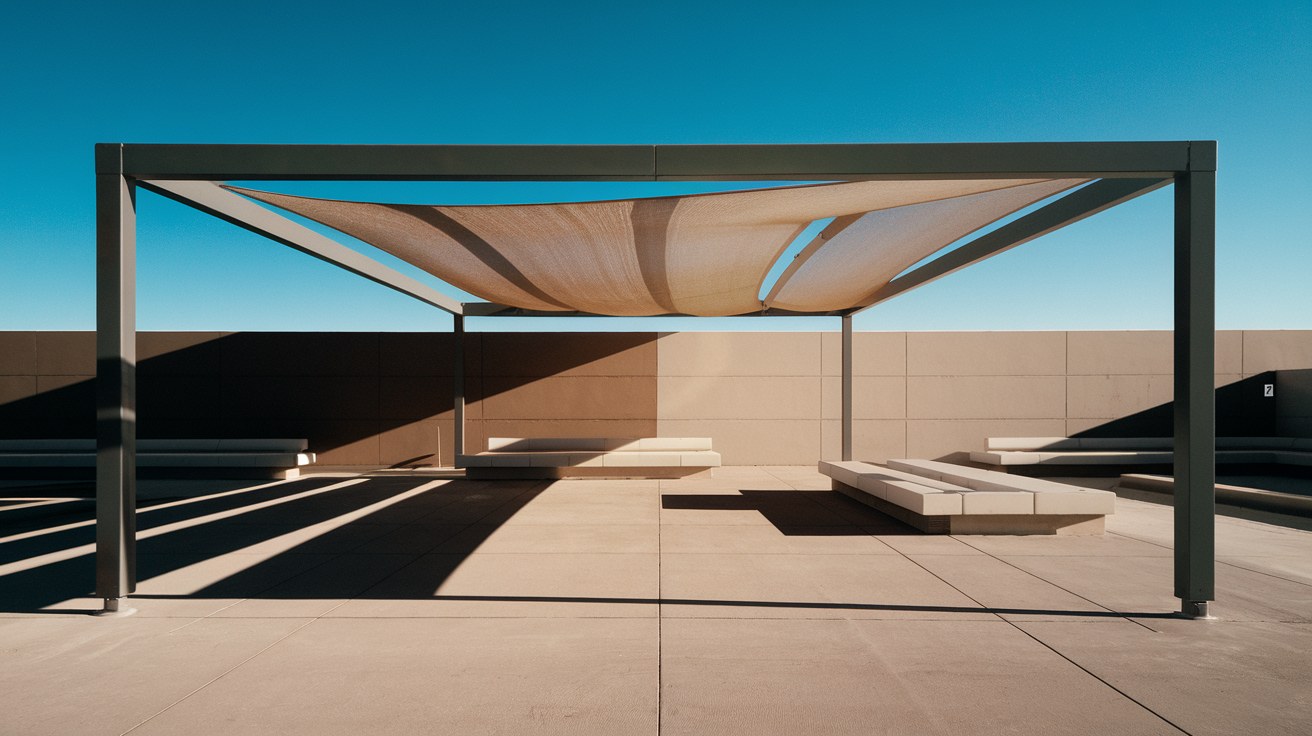
Cost aside, the two structures behave differently in the heat — and not always the way buyers assume. Shade is not one thing. There is blocking the sun’s UV, and there is managing the heat that builds underneath the cover, and a good Arizona structure has to do both. This is where fabric’s engineering quietly outperforms a solid panel roof for human-occupied spaces.
Commercial 340/95 HDPE shade fabric blocks up to 96% of UV radiation per manufacturer specifications, and Arizona State University’s SHaDE Lab has measured surfaces under knitted HDPE running 30°F to 40°F cooler than the same surfaces in full sun. Just as important, the knit breathes: rising hot air passes through the weave instead of pooling under the canopy. A solar panel array is a solid, sealed roof. It throws excellent shadow, but it also absorbs heat across its dark surface all day and radiates it back down and outward in the late afternoon, and it traps the hot air rising beneath it. For a parking row that is tolerable. For a playground, a lunch court, or a pool deck where people linger, the difference in comfort under the canopy is real. We walked through the fabric science in detail in our piece on Arizona shade structure UV protection; the short version is that the fabric spec, not just the footprint, determines what the shade actually delivers to the people under it.
The Monsoon Does Not Care Which One You Bought
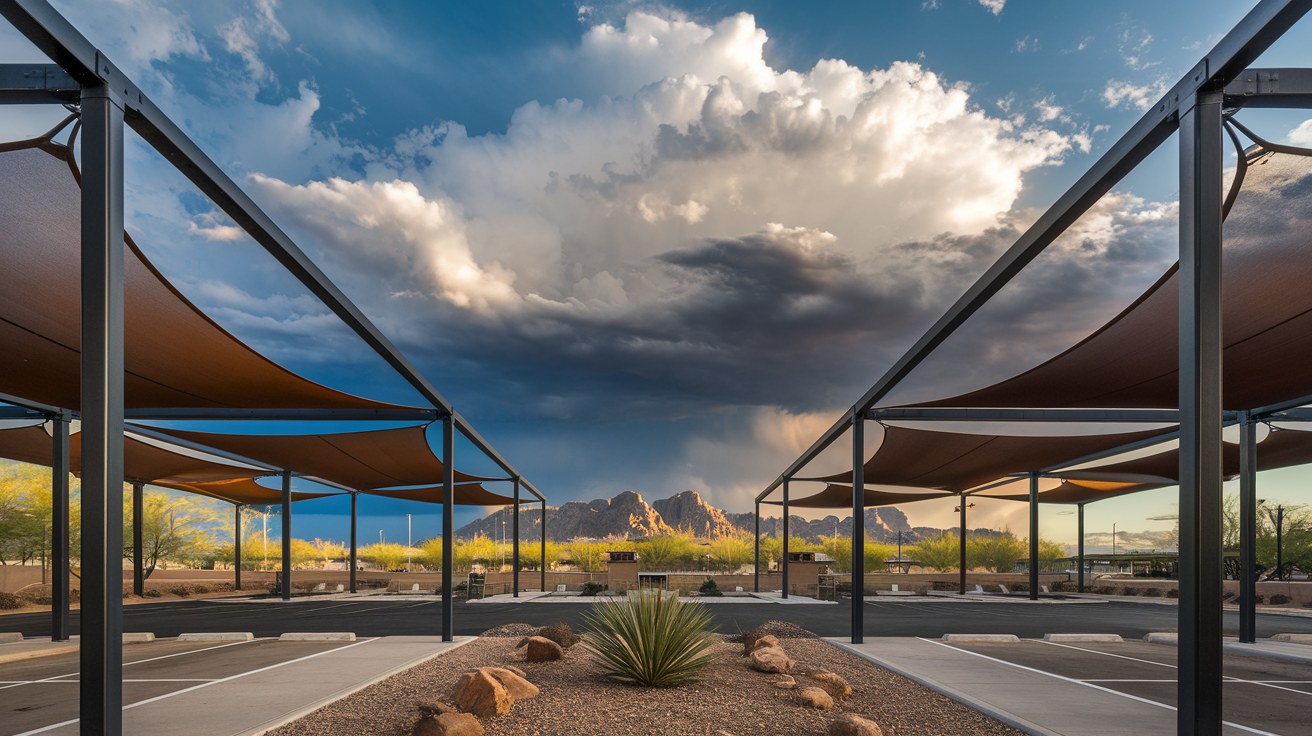
Whatever a buyer chooses, the storm season that opened June 15 applies the same test. The 2026 National Weather Service outlook leans above normal for both Phoenix and Tucson, and the failure mechanism is always the same: an outflow boundary off a collapsing thunderstorm throwing a 50-to-70 mph wall of wind with minutes of warning. Anything spanning a parking lot or a play area takes that load in fully open exposure.
A shade structure in Phoenix or Maricopa County has to be engineered to the ASCE 7-22 wind-load standard adopted under current building codes, with stamped calculations covering the steel, the footings, and the fabric or panel attachment hardware. This is non-negotiable for both products, and it is where the buyer’s scrutiny belongs. We made the full argument in our breakdown of monsoon-ready commercial shade structures in Arizona. The relevant point for this decision is that a solar carport raises the stakes of getting the wind engineering right: it is carrying tens of thousands of dollars in glass and electronics overhead, and a panel that comes loose in an outflow is both expensive debris and an electrical hazard. A fabric structure under-engineered to the same storm fails too — but the fabric’s permeability sheds some wind load by design, and a properly specified structure rated for 90 mph design winds rides the storm out. The lesson is identical for both: demand the stamped engineering and the wind rating for your exact site, not a catalog number.
When a Solar Carport Actually Makes Sense
None of this means solar carports are a bad buy — it means they are a specific buy. There are clear cases where the premium is justified. First, when generating on-site power is a genuine goal, not a rationalization for the shade, the panels turn an otherwise idle parking lot into a producing asset, and the shade comes along for the ride. Second, when EV charging is on the roadmap, a solar canopy is a natural host for charging infrastructure and pairs the two capital projects sensibly. Third, when a building’s sustainability commitments or available energy incentives change the financial picture enough that the energy project pencils out on its own terms. In those situations the right answer may well be solar over the parking field and fabric over everything that does not need power.
The trap is buying the energy project to solve a shade problem because the proposal arrived first and framed shade as free. It is not free. It is the most expensive line item in a solar canopy, dressed up as a bonus.
How to Decide for Your Site
Start by writing down the objective in one sentence before any vendor sizes anything. If the sentence is about kilowatt-hours, get solar bids and make sure the shade engineering is sound. If the sentence is about getting children, residents, diners, or employees out of dangerous sun — and about doing it across multiple areas on a real budget and a summer timeline — price commercial fabric first and treat solar as a separate, deliberate energy decision. The two can absolutely coexist on one campus; they just should not be confused for each other on one purchase order.
From there, the choice among fabric forms follows the site: flat cantilevers for parking and courts where columns can only sit on one edge, hip structures for large open spans over playgrounds and gathering areas, awnings where the cover attaches to an existing building, and a sculptural hypar structure where a signature space wants architecture rather than utility. The full range, and the Arizona projects behind it, are on our products overview and testimonials page.
The Bottom Line
A solar carport and a fabric shade structure look alike from the parking lot, but they answer different questions. One generates power and shades what sits beneath it as a consequence. The other is built to do one job — put people and surfaces in cool, UV-blocked, monsoon-rated shade — and to do it over more square footage per dollar than any structure carrying panels can match. In the hottest spring Phoenix has ever recorded, with the monsoon already open, the worst outcome is funding an energy project by accident when what the site needed was shade. Decide the objective first, then buy the structure that fits it. If your project is about getting Arizona’s sun off the people and places you are responsible for, contact Total Shade today for a site walk, stamped engineering, and a straight answer about which structure your budget should buy.
Sources: Fortune Business Insights commercial solar carport market sizing ($1.18B in 2025, $1.29B in 2026, $2.59B by 2034 at 9.13% CAGR); 2026 commercial solar carport installed-cost figures from EnergySage, SurgePV, and SolarReviews ($3.15–$4.50/watt; ~$3.24/W DC for 200–800 kW commercial systems; carport solar 2–3× rooftop cost); KJZZ and Arizona’s Family reporting on Phoenix’s hottest meteorological spring on record (80.2°F average) and NWS data that nine of the ten hottest Phoenix summers have occurred since 2000; NWS 2026 Arizona Monsoon Outlook (above-normal lean for Phoenix and Tucson; June 15–September 30 season); ASU SHaDE Lab surface-temperature measurements; Skin Cancer Foundation guidance on UV exposure; City of Phoenix and Maricopa County building-code amendments adopting ASCE 7-22; manufacturer specification sheets for Commercial 340/95 HDPE shade fabric.
