Proper tensioning is the single most important factor in a shade sail’s performance, longevity, and appearance. A correctly tensioned sail resists wind, sheds water, looks clean and taut, and lasts significantly longer than one that was installed without attention to this critical detail.
Without adequate tension, shade sails sag in the center, pool water during monsoon season, flap in the wind causing accelerated fabric wear, and stress corners unevenly – increasing the risk of tearing and premature failure. For commercial properties, schools, and municipalities investing in 3-point tensioned fabric sails or 4-point tensioned fabric sails, understanding tensioning principles protects both the investment and the people beneath it.
Total Shade LLC has installed thousands of tensioned shade structures across Arizona and Nevada over the past 25 years. This guide shares everything we have learned about achieving and maintaining proper tension in commercial shade sail applications.
Why Tension Matters for Commercial Shade Sails
Tension is not merely an aesthetic consideration. It is a structural requirement that directly affects safety, durability, and total cost of ownership.
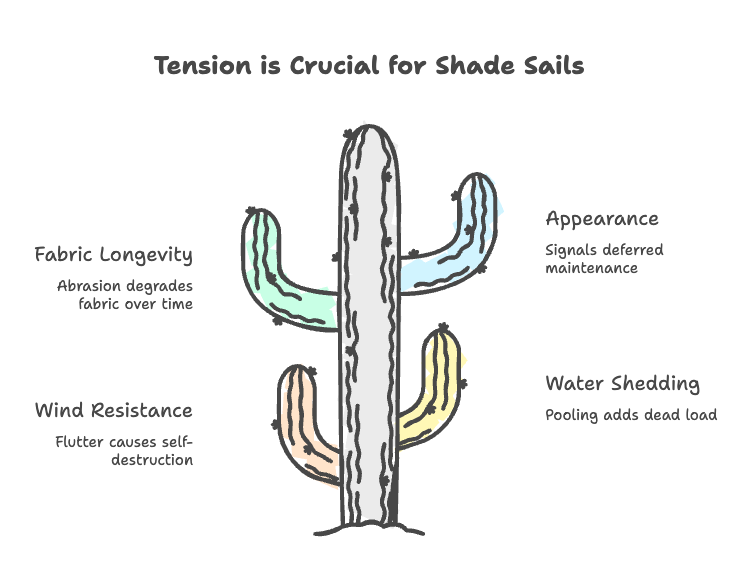
Wind Resistance
A taut shade sail deflects slightly in a gust but immediately snaps back, preventing the self-destructive cycle of flutter. Loose sails catch wind like a parachute, generating forces that can tear fabric, bend poles, or pull anchor hardware from walls and footings. In Arizona’s monsoon season, a poorly tensioned sail becomes a liability.
Water Shedding
Proper tension combined with height variation ensures water runs off toward a lower attachment point rather than pooling in the center. Water accumulation adds hundreds of pounds of dead load to fabric and hardware never designed to carry it. We have seen pools form, stretch fabric permanently, and eventually cause catastrophic failures.
Fabric Longevity
Flutter causes fabric to rub against itself and hardware at every wind event. Over months and years, this abrasion degrades even the best commercial-grade HDPE fabrics. A properly tensioned sail can last 15 or more years; a poorly tensioned one often fails in three to five.
Appearance and Professionalism
For hotels, resorts, schools, and commercial properties, a sagging shade sail sends the wrong message. It signals deferred maintenance and erodes the premium aesthetic that shade structures should deliver. Taut sails look intentional, architectural, and well-maintained.
 The Three Pillars of Shade Sail Tension
Before touching a turnbuckle, understand that tension in a shade sail comes from three interacting factors. Addressing only one while ignoring the others produces poor results.
Perimeter Wire Rope
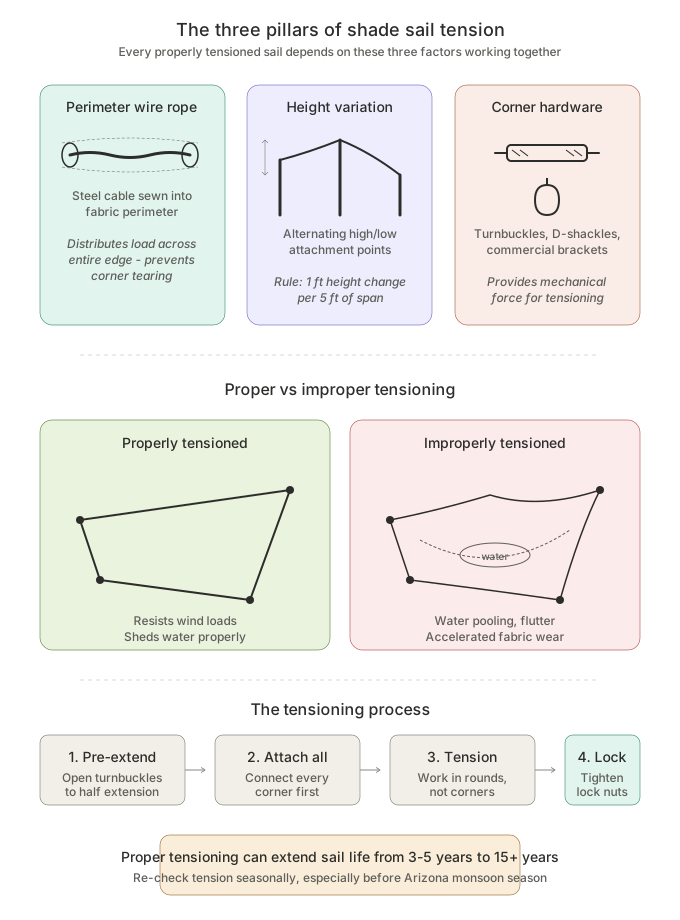
Quality commercial shade sails have a steel cable sewn into a pocket around the entire perimeter. This cable distributes corner forces across the whole edge rather than concentrating stress at attachment points. Without perimeter cable, corners tear and centers sag – regardless of how much hardware tension you apply.
Total Shade LLC fabricates all shade structures with perimeter wire rope as standard. This is not optional for commercial applications.
Height Variation (Hyperbolic Paraboloid Geometry)
Alternating high and low attachment points creates opposing pull forces that naturally suspend and tension the sail’s center. A flat sail will always sag – it is geometrically impossible to tension a fabric membrane mounted at uniform height.
The recommended rule of thumb is one foot of height variation for every five feet of span. A 20-foot sail needs approximately four feet of height difference between its highest and lowest corners. Our hypar shade structures use this same hyperbolic paraboloid geometry to achieve both structural stability and visual interest.
Corner Hardware
Turnbuckles, pulleys, or commercial brackets provide the mechanical force to pull each corner taut after the sail is positioned. Hardware selection depends on sail size, expected loads, and whether the installation is permanent or seasonal.
Tensioning Methods for Commercial Applications
Turnbuckle Method
This is the standard professional approach for permanent commercial installations:
Pre-extend turnbuckles. Before attaching the sail, open each turnbuckle to approximately half of its extension. This gives adjustment range in both directions for initial tensioning and future maintenance.
Attach all corners first. Connect every corner to its anchor point using D-shackles before tensioning any single corner. Use a come-along or pulley system if you cannot reach a corner by hand.
Tension in rounds, not corners. Turn each turnbuckle a few rotations clockwise, then move to the next corner. Keep cycling around the sail, applying a little tension at each corner per pass. This distributes stress evenly and prevents misalignment.
Never fully tighten one corner first. Doing so creates uneven stress points and pulls other corners out of alignment. The sail will never achieve uniform tension.
Use a wrench on the body. Grip the entire body of the turnbuckle with a wrench for leverage. Do not insert a screwdriver through the body – this damages the turnbuckle and reduces its service life.
Lock it off. Once the sail is taut, use a second wrench to tighten lock nuts against the turnbuckle body. This prevents vibration from loosening tension over time.
Pulley Method
Pulleys offer a four-to-one mechanical advantage, making them easier to tension without tools or lubricant. This method works well for seasonal installations where sails will be taken down during monsoon season or winter.
Attach the pulley to the corner of the sail and the anchor point, pull the rope end until taut, and tie off. When it is time to remove the sail, simply release the rope.
Commercial Brackets
For large custom shade structures beyond standard residential sizes, commercial brackets provide up to 18 inches of take-up and are engineered to handle substantially higher load forces. These are standard on most of our commercial installations.
 What Properly Tensioned Looks Like
A correctly tensioned sail should be:
Firm and wrinkle-free across the entire surface. Minor wrinkles at corners where hardware attaches are acceptable; wrinkles radiating across the body of the sail indicate insufficient tension.
Angled so water runs off toward a lower attachment point, not pools in the center. After a rain event, the sail should be dry within an hour.
Taut but not over-strained. You should not see fabric distorting around perimeter cables or hardware pulling away from mounting surfaces. Over-tensioning damages fabric and can pull anchors from walls.
Common Tensioning Mistakes
| Mistake | Why It Is a Problem |
|---|---|
| Tightening one corner fully before others | Creates uneven stress and misaligns the sail permanently |
| Installing at uniform height | Removes hyperbolic geometry, causing center sag regardless of hardware tension |
| Skipping lock nuts on turnbuckles | Vibration loosens turnbuckles over time, reducing tension gradually |
| Over-tightening | Damages fabric, bends poles, or pulls mounting hardware from walls |
| Using unlubricated turnbuckles | Leads to galling and seized threads; always grease threads before tensioning |
| Ignoring perimeter cable condition | Frayed or corroded cable cannot distribute loads, leading to corner failure |
UV Protection and Public Health
Beyond structural considerations, properly tensioned shade sails deliver the UV protection that makes them valuable to schools, parks, and commercial properties in the first place.
The CDC recommends shade as a primary defense against ultraviolet radiation, which causes the most common cancer in the United States. Skin cancer prevention is particularly important for children, who receive a disproportionate share of lifetime UV exposure before age 18.
The EPA notes that UV radiation reaches dangerous levels even on cloudy days and reflects off surfaces like concrete, sand, and water – exactly the surfaces surrounding pools, playgrounds, and outdoor seating areas.
A sagging shade sail provides inconsistent coverage. As the sun moves through the day, gaps open and close unpredictably. Properly tensioned sails maintain their designed coverage pattern, ensuring the UV protection you specified actually reaches the ground.
For employers with outdoor workers, OSHA’s Water-Rest-Shade guidelines emphasize shade as essential for heat illness prevention. Commercial shade structures that sag or flutter undermine compliance with these workplace safety requirements.
Applications Where Tension Is Critical
Certain commercial applications demand particular attention to tensioning:
School playgrounds and lunch areas. Children use these spaces daily, and UV exposure accumulates over years. Sagging creates gaps in coverage exactly when and where children are most exposed.
Pool decks and aquatic facilities. Water reflection intensifies UV exposure. Combined with wet surfaces that can become dangerously hot, consistent shade coverage is essential. Our commercial umbrellas and tensioned sails must maintain their geometry season after season.
Outdoor dining and hospitality. Awnings and shade sails define the guest experience at restaurants, hotels, and resorts. A flapping, sagging sail is incompatible with premium positioning.
Sports facilities and bleachers. Spectators and athletes need predictable shade. Cantilevered shade structures and large-span MAX Hip structures over bleachers must maintain tension under wind loads that would destroy lesser installations.
Parks and municipal facilities. Public spaces see heavy use and limited maintenance budgets. Structures that lose tension and require frequent adjustment are poor investments. Ramadas and hip shade structures with proper initial tensioning require minimal ongoing attention.
Ongoing Maintenance and Re-Tensioning
Re-check tension after the first few weeks of installation. New fabric and hardware will settle and stretch slightly as they work through initial load cycles.
In Arizona’s climate, UV exposure and temperature swings cause fabric to relax more quickly than in temperate regions. A seasonal tension check – especially before summer monsoon season – is good practice. We recommend inspections in April before temperatures peak and again in September after monsoon.
Signs that re-tensioning is needed include visible sag in the center of the sail, water pooling after rain, increased flutter or flapping in wind, and wrinkles that were not present at installation.
If your existing shade sails have lost tension and the fabric is still in good condition, re-tensioning is often sufficient. If fabric has been damaged by prolonged flutter or UV degradation from age, our canopy replacement and repair service can fabricate new sails to fit your existing hardware and posts.
Why Professional Installation Matters
Commercial shade sail tensioning is not a DIY project. The loads involved – hundreds or thousands of pounds of tension per corner – require engineered anchor points, properly sized hardware, and installation techniques that account for wind loads specific to your site.
Arizona building codes require engineered drawings and permits for most commercial shade structures. These calculations assume proper tensioning; an improperly tensioned sail will not perform as engineered and may fail under design wind loads.
Total Shade LLC handles engineering, permitting, fabrication, and installation from our Phoenix facility. Every tensioned structure we build is installed by our own crews – never subcontracted – using techniques refined over 25 years and thousands of installations.
Total Shade LLC: Arizona’s Commercial Shade Experts
Total Shade LLC has designed, fabricated, and installed shade structures for schools, municipalities, HOAs, hotels, resorts, and commercial properties across Arizona and Nevada since 1999. Our project portfolio includes Six Flags Hurricane Harbor, Tumbleweed Park Ballfields, and hundreds of school districts throughout the Valley.
We fabricate all tensioned shade sails in-house at our Phoenix facility using Commercial 340/95 HDPE fabric with up to 96% UV block. Steel columns receive a minimum 3-mil powder coat finish in your choice of colors. Every installation is engineered for Arizona wind loads and permitted through local jurisdictions.
Our client testimonials reflect 25 years of delivering shade structures that perform as promised – and stay tensioned season after season.
Ready to Discuss Your Shade Sail Project?
Whether you need new tensioned shade sails, re-tensioning of existing structures, or replacement fabric for sails that have lost their shape, Total Shade LLC can help.
Contact us for a quote. We will discuss coverage requirements, and provide engineering and pricing for a shade solution that will stay taut, look professional, and protect your visitors for years to come.
Total Shade LLC
2331 W. Holly Street, Phoenix, AZ 85009
Phone: (602) 265-0905
Email: info@totalshadellc.com
