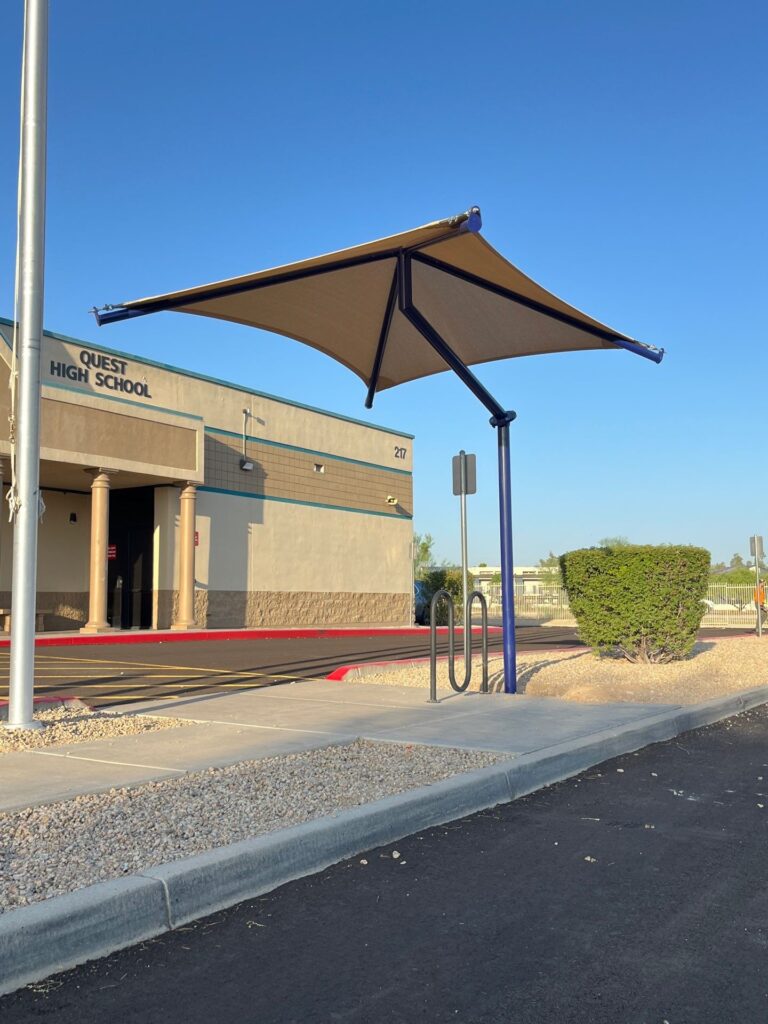
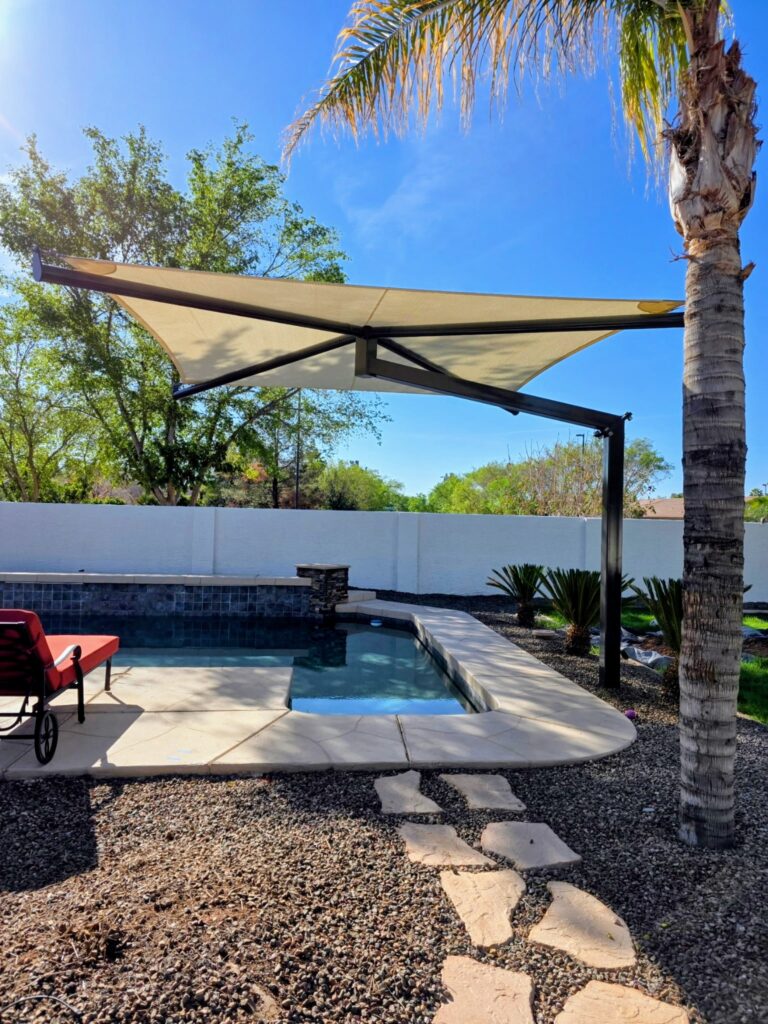
What Is a Commercial Umbrella Shade Structure?
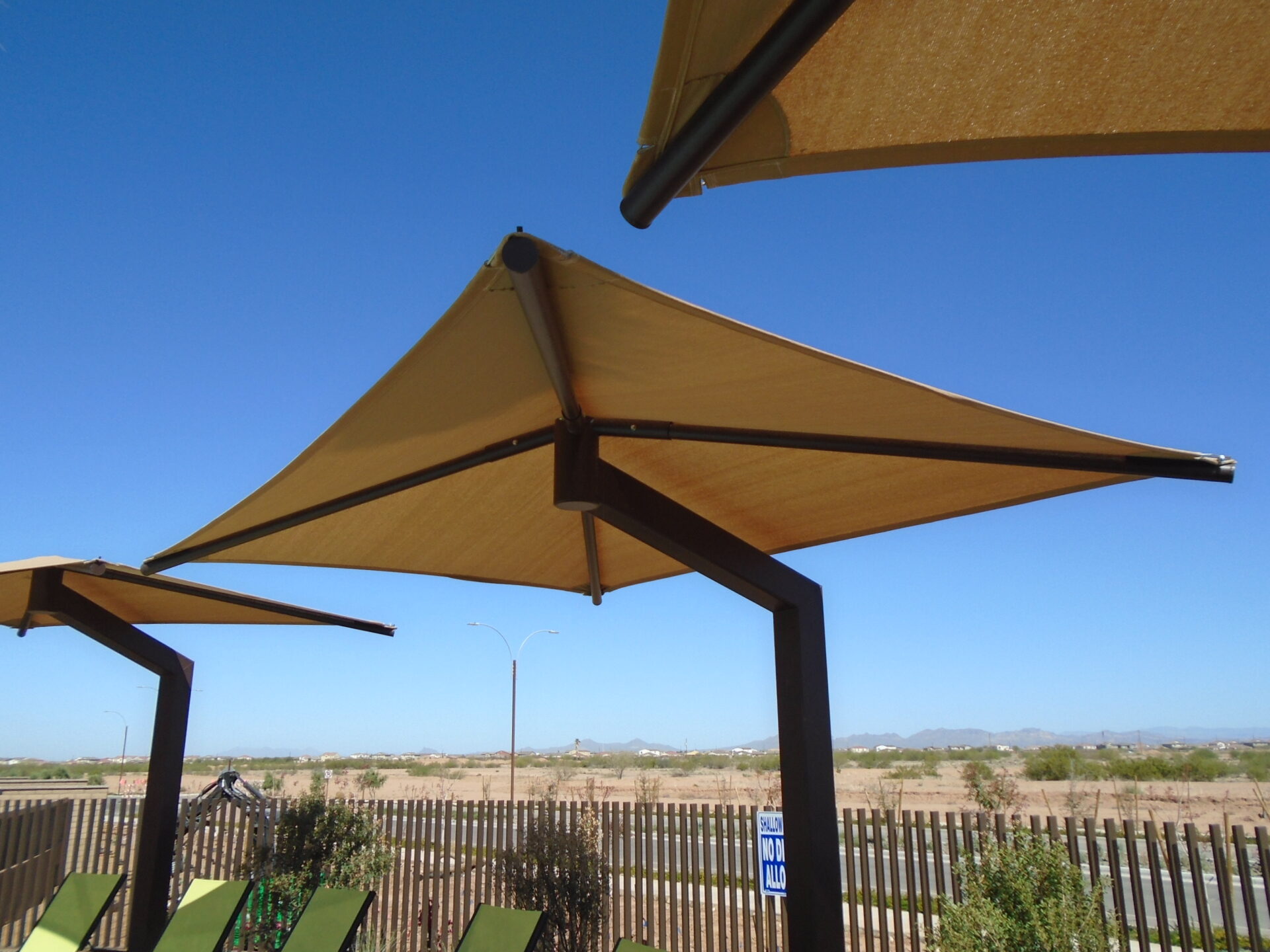
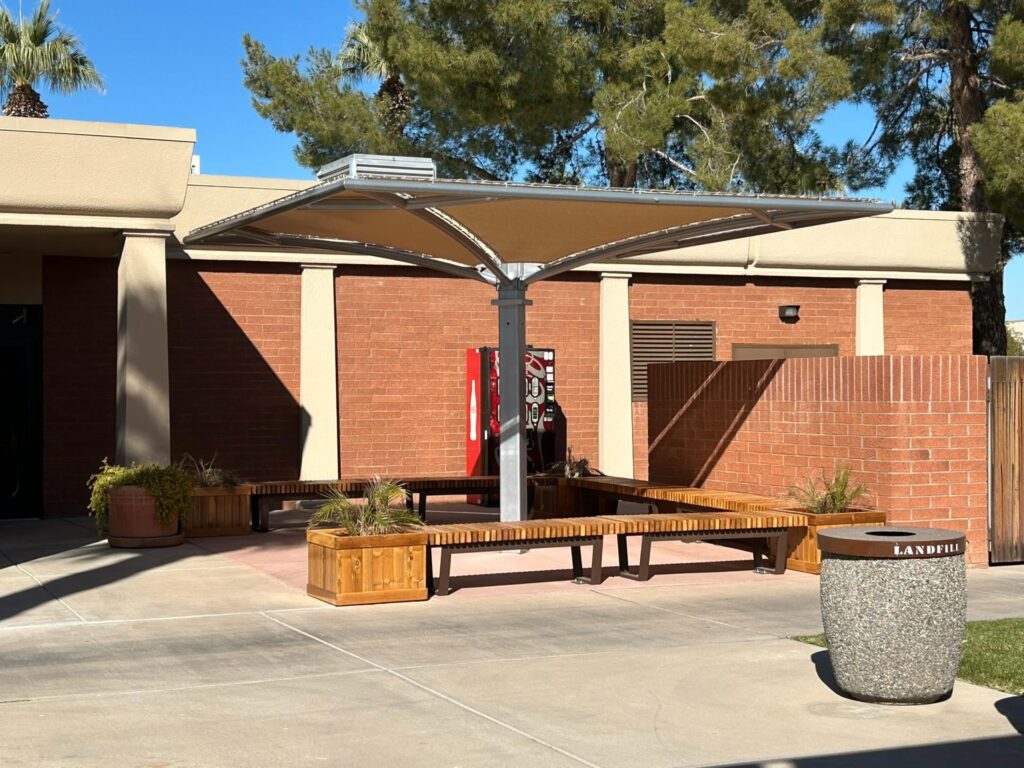
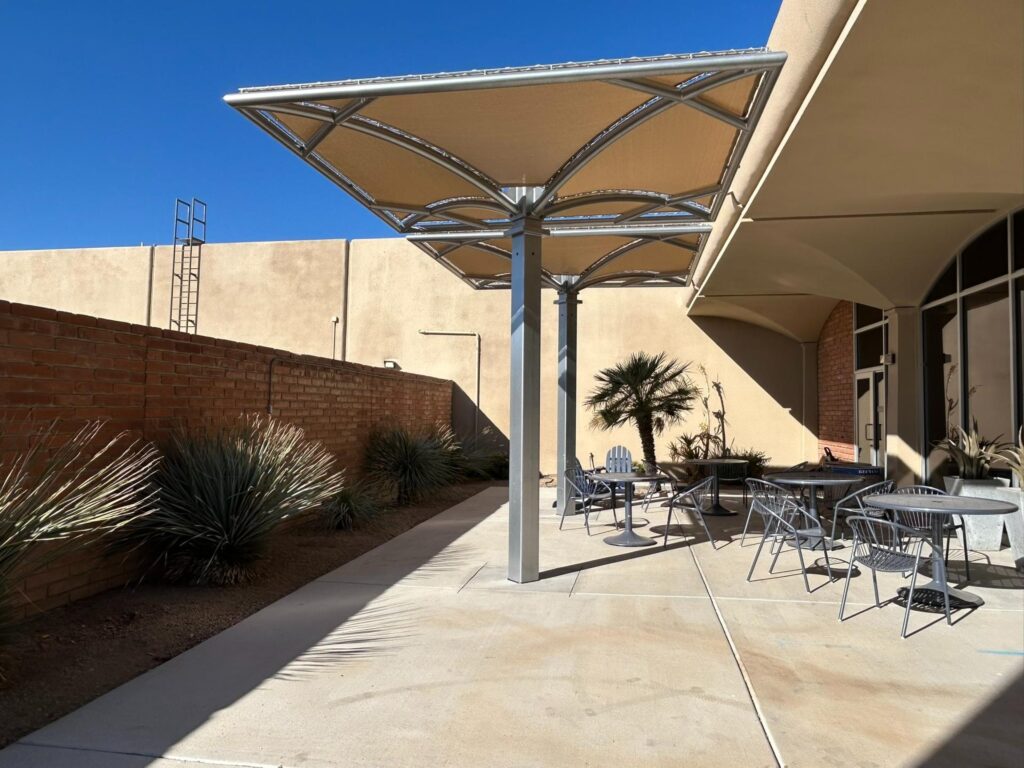
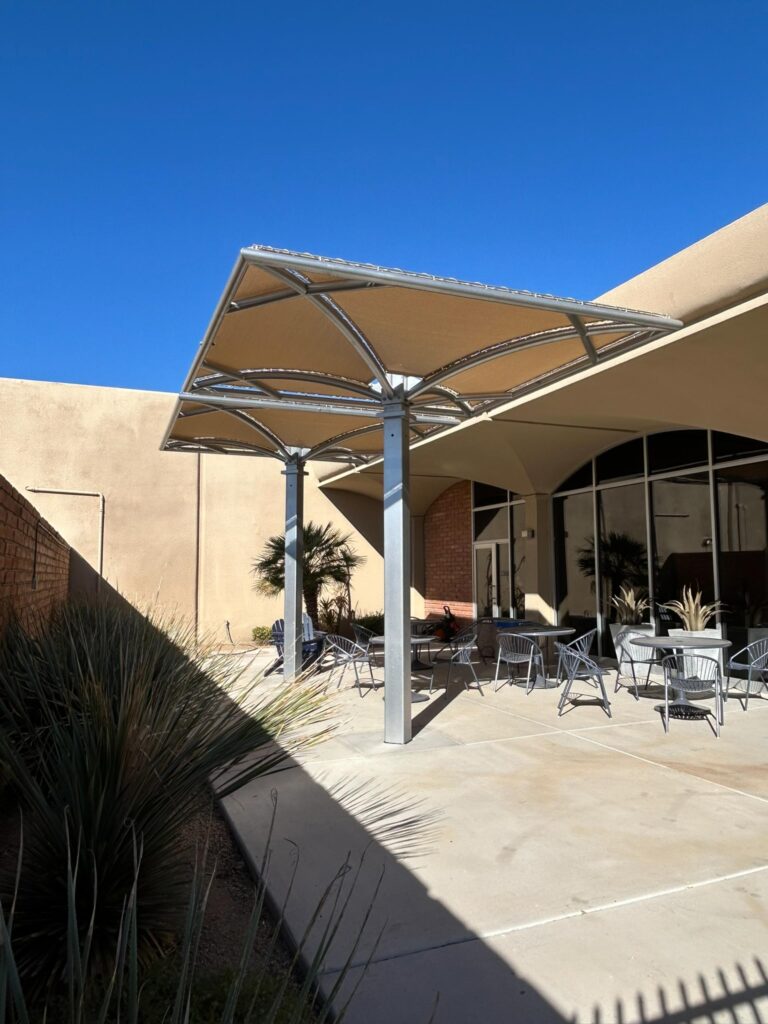
A commercial umbrella shade structure is a freestanding or fixed-post shade canopy supported by a single central pole or an offset cantilever arm. Unlike permanent multi-post shade structures that require engineered footings and sealed drawings, umbrellas can be mounted in weighted bases for full portability, set into in-ground sleeves for a permanent but removable installation, or fixed directly into concrete for maximum stability.
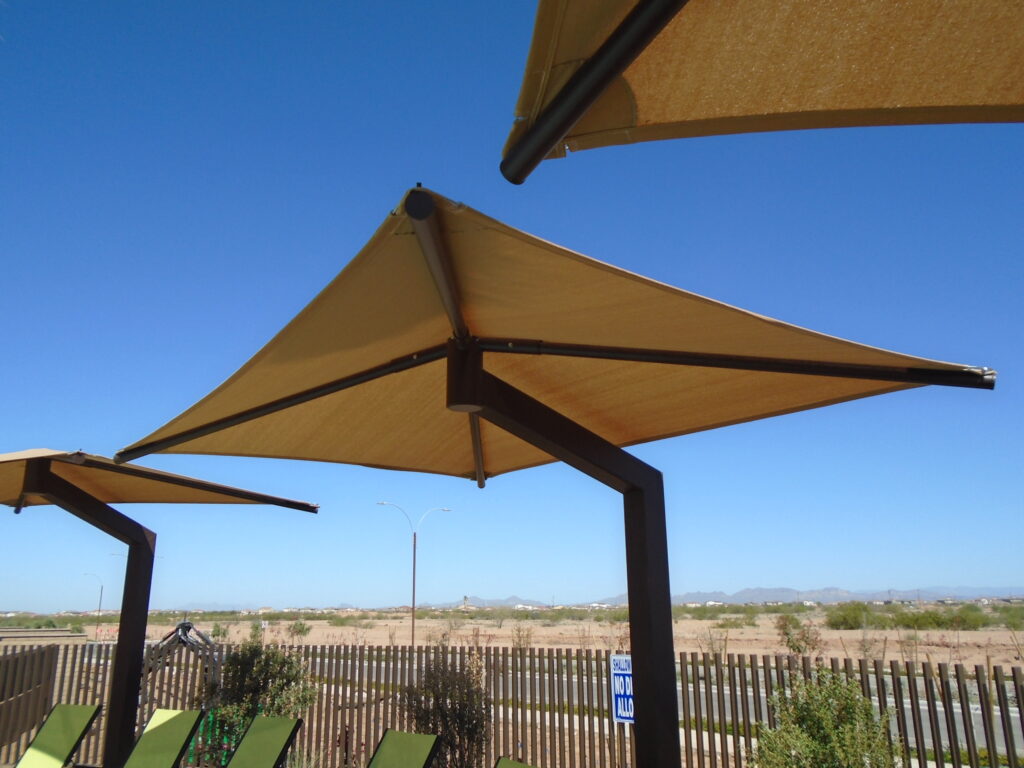
Commercial umbrellas are available in center-post and cantilever configurations. Center-post umbrellas place the pole in the middle of the shaded area — ideal for single-table dining setups or individual seating clusters. Cantilever (offset) umbrellas suspend the canopy from a side-mounted arm, keeping the area beneath completely free of obstructions — better for lounge furniture arrangements, pool deck layouts, and anywhere the center post would interfere with the intended use.
Canopy shapes include round, square, and rectangular, with sizes typically ranging from 7 feet across for single-seat coverage up to 13 feet or larger for multi-table or group shading. Commercial models feature wind vents in the canopy to reduce uplift forces, heavy-duty crank or pulley mechanisms for daily operation, and frames built from powder-coated steel or marine-grade aluminum that can handle thousands of open-close cycles without failure.
When Umbrellas Are the Right Choice
Every shade structure type has a sweet spot. Commercial umbrellas excel in situations where flexibility, portability, or per-table coverage is the priority:
- Dining patios and outdoor restaurants — Each table gets its own dedicated shade canopy that moves with the sun, can be closed during off-hours, and replaced individually if damaged. Umbrellas also offer branding opportunities with custom colors and logo printing on the canopy and valance.
- Pool decks and resort lounge areas — Umbrellas shade individual chaise groups or cabana zones without the permanent footings that pool deck construction makes difficult. Cantilever models keep the pole off to the side so the lounge area stays unobstructed.
- Event venues and seasonal operations — Venues that reconfigure their outdoor space for different events benefit from shade that can be repositioned, collapsed, or stored when not needed.
- Waiting areas and outdoor queues — Quick-deploy shade for customer comfort at retail storefronts, ticket windows, or any space where people stand in direct sun.
- Corporate campuses and break areas — Shading outdoor employee seating and break zones where permanent structures may not be justified or where lease restrictions apply.
- Temporary or phased projects — Properties under development or renovation that need shade now but plan to install permanent structures later.
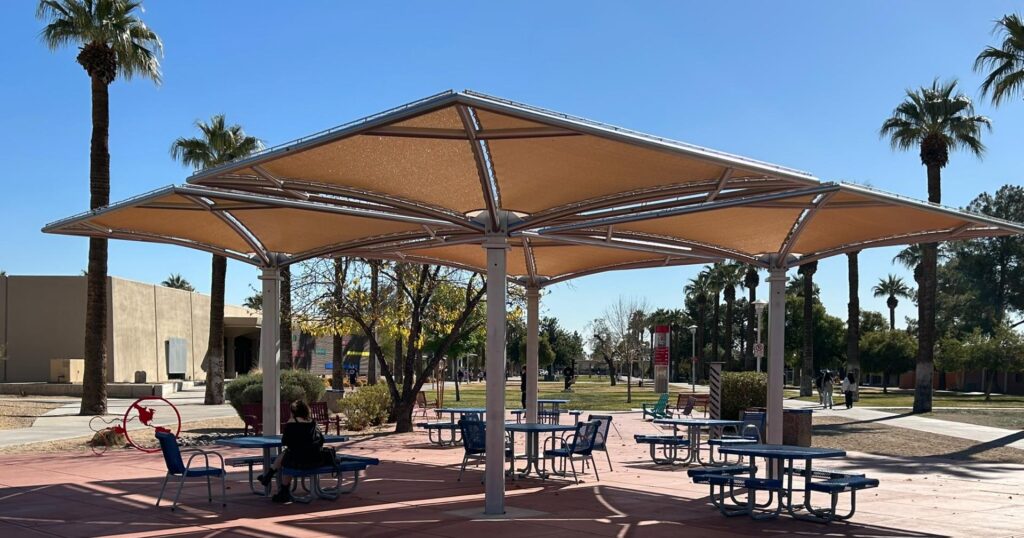
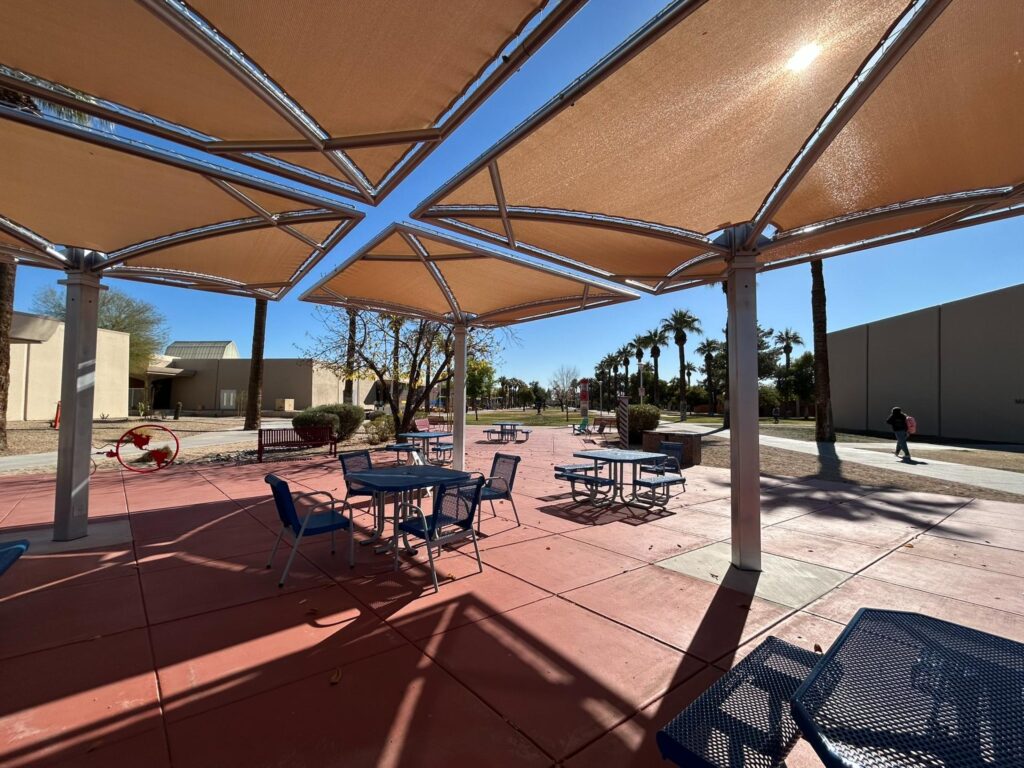
For sites that need larger continuous shade coverage, permanent engineering, or wide-span protection, our hip shade structures, tensioned fabric sails, and flat cantilevered structures are designed for those applications. For the largest spans, see our MAX Hip structures.
UV Protection and Public Health
The Centers for Disease Control and Prevention (CDC) recommends shade as a frontline defense against ultraviolet radiation, advising businesses, schools, and public facilities to provide shaded areas where people spend time outdoors. For restaurants and hospitality venues, providing effective shade over dining and lounge areas is both a guest comfort issue and a health responsibility.
The U.S. Environmental Protection Agency (EPA) reports that one in five Americans will develop skin cancer, with unprotected UV exposure being the most preventable risk factor. The EPA advises seeking shade during peak UV hours between 10 a.m. and 4 p.m. — precisely the hours when outdoor dining and poolside activity peak in Arizona.
For employers with outdoor workers or customer-facing staff, OSHA’s Water-Rest-Shade guidelines identify shade as a core element of heat illness prevention. Commercial umbrellas over break areas, valet stations, and service points provide the cool recovery space OSHA recommends.
In Arizona’s climate, where summer surface temperatures on exposed concrete can exceed 160 degrees F, shade does not just protect skin — it determines whether an outdoor space is usable at all during the months that matter most for hospitality revenue.
Materials and Construction
Frames
Commercial umbrella frames must survive daily operation, sustained UV exposure, wind events, and years of outdoor weather without warping, corroding, or failing at the joints. The frame is the structural backbone — it is not the place to cut costs. Total Shade specifies commercial-grade frames built from powder-coated steel or heavy-duty aluminum, with reinforced hubs, stainless steel hardware at all pivot and connection points, and mechanisms rated for thousands of open-close cycles.
Residential-grade frames use thinner wall tubing, lighter-duty hinges, and plastics at stress points that crack and fail within a season or two of Arizona sun. The cost difference between a residential and commercial frame is modest compared to the cost of frequent replacements and the liability risk of a collapsed umbrella in a crowded dining area.
Canopy Fabric
Canopy fabric for commercial umbrellas must deliver high UV block, resist fading and degradation from sustained sun exposure, and withstand the repeated stresses of opening, closing, and wind loading. We specify UV-stabilized fabrics — including HDPE mesh, solution-dyed acrylic, and coated polyester — selected to match each project’s UV-blocking requirements, color and branding goals, and expected service life.
For applications where the canopy fabric must meet specific fire ratings, we offer FR-rated options certified to NFPA 701 and CSFM 1237.1 — important for installations near grills, fire features, heaters, or building facades where local fire codes apply.
Commercial canopy fabrics are available in a wide range of colors, and many can accommodate custom logo printing or brand-specific color matching — a significant advantage for restaurants, resorts, and branded venues that use their outdoor space as an extension of their identity.
When canopy fabric wears out before the frame does, our in-house sewing team can fabricate replacement canopies to extend the life of your existing umbrella hardware.
Mounting and Base Options
How an umbrella is anchored determines its stability, portability, and safety. Commercial installations typically use one of three mounting approaches:
- Weighted freestanding bases — Heavy steel or concrete-filled bases that hold the umbrella in place without penetrating the surface. Fully portable and ideal for patios, pool decks, and leased spaces where ground modification is not permitted. Bases must be heavy enough to resist wind loads — typically 100 pounds or more for commercial-size canopies in Arizona wind conditions.
- In-ground sleeves — A permanent steel sleeve set into concrete below grade, into which the umbrella pole drops. This provides maximum stability while still allowing the umbrella to be removed for storage, servicing, or seasonal closure. The preferred option for permanent dining patios and public facilities.
- Direct concrete mount — The umbrella pole is fixed permanently into a concrete footing. Most stable option, but the umbrella cannot be removed or repositioned. Used where wind loads are highest or where the umbrella will never need to be relocated.
Design Considerations for Arizona’s Climate
Deploying commercial umbrellas in Arizona’s desert environment requires attention to factors that do not apply in milder climates:
- Wind management — Arizona’s monsoon season produces sudden, violent gusts that can destroy improperly anchored umbrellas in seconds. Wind vents in the canopy are essential, not optional. Base weight must be calculated for local gust speeds, not just average wind. Operational protocols should include closing and securing umbrellas when wind warnings are issued — a detail that matters for staff training, not just product selection.
- Sun path and orientation — Arizona’s intense afternoon sun from the west creates the worst heat conditions. Umbrella placement should account for shifting shade angles throughout the day so guests remain covered during peak dining and pool hours, not just at noon.
- UV degradation — Arizona’s UV index regularly reaches extreme levels. Canopy fabrics without proper UV stabilization will fade and degrade within a single season. Specify solution-dyed or UV-stabilized fabrics with documented UV-block ratings and manufacturer warranties against degradation.
- Heat on materials — Metal frames and mechanisms reach temperatures that can burn skin during summer months. Powder-coated or anodized finishes reduce surface heat absorption compared to bare metal, and operational handles should be positioned where staff can reach them without contacting sun-heated components.
- Daily operations — Commercial umbrellas in Arizona need to be opened and closed daily, and sometimes multiple times per day in response to wind conditions. Mechanisms must be commercial-grade with reinforced gears, stainless steel cables, and hubs designed for high-cycle use.
Site Planning and Layout
Getting the most value from a commercial umbrella installation requires planning that goes beyond choosing a canopy size:
- Coverage per unit — Umbrellas should extend several feet beyond the table or seating area in every direction to keep occupants shaded as the sun moves. A common mistake is sizing the umbrella to match the table — the shade footprint must exceed the table footprint to provide meaningful protection throughout service hours.
- Quantity and spacing — Map out the exact number of units needed, accounting for adequate spacing between umbrellas for circulation, service access, door swings, and fire egress paths.
- Center-post vs. cantilever — Seated dining setups typically work well with center-post umbrellas where the pole passes through a table hole. Lounge areas, pool decks, and flexible-furniture zones benefit from cantilever models that keep the shaded area completely open.
- Mounting logistics — Determine whether the site allows ground penetration for in-ground sleeves or requires surface-mounted weighted bases. Pool decks, rooftop patios, and leased properties often restrict excavation.
- Color and branding — Select canopy colors that reinforce your brand and complement the surrounding architecture. Custom logo printing is available for restaurants, resorts, and branded venues that want their shade to double as a marketing asset.
Not sure whether umbrellas or a permanent structure is the better fit? Explore our full range of shade products, including 4-point tensioned fabric sails, hypar structures, ramadas, and custom designs.
Understanding Total Cost of Ownership
Commercial umbrellas have a lower upfront cost per unit than permanent shade structures, but they also have a shorter replacement cycle and higher per-unit maintenance overhead. Smart buyers evaluate the total cost of ownership over the expected service life of the umbrella system — typically 5 to 10 years for frames and 3 to 7 years for canopy fabric, depending on quality and Arizona exposure conditions.
| Cost Category |
What It Includes |
Why It Matters |
| Umbrella Units |
Frame, canopy, mechanism, and any logo or custom color work |
Unit quality determines replacement frequency; commercial-grade costs more upfront but lasts far longer than residential |
| Bases or Mounting |
Weighted bases, in-ground sleeves, or direct concrete mounts |
Mounting type affects stability, portability, and any required concrete work |
| Installation |
Assembly, base placement or sleeve setting, and initial setup |
In-ground sleeves require excavation and concrete; weighted bases require minimal setup |
| Replacement Canopies |
New fabric panels when UV degradation or storm damage requires replacement |
Plan for canopy replacement every 3-7 years in Arizona conditions; availability of matching replacement fabric matters |
| Ongoing Maintenance |
Cleaning, mechanism lubrication, hardware inspection, off-season storage and protective covers |
Regular maintenance extends service life; neglected umbrellas fail prematurely and create liability |
| Operational Labor |
Daily opening, closing, and securing; storm response protocols |
Unlike permanent structures, umbrellas require daily staff interaction — factor this into the total cost picture |
Umbrellas vs. Permanent Shade Structures
One of the most common questions commercial buyers ask is whether they should invest in umbrellas or a permanent shade structure. The right answer depends on the specific site, use case, and budget. Here is how they compare on the factors that matter most:
| Factor |
Commercial Umbrellas |
Permanent Shade Structures |
| Upfront cost |
Lower per unit |
Higher (engineering, steel, footings, installation) |
| Lifespan |
5-10 years (frames); 3-7 years (canopies) |
15-25+ years with proper maintenance |
| Flexibility |
Repositionable, removable, storable |
Fixed in place; requires engineering to relocate |
| Coverage area |
Individual tables or small groups |
Large continuous areas (hundreds to thousands of sq ft) |
| Daily operations |
Require daily opening, closing, and storm response |
No daily interaction required |
| Wind performance |
Must be closed or secured in high wind |
Engineered for rated wind speeds; stays in place during storms |
| Branding |
Excellent — logo printing on canopy and valance |
Limited to fabric and post color selection |
| Permitting |
Often not required for portable units |
Typically required; sealed engineering drawings needed |
In many cases, the best approach is a combination — permanent structures for large, high-traffic shade zones and umbrellas for individual dining positions, flexible lounge areas, and seasonal overflow. We help you determine the right mix during the consultation process.
What to Compare When Evaluating Proposals
| Your Question |
What You’re Really Comparing |
Why It Matters |
| Is the frame commercial-grade? |
Steel gauge, hub reinforcement, mechanism quality, hardware material |
Residential frames fail within 1-2 Arizona seasons; commercial frames last 5-10 years |
| What fabric and UV rating? |
UV-block percentage, colorfastness rating, UV degradation warranty |
Determines how long the canopy performs before needing replacement |
| How is it mounted? |
Base weight, sleeve depth, wind resistance of the mounting system |
An umbrella that blows over in a gust is a liability, not an amenity |
| Are replacement canopies available? |
Whether the vendor stocks matching replacement fabric for the specific model |
Without available replacements, a worn canopy means replacing the entire umbrella |
| What warranty coverage? |
Frame warranty vs. fabric warranty vs. mechanism warranty |
Different components have different lifespans; know what is covered and for how long |
| What’s the total cost? |
Units + bases + install + replacement canopies + maintenance over 5-10 years |
Cheap umbrellas replaced every year cost more over 5 years than quality units maintained properly |
Why Work with Total Shade LLC?
- 25+ years of commercial shade experience — We have supplied and installed umbrella shade systems for restaurants, resorts, HOAs, churches, corporate campuses, and major brands across Arizona and the Southwest.
- Commercial-grade products only — We do not sell residential umbrellas. Every unit we supply is built for the demands of daily commercial operation in Arizona’s climate.
- Full shade system consultation — We help you determine whether umbrellas, permanent structures, or a combination is the right solution for your site. Our goal is the best outcome for your property, not the biggest sale.
- In-house canopy fabrication — Our Phoenix sewing facility can produce replacement canopies when your umbrella fabric reaches the end of its service life, extending the value of your frame investment.
- Single source for all shade types — If your site needs umbrellas for the dining patio and a hip structure over the playground, we handle both under one contract with one point of contact.
Read what our clients say on our testimonials page.
Get a Free Consultation for Your Umbrella Shade Project
Whether you need a handful of patio umbrellas or a full site plan combining umbrellas with permanent shade structures, Total Shade LLC is here to help. We will evaluate your site, discuss your coverage and branding goals, recommend the right products, and provide a detailed proposal — all at no cost or obligation.
Call us today: (602) 265-0905
Email: info@totalshadellc.com
Submit a Project Inquiry Online →
Total Shade, Total Solution!