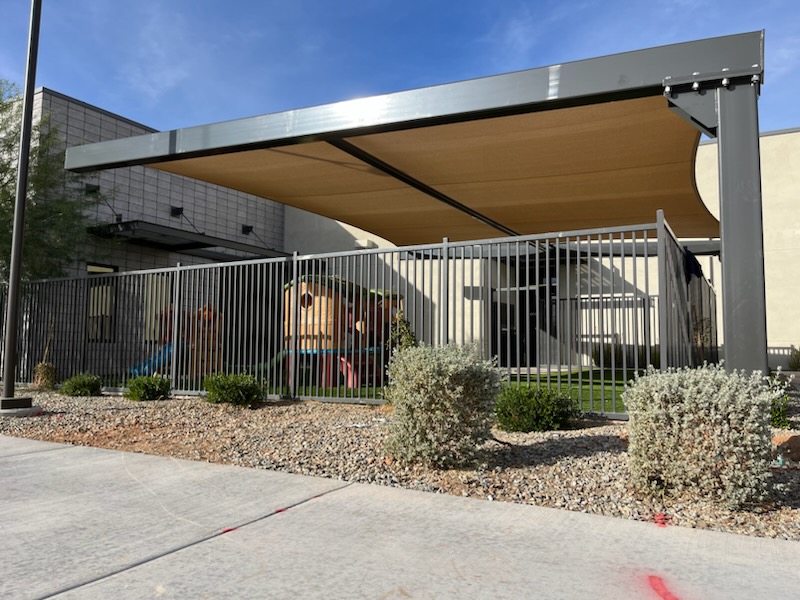
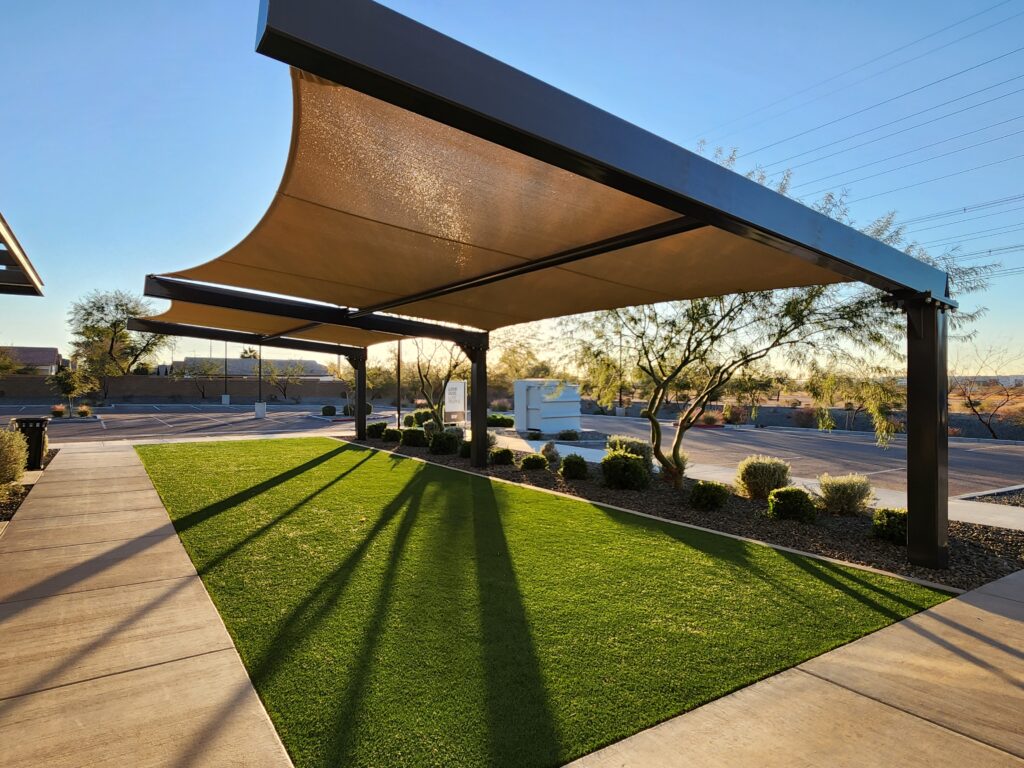
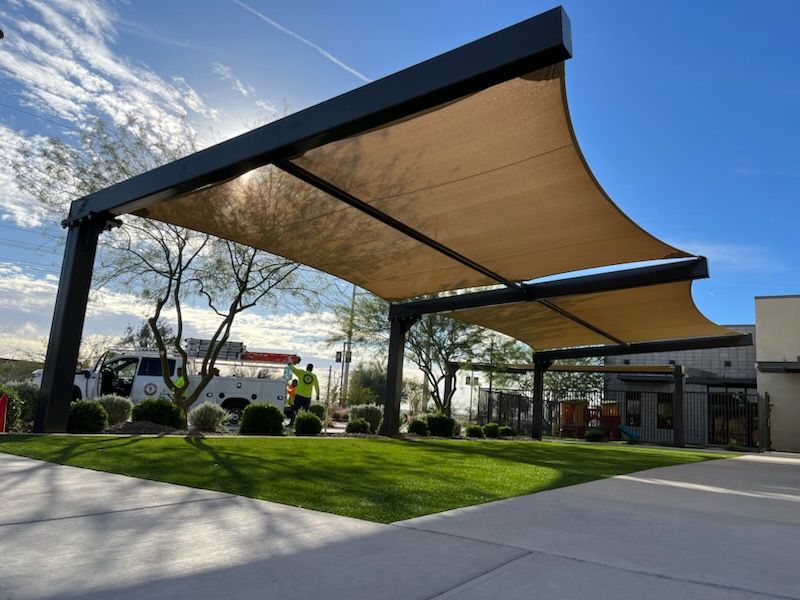
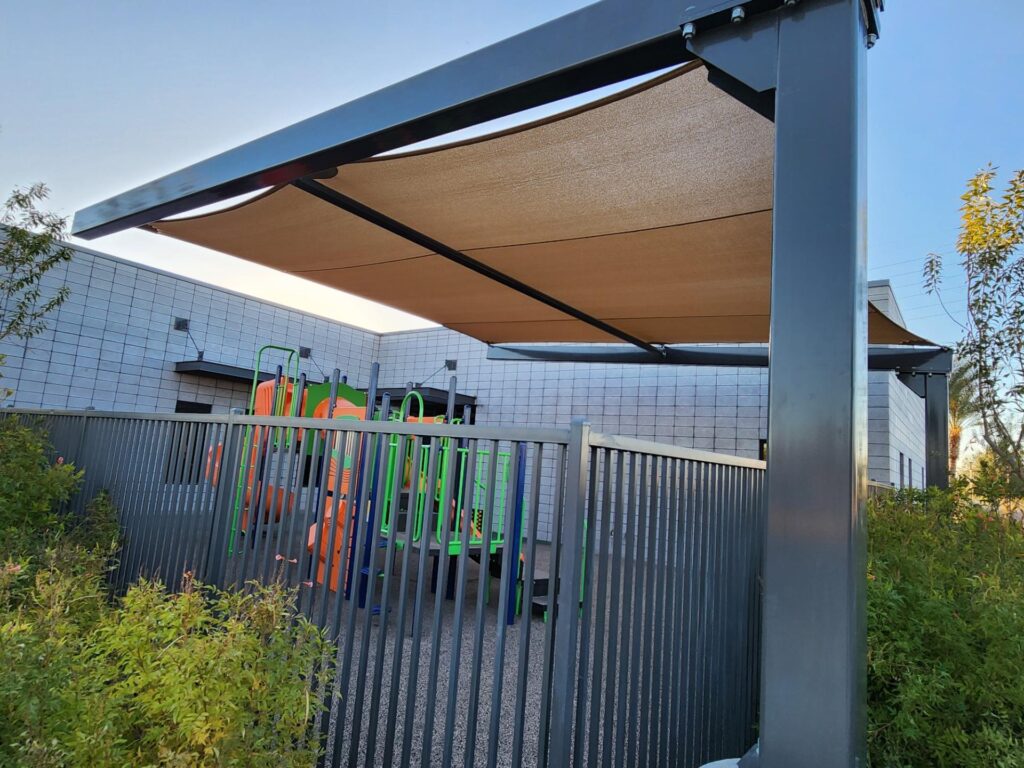
What Is a Flat Cantilevered Shade Structure?
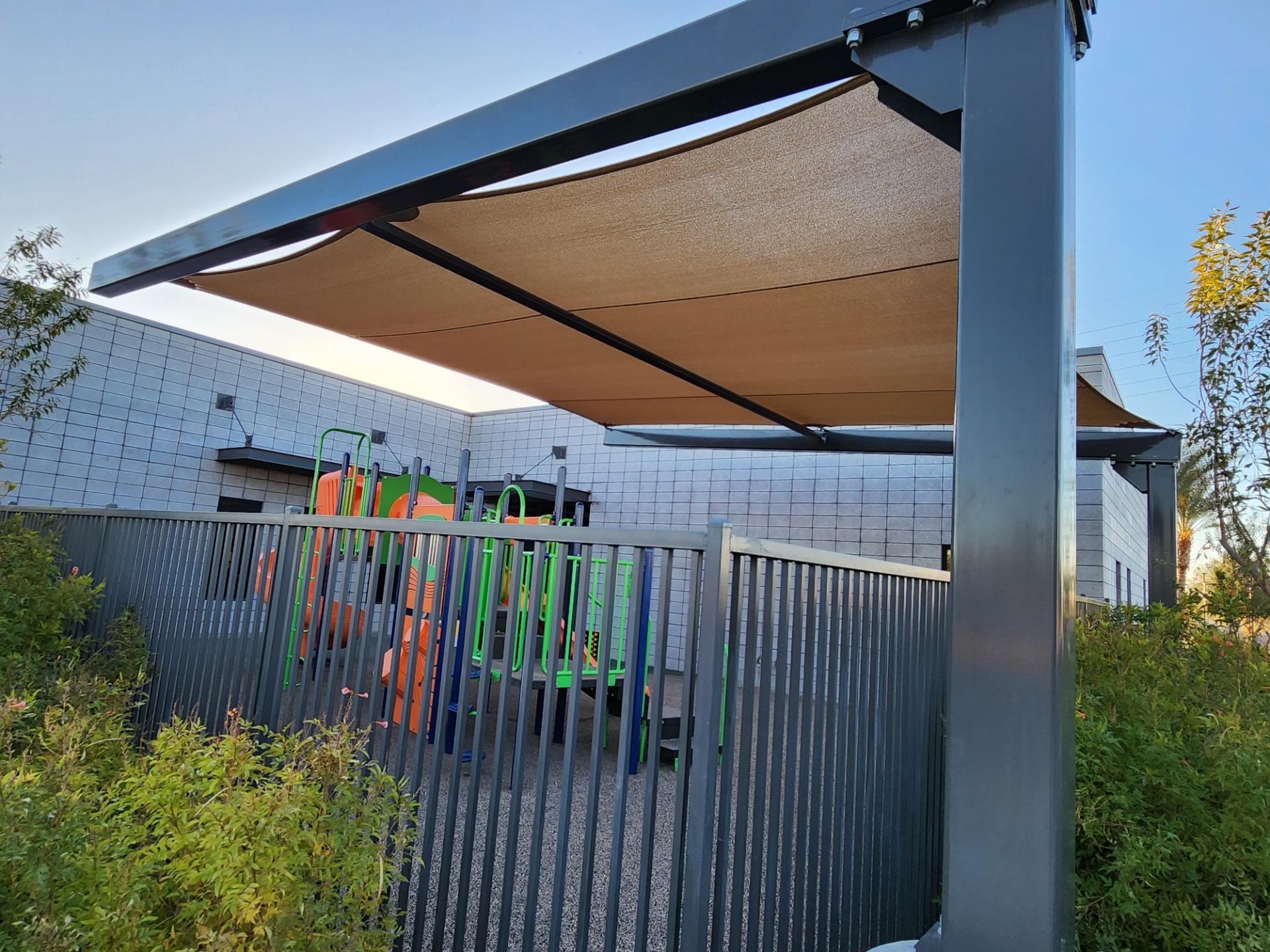
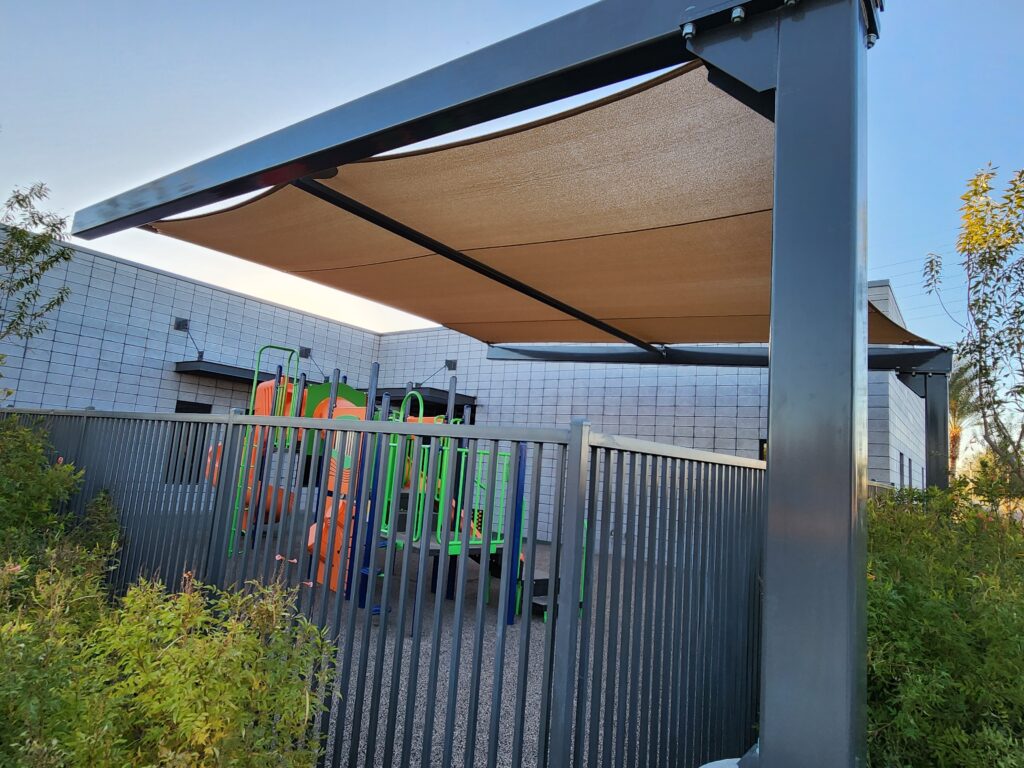
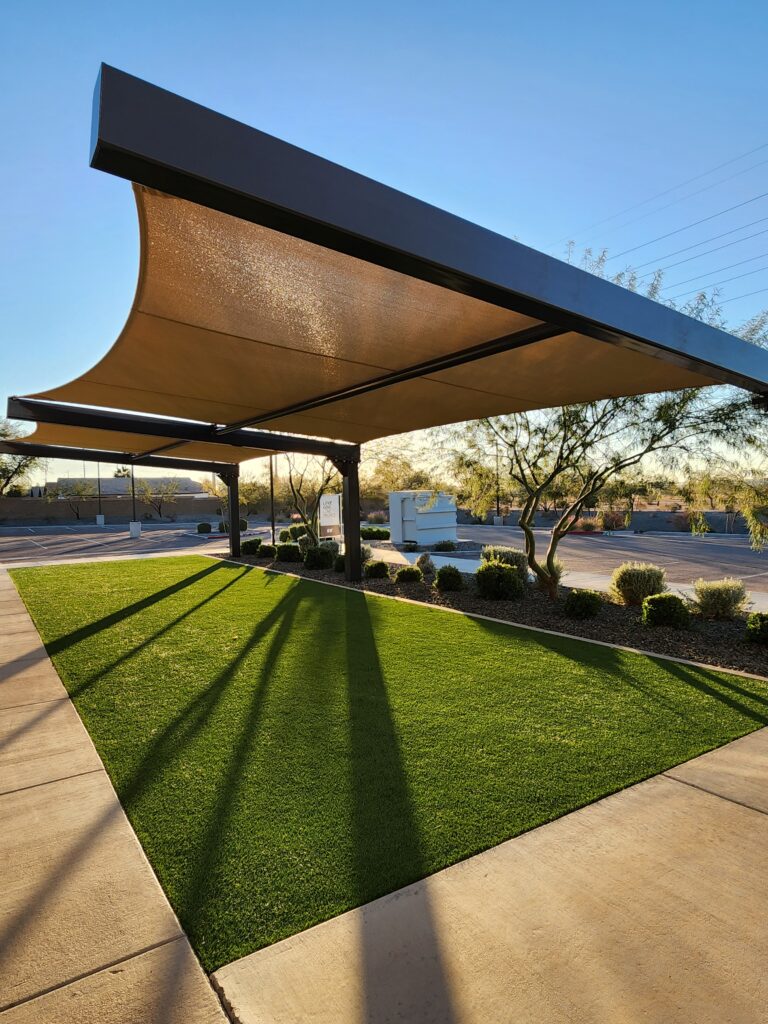
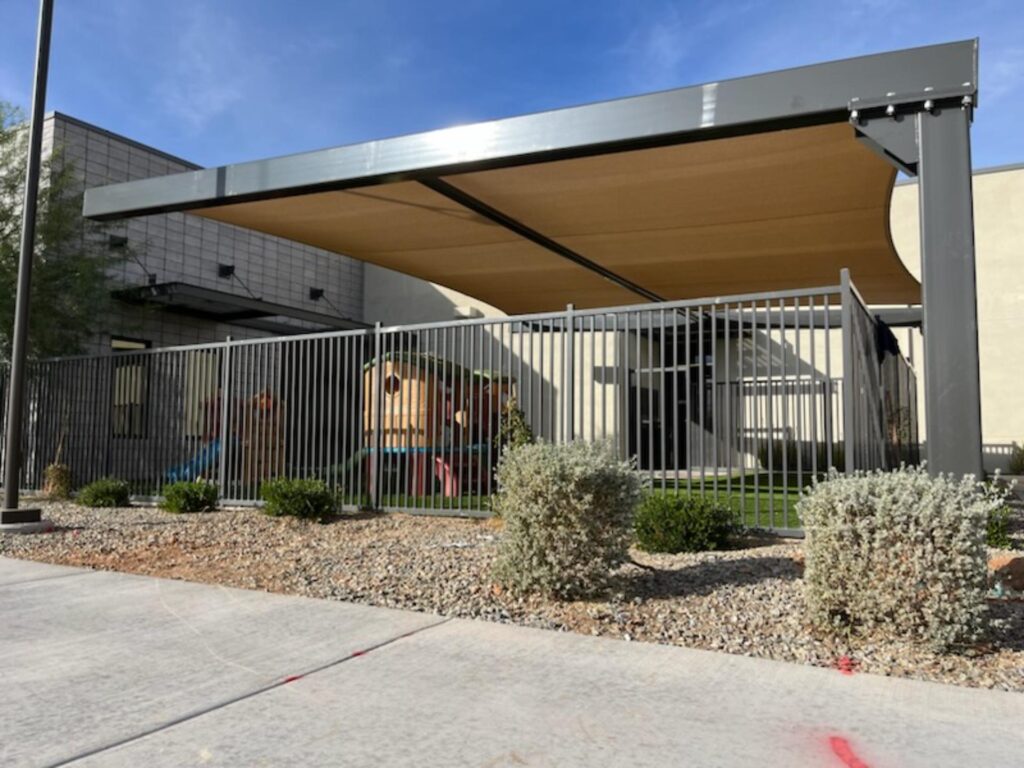
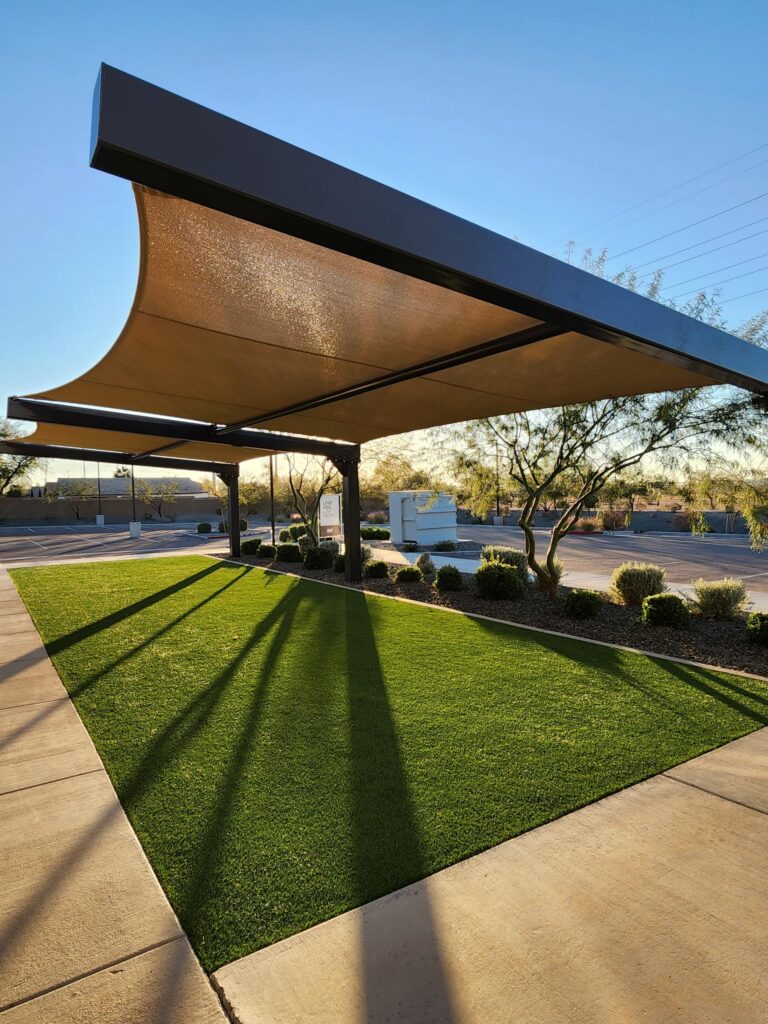
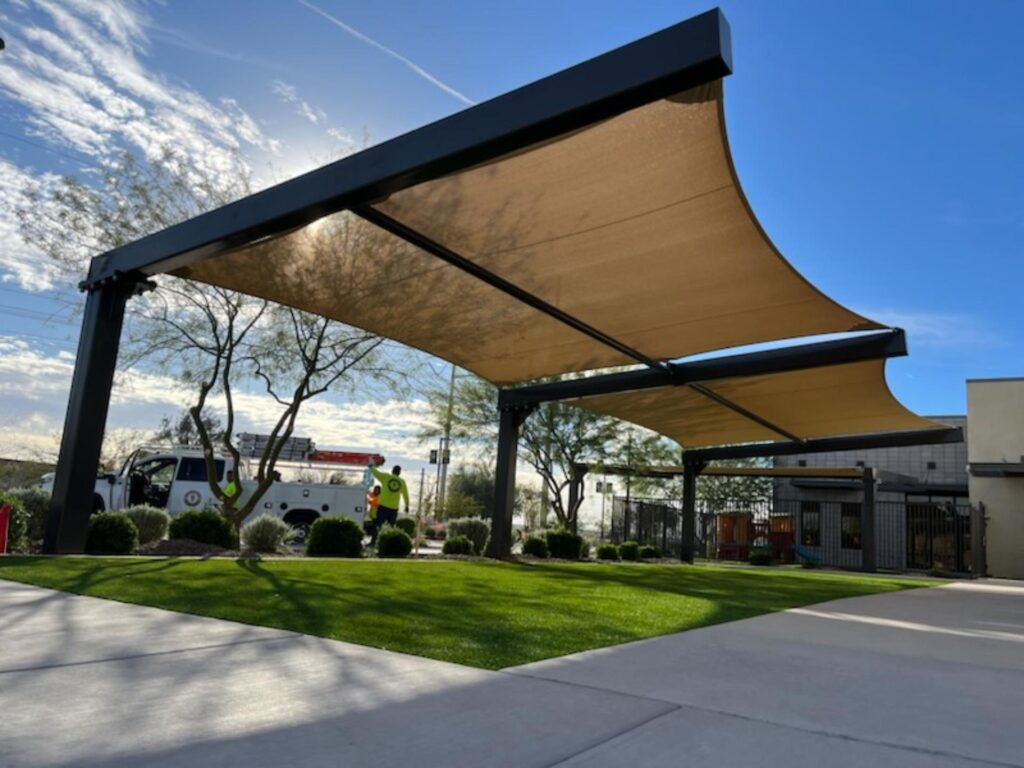
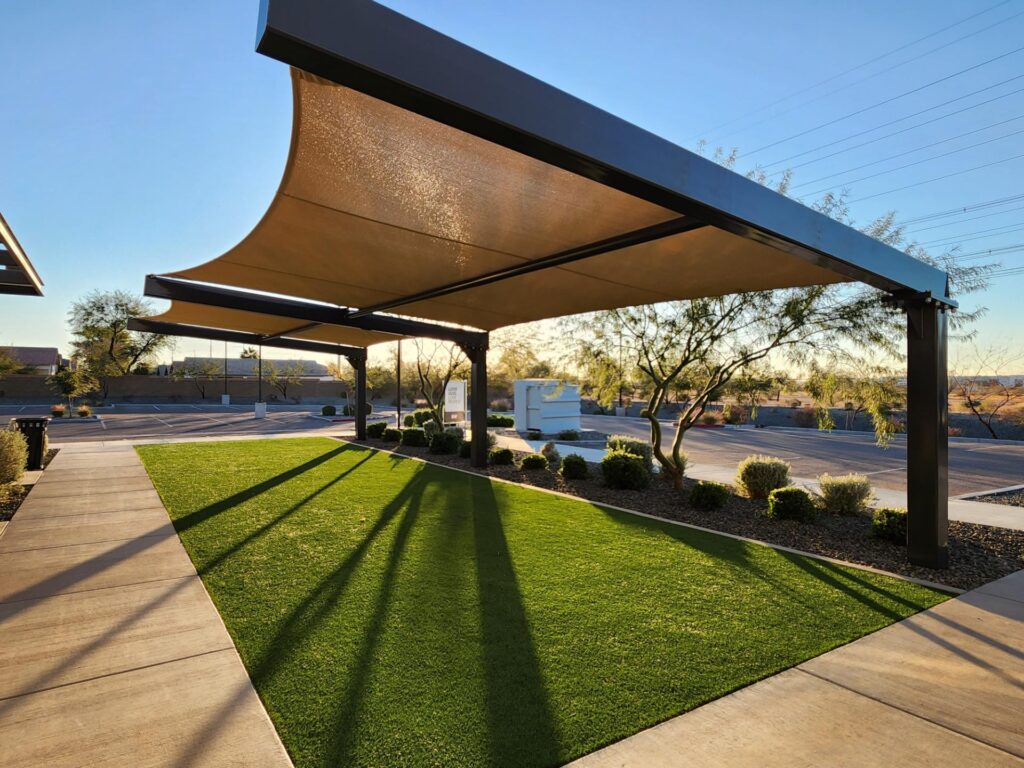
A flat cantilever shade is a steel-framed structure with all support columns located on one side only. The canopy — either tensioned HDPE shade fabric or a rigid panel — projects outward from the columns in a flat or slightly pitched profile, shading the area in front without any posts interrupting the covered space. This open-front design is what makes the cantilever uniquely suited for applications where columns in the middle of the shaded area would create hazards, obstruct circulation, or interfere with the intended use.
Cantilever structures can be installed as single bays or connected in multi-bay runs to cover long stretches of parking, extended bleacher seating, or continuous walkways. The canopy projection — how far the shade extends from the columns — typically ranges up to approximately 18 to 20 feet per bay, depending on wind loads, steel sizing, and the specific engineering of the structure.
While the flat canopy provides a sleek, modern profile, most cantilever installations incorporate a slight pitch to promote water runoff and prevent ponding — a critical detail in any region that experiences sudden, heavy rainfall like Arizona’s monsoon season.
Why Choose a Cantilever Over Other Shade Structures?
The flat cantilever solves a specific problem that multi-post structures cannot: it keeps the shaded area completely free of columns. This matters in situations where:
- Vehicles need unobstructed access — Parking lots, drive-through lanes, car dealerships, and fleet staging areas cannot have posts where cars, trucks, or buses need to maneuver. Cantilever columns sit behind the curb or at the back of the parking bay while the canopy projects out over the vehicles.
- Spectators need clear sightlines — Bleachers, grandstands, and outdoor event seating require overhead shade without columns blocking the view. A cantilever behind the top row projects shade forward over every seat.
- Pedestrian circulation cannot be interrupted — Walkways, building entries, bus stops, loading zones, and drop-off areas need shade overhead without posts in the path of foot traffic.
- Pool decks and wet areas need open floor plans — Columns in a pool deck create trip hazards and interfere with lounge furniture layouts. A cantilever at the deck edge shades the seating zone while keeping the surface clear.
- ADA accessibility requires unobstructed paths — Cantilever designs eliminate the post-placement conflicts that multi-column structures can create in tight or code-regulated circulation zones.
For sites where columns in the middle of the shaded area are acceptable, our hip shade structures and MAX Hip structures deliver broader coverage at a lower cost per square foot. For sculptural shade with more design flexibility, see our 3-point and 4-point tensioned fabric sails.
UV Protection, Heat Safety, and Compliance
The Centers for Disease Control and Prevention (CDC) recommends shade structures as a primary defense against ultraviolet radiation, particularly in schools, parks, and public facilities where children and outdoor workers spend extended time in direct sun. The CDC notes that most of a person’s lifetime UV exposure occurs before age 18, making shade over playgrounds, athletic venues, and outdoor gathering areas a public health priority.
The U.S. Environmental Protection Agency (EPA) reports that one in five Americans will develop skin cancer, with unprotected UV exposure being the most preventable risk factor. For parking lots and vehicle staging areas, shade structures also reduce interior vehicle temperatures — a significant safety and comfort issue in Arizona, where unshaded vehicle cabins can exceed 150 degrees F during summer months.
For employers, OSHA’s Water-Rest-Shade guidelines identify shade as a core element of heat illness prevention for outdoor workers. A cantilever over a loading dock, break area, or vehicle staging zone provides the cool recovery space OSHA recommends while keeping the work area free of column obstructions.
Common Applications
The flat cantilever’s column-free coverage makes it the right choice for a specific set of commercial applications:
- Parking lots and covered parking — Multi-bay cantilever runs shade entire parking rows with all columns behind the curb. Protects vehicles, reduces interior temperatures, and improves the customer or tenant experience at retail centers, office parks, hotels, and multifamily properties.
- Bleachers and spectator seating — Athletic fields, stadiums, and outdoor event venues use cantilevers to shade spectators without obstructing sightlines to the field or stage.
- Walkways, corridors, and building entries — Covered walkways between buildings, school campus connections, and commercial building entries benefit from cantilever shade that keeps the path clear while providing overhead UV and rain protection.
- Bus stops and transit shelters — Municipalities and transit agencies use cantilever structures to shade waiting areas without posts interfering with passenger boarding or wheelchair access.
- Pool decks and resort amenity areas — Cantilevered shade at the pool edge covers lounge areas while keeping the deck surface unobstructed for furniture, foot traffic, and safety equipment access.
- Loading docks and service areas — Cantilevers shade dock workers and staging areas without posts interfering with truck access, pallet handling, or forklift circulation.
- Car dealerships and vehicle display areas — Shade over display inventory protects paint and interiors while maintaining an open, inviting showroom atmosphere.
Browse completed cantilever installations in our project gallery.
Materials and Construction
Heavy-Duty Steel Framework
A cantilever structure concentrates all structural loads — wind, gravity, and fabric tension — on one side of the canopy. This means the columns, the connection between column and canopy frame, and the footings all carry significantly higher forces than an equivalent multi-post structure where loads are distributed across four or more columns. There is no room for undersized steel in a cantilever design.
At Total Shade, every cantilever frame is fabricated from structural steel in our Phoenix facility, using heavier columns and reinforced connection plates engineered for the specific projection length and wind loads of each project. After fabrication, all steel components are powder coated to a minimum of 3 mil thickness, creating a hard, corrosion-resistant finish that withstands decades of Arizona sun, monsoon rain, and temperature extremes.
We offer over 25 standard powder coat colors with custom color matching available, so your structure coordinates with building architecture, corporate branding, or community design standards.
Shade Fabric
Our primary fabric for cantilever structures is Commercial 340/95, a high-density knitted HDPE shade cloth that delivers up to 96% UV block while remaining fully permeable to air. The breathable weave allows hot air to escape upward rather than trapping it beneath the canopy — a critical advantage in Arizona, where solid roof structures can create heat pockets that make the shaded space nearly as uncomfortable as full sun.
Commercial 340/95 is available in three configurations:
- Standard weight — The workhorse option for most parking, walkway, and bleacher applications.
- Heavy weight — For sites with higher wind exposure or where extra durability is required.
- FR (Fire Resistant) — Certified to CSFM 1237.1 and NFPA 701 for installations near buildings or where fire codes mandate flame-retardant materials.
We also work with Polyfab, Alnet, and Serge Ferrari fabric lines for projects requiring specialized UV performance, fire ratings, or color options. All of our HDPE shade fabrics are 100% lead-free, phthalate-free, and backed by manufacturer UV degradation warranties of 10 to 15 years.
If your existing cantilever structure has worn or storm-damaged fabric, our in-house sewing team can fabricate a replacement canopy cut to fit your current frame.
Mounting Options
Cantilever columns can be installed using several mounting methods depending on site conditions and project requirements:
- Embedded posts — Steel columns set directly into concrete footings below grade. This is the most common method for new construction and provides the strongest connection for high-wind environments.
- Base plate mounts — Columns bolted to a surface-mounted base plate anchored to an existing concrete slab or foundation. Used when excavation is impractical or when the structure needs to be relocatable.
- Recessed plate mounts — Anchor plates set flush with the finished surface during concrete pour, with the column bolting on after the slab cures. Provides a clean, flush look with no exposed base plate.
Our engineering team specifies the mounting method based on your site’s soil conditions, existing infrastructure, wind exposure, and aesthetic preferences.
Engineering, Wind Loads, and Permitting
Cantilever structures face unique engineering demands. Because the canopy is supported from one side only, the overturning moment — the force trying to tip the structure forward — is significantly higher than in a multi-post design. Wind loads on the flat canopy profile compound this effect. In Arizona, where design wind speeds typically range from 90 to 115 mph depending on jurisdiction and risk category, a cantilever must be engineered with substantial safety margins.
Total Shade provides sealed structural engineering drawings prepared by licensed engineers for every cantilever project. Our engineering package includes:
- Site-specific wind and seismic load calculations based on your project’s location, exposure category, and governing building code
- Footing designs sized for overturning resistance accounting for cantilever projection length, soil bearing capacity, and water table conditions
- Column and connection specifications documenting the heavier steel sections and reinforced base connections that cantilever designs require
- Canopy pitch and drainage analysis ensuring water runoff is directed away from the use area and does not pond on the fabric
- Complete permit-ready documentation formatted for submission to your local building department
Many Arizona municipalities require permits for fixed shade structures. We navigate the permitting process as part of every project, including coordination with building officials on any setback, height, or zoning requirements specific to cantilever installations.
Site Planning and Design Considerations
Cantilever shade requires more site-specific planning than multi-post structures because the column placement, projection direction, and footing depth all interact with site constraints:
- Column location and setback — Columns must be positioned where they will not conflict with vehicle traffic, pedestrian circulation, fire lanes, or door swings. For parking applications, this typically means columns behind the curb or in a landscape island.
- Projection direction and sun path — The canopy only extends in one direction from the columns. Orienting the projection to shade the use area during peak afternoon hours is critical in Arizona, where western sun exposure creates the worst heat conditions.
- Underground utilities — Cantilever footings are deeper and wider than standard footings because they must resist overturning forces. We identify below-grade conflicts during design so footing locations can be adjusted before excavation.
- Vehicle and equipment clearances — The underside of the canopy must provide adequate clearance for the tallest vehicles, equipment, or activities in the shaded area. We verify clearances against your specific operational requirements.
- Sightlines and security — Cantilever structures are prominent visual elements. We evaluate whether the structure’s profile will obstruct signage, security cameras, or important views from adjacent buildings or roadways.
- Multi-bay connections — For long runs of parking or walkway shade, individual cantilever bays can share intermediate columns, reducing total post count and cost while maintaining a continuous shade canopy.
Not sure which structure type fits your site? Explore our full range of shade products, including umbrellas, hypar structures, ramadas, and custom designs.
Understanding Total Cost of Ownership
Cantilever shade structures carry a higher per-bay cost than multi-post designs because of the heavier steel, deeper footings, and more complex engineering required to support the canopy from one side. However, for sites where columns cannot be placed in the use area, the cantilever is not a premium — it is the only viable solution. Commercial buyers should evaluate the full cost of ownership over the structure’s expected 15 to 25 year lifespan.
| Cost Category |
What It Includes |
Why It Matters |
| Structure & Steel |
Heavy-gauge columns, cantilevered frame, connection plates, powder coat finish |
Cantilever steel is heavier than multi-post designs; this is the largest cost driver and the structural backbone |
| Fabric & Hardware |
HDPE shade cloth, edge reinforcement, tensioning hardware, attachment fittings |
Fabric quality drives UV performance, wind resistance, and replacement interval |
| Engineering & Permits |
Sealed structural drawings with overturning analysis, wind/seismic calculations, permit fees |
Cantilever-specific engineering is more complex; required for code compliance and liability protection |
| Foundations |
Concrete footings with overturning resistance, anchor bolts, soil preparation |
Cantilever footings are deeper and wider than standard; soil conditions can significantly affect cost |
| Installation |
Crane mobilization, steel erection, fabric tensioning by OSHA-certified crew |
Heavier components may require larger crane equipment and longer installation windows |
| Freight & Logistics |
Delivery of fabricated steel and fabric to site |
Heavier, longer steel members may require specialized transport |
| Ongoing Maintenance |
Periodic fabric cleaning, re-tensioning, steel inspection and touch-up over 15-25 years |
Well-maintained cantilevers last decades; neglected connections and fabric require premature replacement |
What to Compare When Evaluating Proposals
If you are reviewing cantilever shade proposals from multiple contractors, these questions expose the differences that matter most:
| Your Question |
What You’re Really Comparing |
Why It Matters |
| Will posts stay out of the way? |
Column location, projection length, bay width |
Safer parking, unobstructed sightlines, and code-compliant circulation |
| Is it strong enough for this site? |
Wind rating, steel gauge, footing depth, sealed engineering |
Code approval, storm performance, and long-term structural safety |
| Does it truly cool the area? |
Shade footprint, UV block percentage, fabric breathability, drainage pitch |
Comfort for people and protection for vehicles and equipment |
| What’s the real project cost? |
Structure + heavy steel + deep footings + crane + install |
Accurate budgeting; cantilever costs are higher than multi-post and must be planned for |
| How long will it last? |
Steel coatings, fabric type, hardware quality, warranty terms |
Lifecycle cost and risk of premature replacement or structural failure |
| Who installs it? |
OSHA-certified crew vs. general labor; crane experience |
Cantilever erection requires precise rigging; improper installation creates safety risks |
Why Work with Total Shade?
- 25+ years of cantilever shade experience — We have designed and installed flat cantilever structures for school districts, municipalities, HOAs, churches, national brands including Six Flags and Amazon, and major general contractors across Arizona and the Southwest.
- In-house design, fabrication, and installation — Steel fabrication, powder coating, fabric sewing, and field installation are all done by our own teams from our Phoenix headquarters. No middlemen, no subcontractors.
- OSHA-certified installation crew — Cantilever structures involve heavy steel, crane lifts, and precise connection assembly. Our field team is trained and certified to the highest safety standards.
- Proudly made in the USA — All fabrication is domestic, ensuring quality control and shorter lead times.
- Full-service project management — From initial site evaluation through engineering, permitting, fabrication, delivery, installation, and final inspection, we manage the entire timeline.
Read what our clients say on our testimonials page.
Get a Free Consultation for Your Cantilever Shade Project
Whether you need a single bay over a building entry or a multi-bay run covering an entire parking lot, Total Shade LLC is here to help. We will evaluate your site, review clearance and projection requirements, recommend the right structure and materials, and provide a detailed proposal — all at no cost or obligation.
Call us today: (602) 265-0905
Email: info@totalshadellc.com
Submit a Project Inquiry Online →
Total Shade, Total Solution!