Ready to get started? Call Total Shade LLC today at (602) 265-0905 or request a free consultation.
Custom Built Shade Structures
Engineered Shade Solutions Designed Around Your Site, Your Brand, and Your Vision
Built for Arizona.
The Ultimate Outdoor Shade Solutions for Arizona’s Sun
Some projects do not fit a catalog. The footprint is irregular. The site has obstacles a standard four-post structure cannot work around. The architecture demands a shape and scale that no standard product offers. Or the property’s brand identity calls for a shade structure that becomes a signature feature — not a generic canopy that could be at any school or shopping center in the country. When that is the situation, you need a custom built shade structure: engineered for your specific site, configured to your exact requirements, and finished to look like it belongs there.
At Total Shade LLC, custom design is what we do best. With over 25 years of experience engineering, fabricating, and installing shade structures across Arizona and the Southwest, we have built one-of-a-kind canopies for school districts, municipalities, churches, resorts, and national brands including Six Flags and Amazon. Our in-house team handles design, engineering coordination, steel fabrication, fabric cutting and sewing, and OSHA-certified installation — all from our Phoenix headquarters. That vertical integration is what allows us to take a project from a hand-sketched concept on a napkin to a finished structure on your site without any of the compromises that come from cobbling together work across multiple subcontractors.
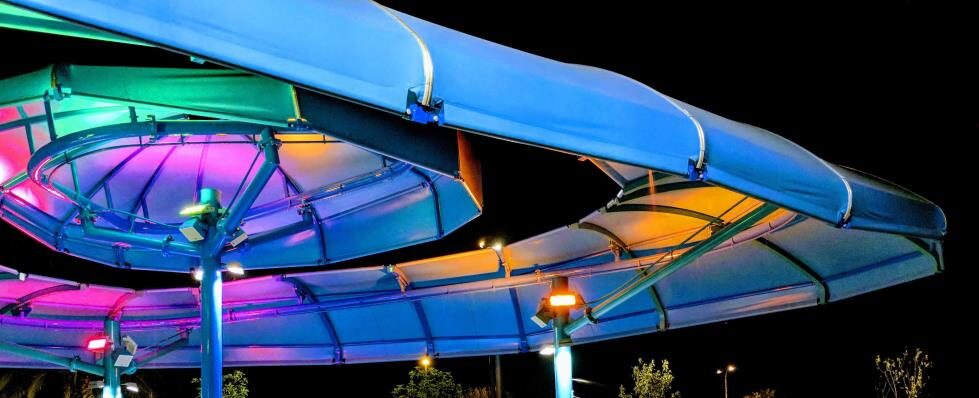
Our Hypar Shade Structures
What “Custom Built” Really Means
“Custom” gets used loosely in the shade industry. For some vendors, it means picking from a slightly larger catalog of standard sizes. For us, it means starting from your site conditions, your goals, and your design preferences — and engineering a structure that does not exist anywhere else.
A true custom built shade structure is designed specifically for:
- Your site footprint — The actual dimensions, obstacles, and constraints of your space, not a generic rectangle that approximates them.
- Your local wind, seismic, and snow loads — Engineered to the specific code requirements and exposure conditions of your jurisdiction.
- Your clearance and circulation needs — Post placement, eave heights, and projection geometry that work with how people, vehicles, and equipment actually move through the space.
- Your aesthetic and branding goals — Custom shapes, multi-color fabric configurations, powder coat colors that match your brand or building, and architectural lines that integrate with the surrounding context.
The result is a structure that looks like it was always meant to be there — not bolted on as an afterthought.
When Custom Is the Right Choice
Standard shade structures from our product line are the most cost-effective solution for most projects. Hip structures, 3-point and 4-point sails, flat cantilevered structures, hypar shades, and ramadas cover the vast majority of commercial shade applications. But custom design is the right answer when:
- The site footprint is irregular — Curved frontages, L-shaped patios, multi-level decks, or spaces that wrap around buildings, trees, or existing structures cannot be efficiently shaded by rectangular catalog sizes.
- Posts cannot go where standard layouts require — Underground utilities, existing foundations, vehicle traffic patterns, or pedestrian circulation may make standard column placement impossible.
- Coverage requirements exceed standard sizes — Mega-span structures over plazas, multi-court sports facilities, or large parking areas may need engineering and steel beyond what stock products offer.
- The architecture demands a specific look — Resort properties, signature commercial developments, and high-design facilities often need shade structures that complement specific architectural lines, materials, or design language.
- Branding is central to the project — When the shade structure is intended to be a visible expression of school colors, corporate identity, or community branding, custom design allows for multi-panel fabric configurations, mixed colors, and powder coat schemes that catalog products cannot match.
- The structure needs to integrate with existing buildings — Wall mounts, rooftop attachments, recessed plate connections, or hybrid configurations that combine ground-mounted columns with building tie-ins require custom engineering.
Design Freedoms in a Custom Project
Shape and Geometry
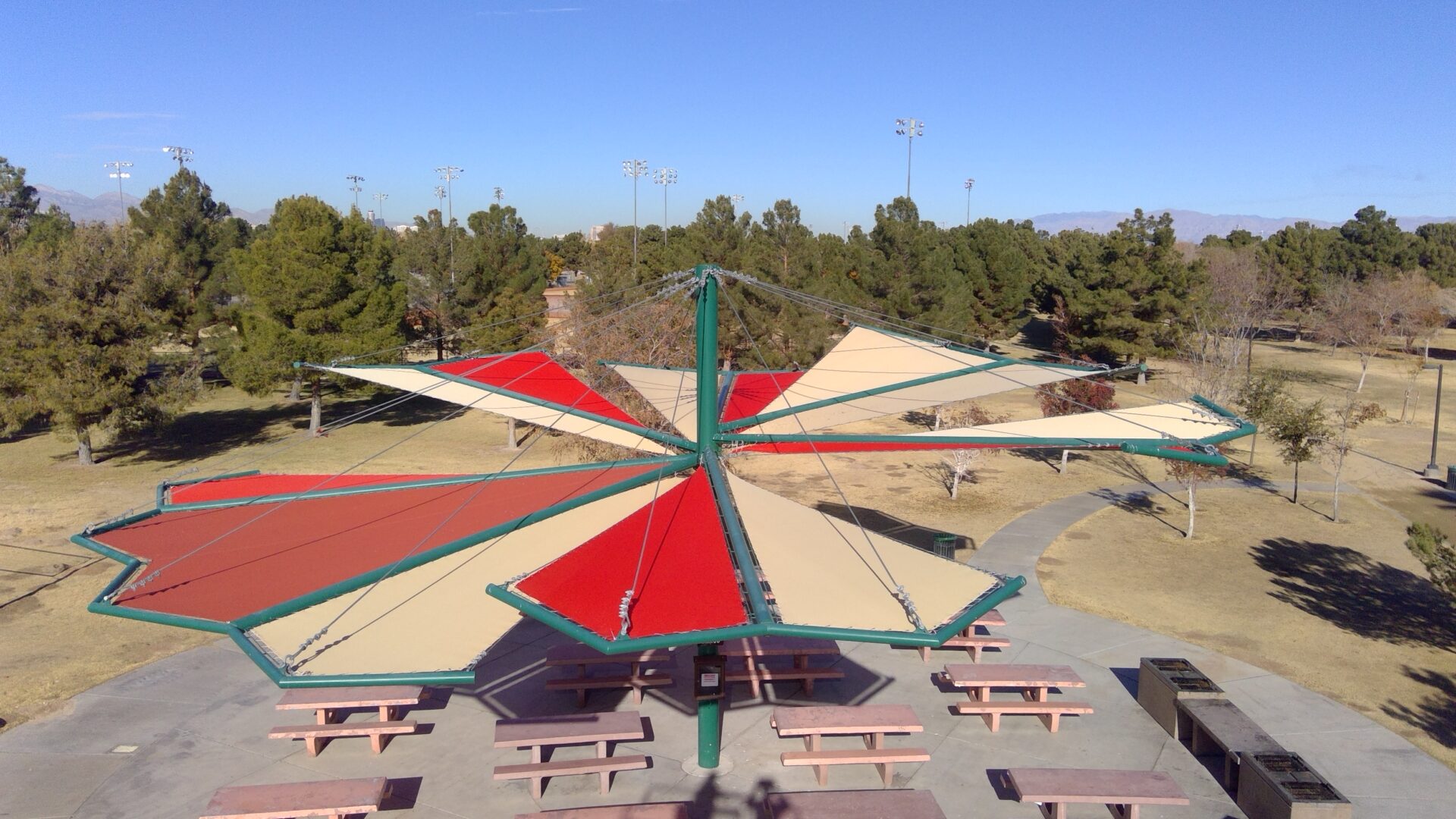
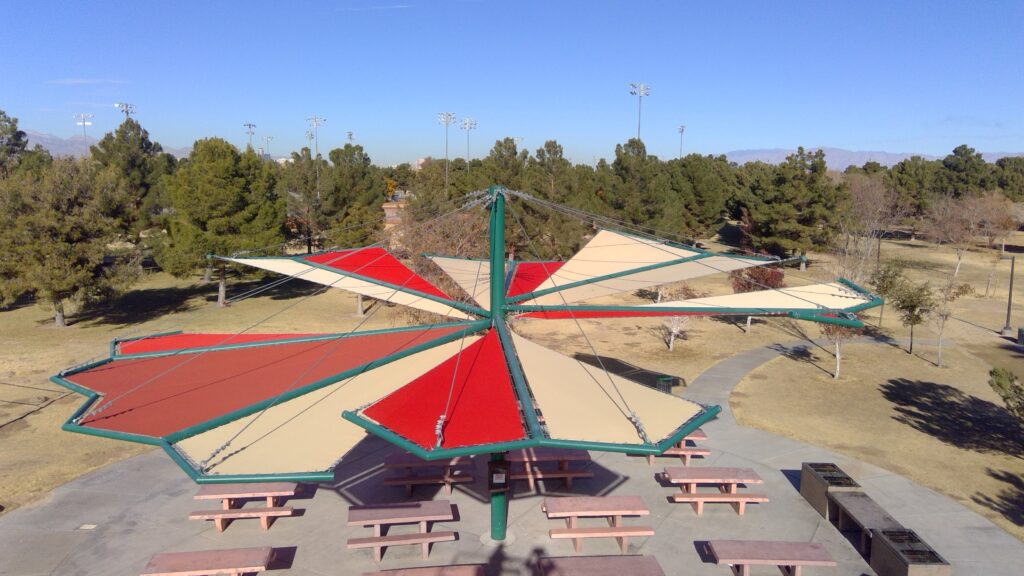
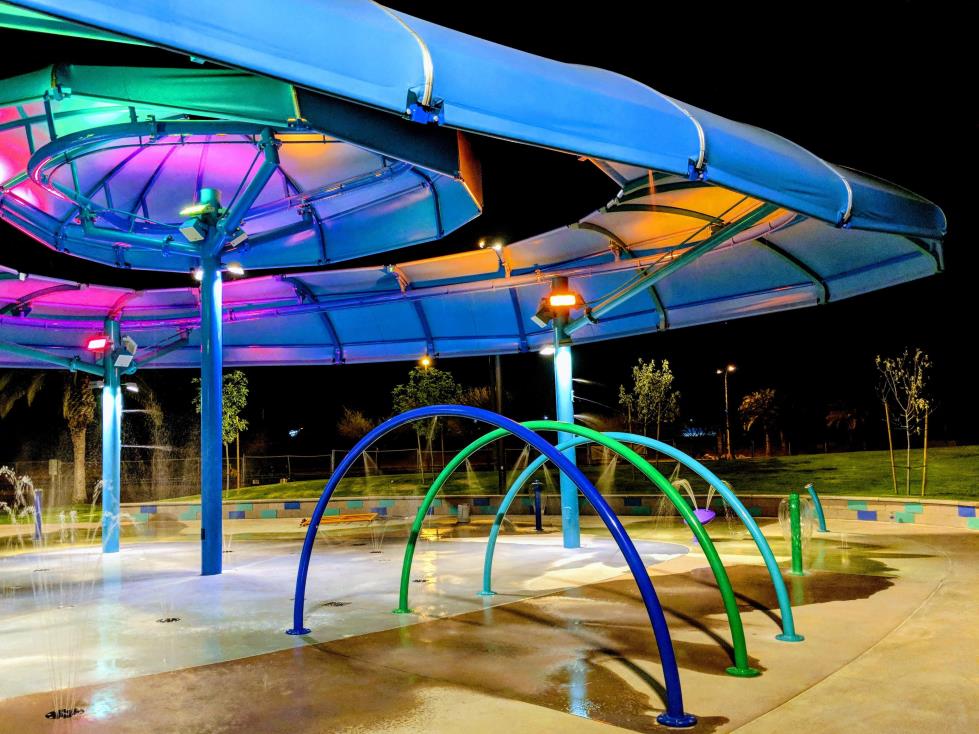
Beyond the standard hip, sail, cantilever, and hypar forms, custom projects use multi-level sails, hexagonal and octagonal roofs, mega-span tensioned membranes, T-post configurations, layered overlapping canopies, and sculptural specialty forms designed to create dramatic geometry while solving real site constraints. We can layer multiple sails at varying heights, twist membranes into hyperbolic paraboloids, combine post types, and build configurations that follow curved frontages, wrap around obstacles, or extend rooflines from existing buildings.
The shape is not just an aesthetic decision — it is a functional one. Custom geometry lets us optimize sun angles for the specific times of day the space is used, create circulation paths that work with how people move through the area, and position the structure so it integrates with the architecture rather than competing with it.
Multi-Color and Multi-Panel Fabric
One of the most powerful design freedoms in custom work is the ability to use different fabric colors on separate panels of the same structure. This is how custom shade installations become signature landmarks rather than generic canopies. Schools use multi-panel configurations to display school colors. Corporate campuses match brand palettes. Theme parks and entertainment venues create distinctive visual identities. Resorts coordinate with landscape and architectural color schemes to make the shade feel intentional.
We work with Commercial 340/95 HDPE shade cloth as our primary fabric, available in standard, heavy weight, and FR (fire resistant) configurations and a wide range of colors. We also source from Polyfab, Alnet, and Serge Ferrari fabric lines, giving us extensive color and performance options for projects with specialized requirements. All of our HDPE shade fabrics are 100% lead-free, phthalate-free, and backed by manufacturer UV degradation warranties of 10 to 15 years.
Powder Coat Colors and Finishes
Steel components on every Total Shade structure are powder coated to a minimum of 3 mil thickness after fabrication, providing a hard, corrosion-resistant finish rated for decades of Arizona sun and weather. We offer over 25 standard powder coat colors with custom color matching available. For custom projects, this means columns and frames can be coordinated with brand colors, school colors, or building architecture — not limited to the basic black, white, and beige options that catalog products typically offer.
Many of our most striking custom installations deliberately mix colors — tan columns supporting green and sand fabric panels, blue columns with multiple shades of blue fabric, school-color columns with contrasting fabric — to create visual identities that simply cannot be replicated with standard product configurations.
Mounting Options and Attachment Methods
Custom projects allow for any combination of mounting methods to solve site-specific challenges:
- Embedded posts in concrete footings for new construction with maximum structural connection
- Surface base plates bolted to existing concrete slabs where excavation is impractical
- Recessed plate mounts set flush during concrete pour for a clean, finished appearance
- Wall and building attachments that tie shade canopies into existing structural framing
- Rooftop installations with engineered connections to building structure
- Hybrid configurations combining ground-mounted columns with building tie-ins to reduce post count and integrate the structure with adjacent architecture
Solving Difficult Site Conditions
Custom design shines where standard products cannot work. Common challenges we solve through custom engineering include:
- Irregular playgrounds — Layered sail configurations and custom column placement to shade play equipment, climbing structures, and safety fall zones that standard rectangular hips cannot efficiently cover.
- Tight walkways and corridors — Cantilevered or single-post designs that provide overhead shade in spaces too narrow for multi-post structures.
- Seating zones with view corridors — Asymmetric designs that shade spectators or diners while preserving sightlines to stages, fields, or scenic views.
- Parking and drive lanes — Cantilever runs and shared-post layouts that shade vehicles without placing columns in traffic paths or fire lanes.
- Around trees and existing structures — Custom footprints that work around mature landscaping, existing buildings, utility easements, and other immovable features.
- Bleachers and grandstands — Cantilevered and projected canopies that shade spectator seating without obstructing views of the action.
- Drop-off loops and porte cocheres — Curved or arched canopies that follow vehicle circulation paths at hotels, schools, and commercial buildings.
- Crowded plazas and entry zones — Multi-sail configurations that cover large areas while keeping ground-level circulation open and clear.
Browse completed custom installations in our project gallery to see how we have solved unique site challenges for clients across Arizona and the Southwest.
UV Protection and Public Health
The Centers for Disease Control and Prevention (CDC) recommends shade structures as a primary defense against ultraviolet radiation, particularly in schools, parks, and public facilities where children and outdoor workers spend extended time in the sun. Custom shade design allows the coverage area to be optimized for the specific times of day and locations where people actually need protection — not just where a standard footprint happens to land.
The U.S. Environmental Protection Agency (EPA) reports that one in five Americans will develop skin cancer, with unprotected UV exposure being the most preventable risk factor. The EPA advises seeking shade during peak UV hours between 10 a.m. and 4 p.m. — which is exactly when custom-engineered shade footprints can be optimized to provide maximum protection over the most-used areas of the site.
For employers, OSHA’s Water-Rest-Shade guidelines identify shade as a core element of heat illness prevention for outdoor workers. Custom shade structures can be designed to cover specific work areas, break zones, and equipment staging locations that standard catalog products cannot efficiently address.
Engineering, Codes, and Permitting
Custom does not mean uncertified. Every custom shade structure we build is engineered to meet or exceed the International Building Code (IBC), with wind loads calculated per ASCE 7 and any local amendments. In Arizona, design wind speeds typically range from 90 to 115 mph depending on jurisdiction and risk category. Our engineering package for custom projects includes:
- Sealed structural drawings prepared by licensed engineers, customized to the unique geometry and load conditions of your project
- Site-specific wind and seismic load calculations based on your project’s location, exposure category, and governing code
- Footing and anchor designs sized for the actual soil conditions at your site and the specific loads of your custom structure
- Connection details and column specifications documenting every steel section, weld, bolt, and hardware component
- Complete permit-ready documentation formatted for submission to your local building department
Custom projects often face more complex permit reviews than standard installations because the geometry and loads are unique to the site. We navigate the permitting process as part of every custom project, including coordination with building officials, fire marshals, and any other reviewing authorities involved in your jurisdiction.
The Custom Design Process
From first contact to finished installation, here is what to expect when you work with Total Shade on a custom project:
- Initial consultation — We discuss your goals, site conditions, budget, timeline, and aesthetic preferences. There is no cost or obligation at this stage.
- Site visit and assessment — We visit your property to take measurements, evaluate soil and access conditions, identify utility conflicts, and document existing features that will affect the design.
- Concept development — Our design team develops one or more conceptual approaches based on your goals and the site constraints. We discuss the trade-offs between options so you can make informed decisions.
- Design refinement and proposal — We refine the chosen concept into a detailed proposal including shape, dimensions, materials, colors, mounting method, and pricing.
- Engineering and permitting — Once you approve the design, our engineering team produces sealed structural drawings and submits permit applications to your local building department.
- Fabrication — Our Phoenix shop cuts, welds, and powder coats the steel; our sewing team cuts and sews the fabric to your exact specifications.
- Installation — Our OSHA-certified field crew installs the structure, including footing excavation, post setting, steel erection, fabric tensioning, and final inspection.
- Project closeout — We provide all warranty documentation, care instructions, and the contact information for ongoing support.
Throughout the process, you work with one team and one point of contact at Total Shade. There are no subcontractor handoffs, no finger-pointing if issues arise, and no surprises about who is responsible for what.
Understanding Custom Project Costs
Custom shade structures cost more than standard catalog products because they require unique engineering, specialized fabrication, and design time that off-the-shelf products do not. But for projects that need custom design, the alternative is either an inadequate standard product that does not solve the problem or no shade at all — both of which cost more in the long run than doing it right the first time.
| Cost Category | What It Includes | Why It Matters |
|---|---|---|
| Design and Engineering | Concept development, sealed structural drawings, site-specific load calculations, permit documentation | Custom projects require more design and engineering hours than catalog products; this is what makes them fit your site precisely |
| Steel Fabrication | Custom-cut steel columns and framework, welding, powder coat finish in selected colors | Custom geometry and color selection drive material and labor cost compared to standard configurations |
| Fabric and Soft Goods | HDPE shade cloth cut and sewn to custom patterns, multi-color panels if specified, edge reinforcement, hardware | Custom fabric patterns and multi-panel configurations cost more than standard rectangular cuts |
| Permits and Approvals | Building permits, plan review fees, any zoning or signage permits | Custom geometry may require more detailed permit review; complex sites can extend the approval timeline |
| Foundations and Site Work | Concrete footings sized for the specific structure, soil preparation, any required site modifications | Site conditions and soil bearing capacity directly affect foundation costs |
| Installation | Crane mobilization, steel erection, fabric tensioning, by OSHA-certified crew | Custom structures may require larger crane equipment and longer installation windows than standard products |
| Ongoing Maintenance | Periodic re-tensioning, fabric cleaning, hardware inspection, steel touch-up over 15-25 years | Custom structures using commercial-grade materials have the same long service life as standard products |
Why Work with Total Shade LLC for Custom Projects?
- 25+ years of custom shade design and engineering — We have built one-of-a-kind structures for school districts, municipalities, churches, HOAs, resorts, and national brands including Six Flags and Amazon across Arizona and the Southwest.
- Vertically integrated capability — Design, engineering coordination, steel fabrication, fabric cutting and sewing, powder coating, and installation are all performed by our own teams from our Phoenix headquarters. No middlemen, no outsourced quality, no finger-pointing.
- OSHA-certified installation crew — Custom structures often involve heavy steel, complex rigging, and precise tensioning. Our field team is trained and certified to the highest safety standards.
- Proudly made in the USA — All fabrication is domestic, ensuring quality control and shorter lead times than contractors who import steel or fabric from overseas.
- Single point of contact — From the first site visit through final punch list, you work with one team that owns every phase of the project.
- Honest design recommendations — If a standard product from our line would actually serve you better than a custom design, we will tell you. Our goal is the best outcome for your site, not the biggest project we can sell.
- Full shade product range — If part of your site needs a custom design and another part is well-served by a standard hip structure, cabana, or awning, we handle both under one contract. Browse our complete product line.
Read what our clients say on our testimonials page.
Get a Free Consultation for Your Custom Shade Project
If you have a site that does not fit a catalog, a vision that needs engineering to become reality, or a project where standard products simply will not work, Total Shade LLC is here to help. We will visit your site, listen to your goals, and develop a custom design that solves your specific challenges — all at no cost or obligation until you decide to move forward.
Call us today: (602) 265-0905
Email: info@totalshadellc.com
Submit a Project Inquiry Online →
Total Shade, Total Solution!