Need a canopy assessment? Call Total Shade LLC today at (602) 265-0905 or request a free inspection.
Canopy Replacement and Repair
In-House Fabric Fabrication to Restore, Replace, or Upgrade Your Existing Shade Structure
Built for Arizona.
The Ultimate Outdoor Shade Solutions for Arizona’s Sun
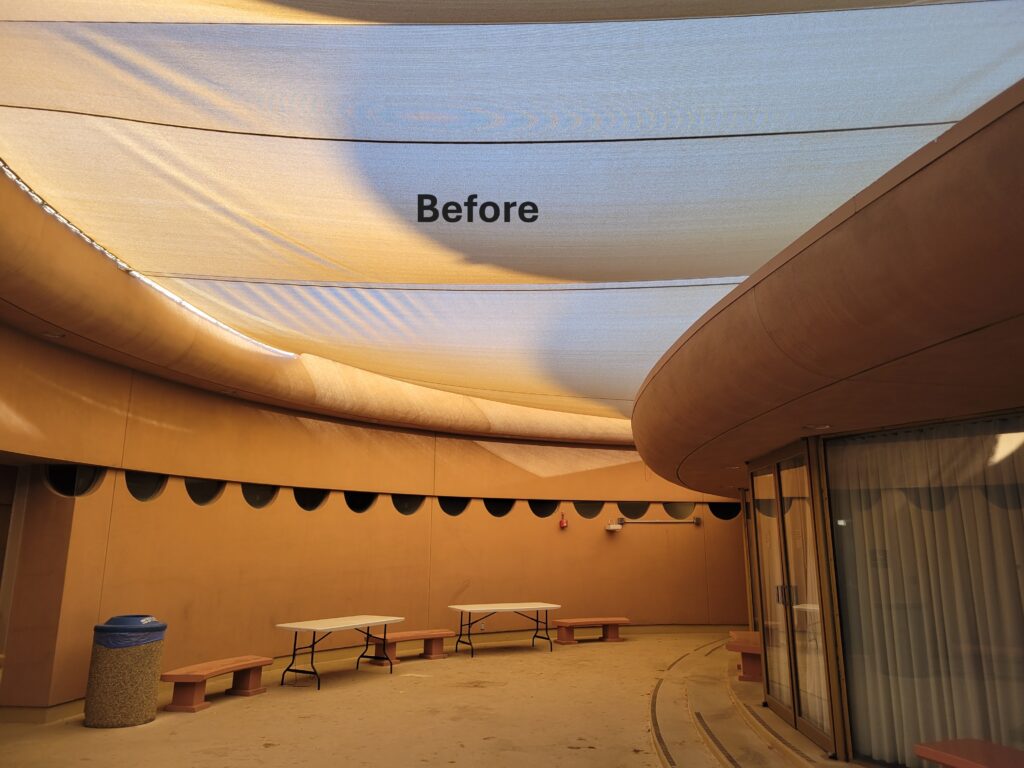
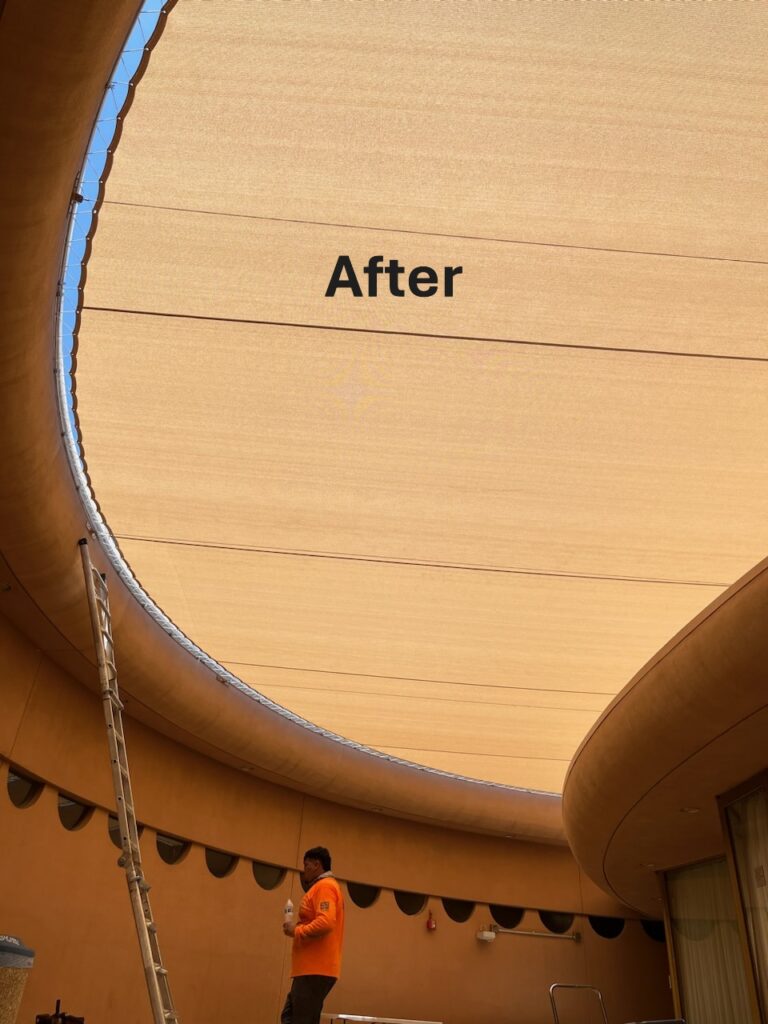
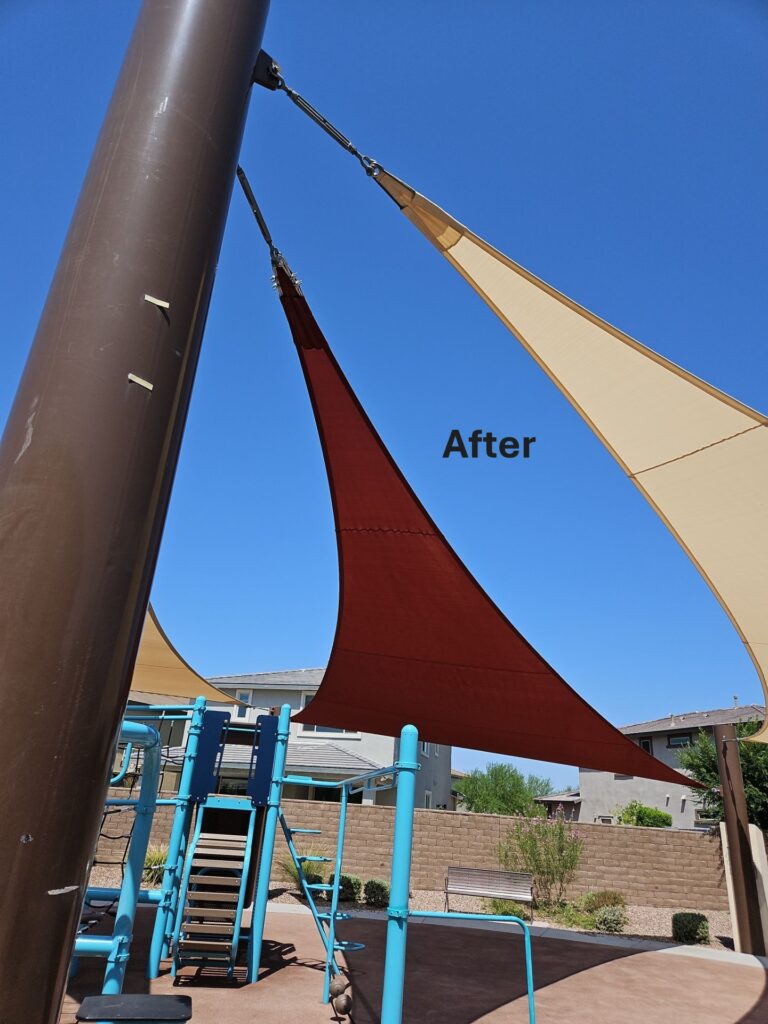
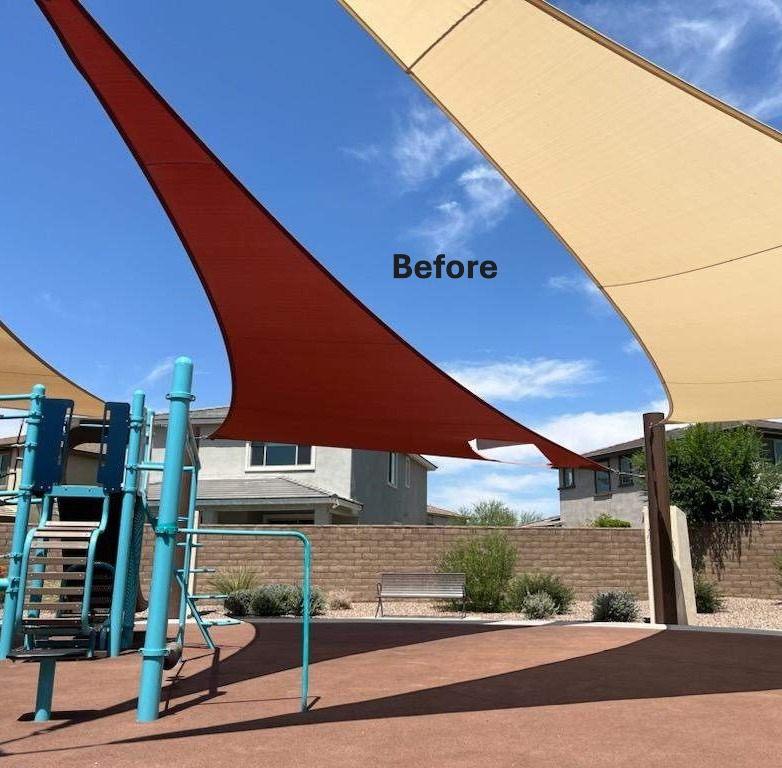
The steel frame is still solid. The footings are fine. The hardware is intact. But the fabric is torn, sagging, faded beyond recognition, or so UV-degraded that it could fail the next time the wind picks up. If that describes your shade structure, you do not need a full replacement — you need a new canopy fabricated to fit your existing frame.
At Total Shade LLC, our in-house sewing team fabricates replacement shade sails, canopy panels, awning skins, cabana curtains, and tensioned membranes from our Phoenix facility. We measure your existing structure, assess your hardware, pattern a new canopy to match your frame’s exact geometry, and install the finished fabric — often at a fraction of the cost of tearing everything out and starting over. With over 25 years of experience building and maintaining shade structures across Arizona and the Southwest, we know when a repair will hold, when a replacement is the smarter investment, and when an upgrade to better fabric can extend the life of your structure by another decade or more.
This page covers what buyers need to know about canopy replacement and repair: when to repair versus replace, what the process involves, fabric options and upgrade opportunities, and how to evaluate the cost against a full structure replacement.
Our Hypar Shade Structures
Repair vs. Replace: How to Decide
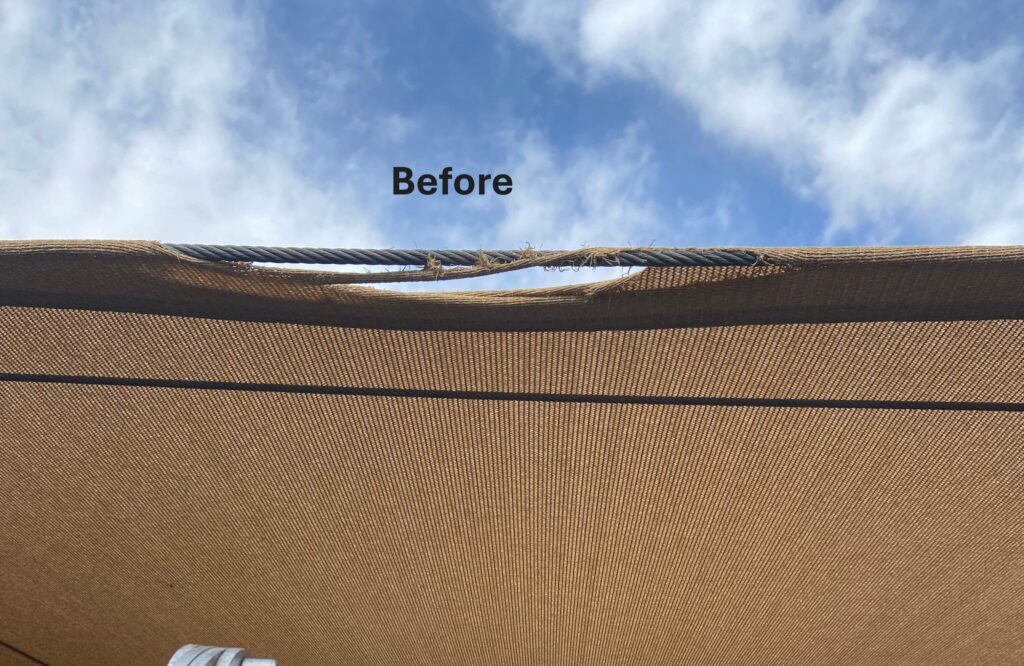
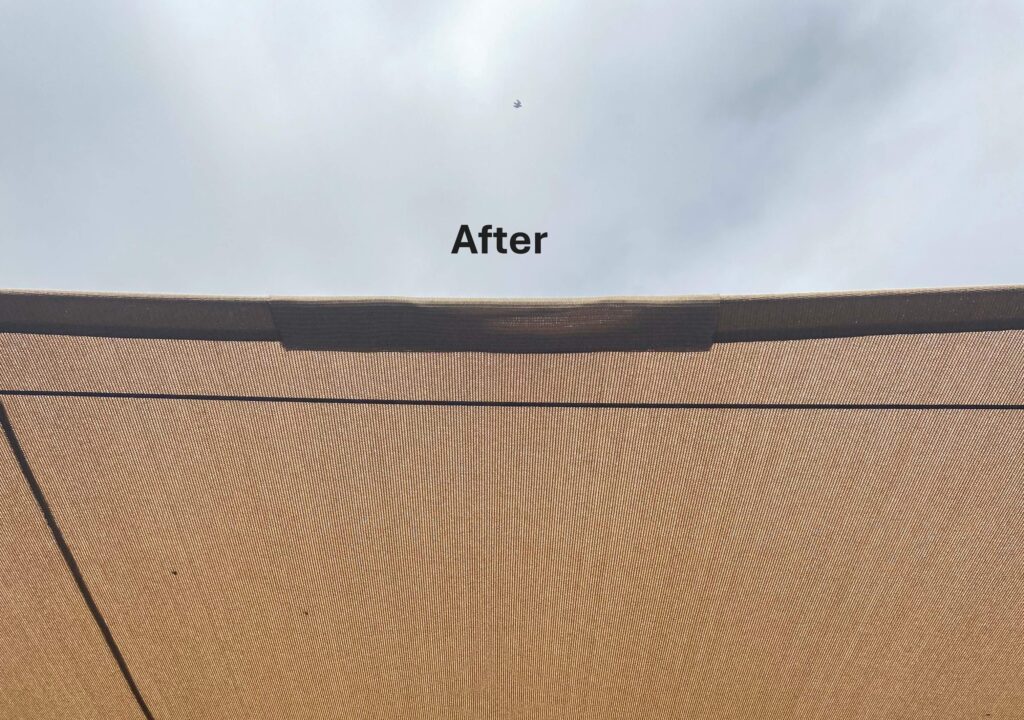
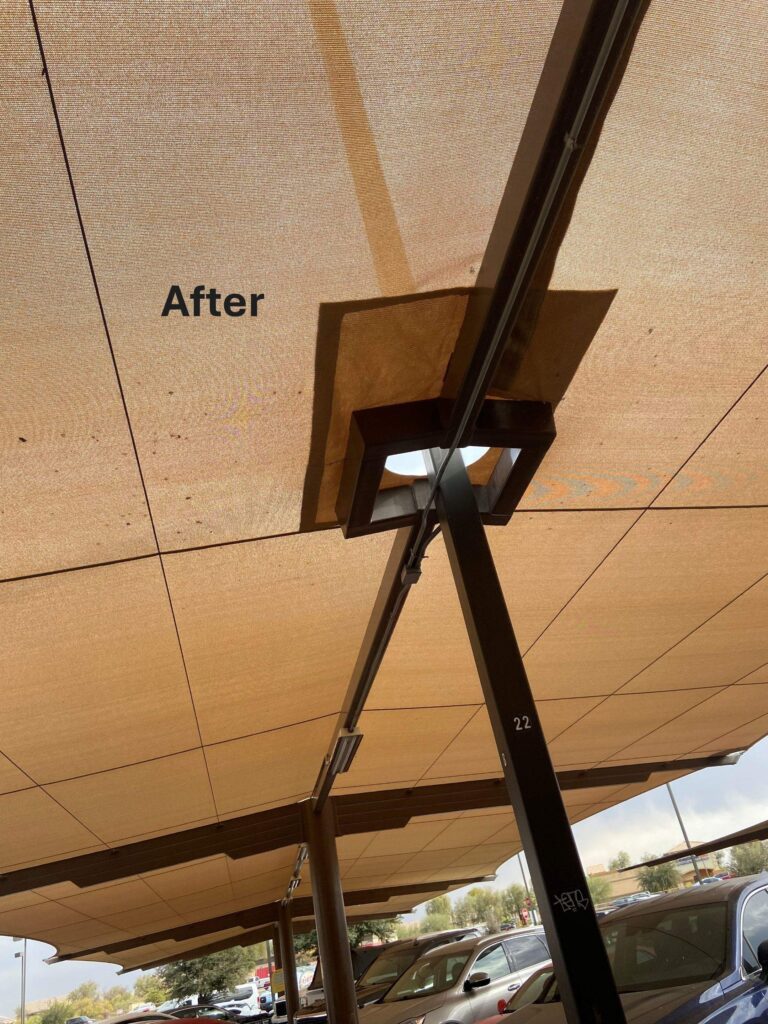
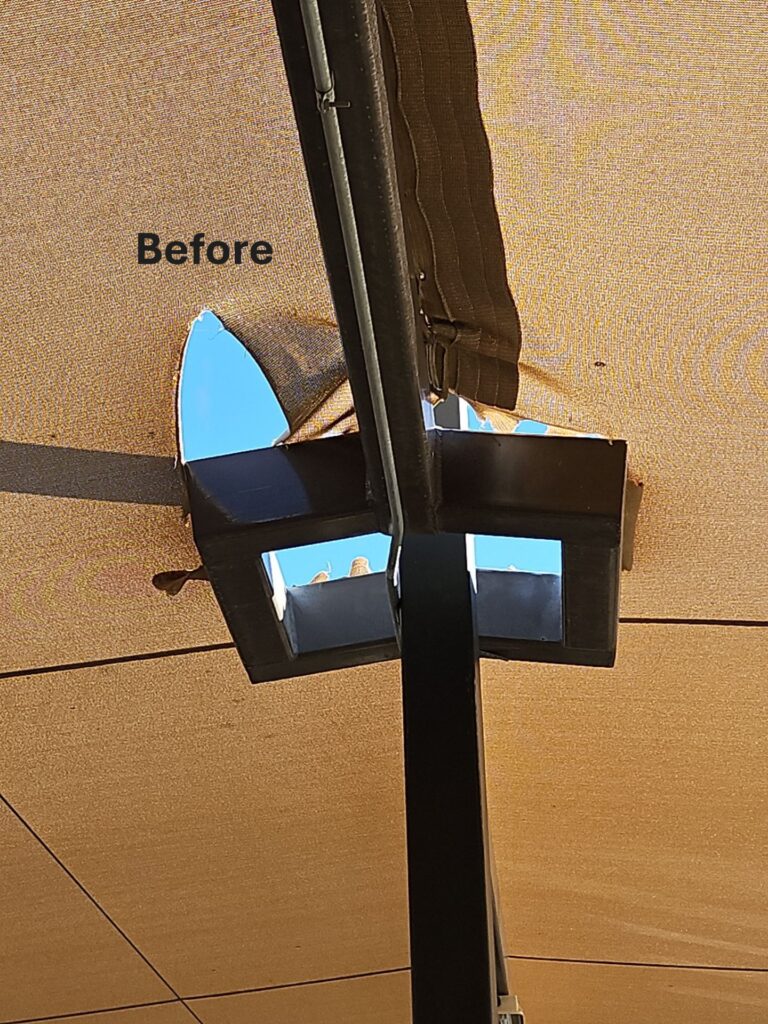
Not every damaged canopy needs to be replaced, and not every damaged canopy should be repaired. The decision depends on the type, location, and extent of the damage, the age and condition of the remaining fabric, and whether the repair will actually hold under tension and weather exposure. Here is how we evaluate it:
When Repair Makes Sense
- Small to medium tears or holes away from edges and corners — Punctures from falling debris, minor storm damage, or accidental contact can often be repaired with UV-resistant stitching and reinforcement patches, provided the surrounding fabric is still structurally sound.
- Isolated seam failures — A single seam that has separated while the rest of the canopy is in good condition can be re-stitched with heavy-duty, UV-resistant thread and reinforced with additional webbing.
- Minor hardware attachment issues — Worn grommets, loosened corner plates, or damaged edge webbing at a single point can be rebuilt without replacing the entire sail.
For repairs to be viable, the base fabric must still have structural integrity. If the HDPE or acrylic has become brittle, thin, or tears easily when handled, a patch will simply move the failure point to the next weakest spot.
When Replacement Is the Better Investment
- Large tears or rips that extend to edges, corners, or hardware points — Damage at stress concentrations cannot be reliably patched because the repaired area will be under the highest tension loads in the canopy.
- Extensive UV degradation — Fabric that has become brittle, chalky, or significantly weakened across its surface is past the point where spot repairs will hold. This is common in Arizona after 8 to 12 years of continuous sun exposure on standard-grade fabrics.
- Widespread sagging or stretch — Fabric that has permanently deformed and can no longer be tensioned properly has reached the end of its service life regardless of whether it has visible tears.
- Frayed edges and worn webbing — When the perimeter reinforcement that carries the tension loads is compromised in multiple locations, the canopy needs to be replaced, not patched.
- Fabric past its expected service life — If the canopy has been in service for 10 to 15 years in Arizona conditions, replacement with new commercial-grade fabric is typically more cost-effective than attempting to extend a material that is approaching end of life from every direction.
We inspect every canopy honestly and tell you whether a repair will hold or whether fabricating a new sail is the smarter use of your budget. There is no value in paying for a repair that fails six months later.
What the Replacement Process Looks Like
When we fabricate a replacement canopy, the process is designed to deliver a precise fit to your existing frame — not a generic, close-enough panel pulled from a catalog. Here is what is involved:
- Site inspection and measurement — We visit your site and measure the existing post locations, connection hardware, and attachment geometry. If the original sail is still in place, we use it as a reference pattern. If it has already been removed or is too damaged to use as a template, we measure the steel frame directly and engineer the new canopy to the as-built dimensions.
- Hardware assessment — We inspect your existing posts, footings, turnbuckles, shackles, mounting plates, and all connection hardware. If hardware is worn, corroded, or undersized, we recommend replacement or upgrade before the new canopy goes on — putting new fabric on compromised hardware wastes the investment.
- Fabric selection — We help you choose the right fabric for your application, whether that means replacing in kind with the same material or upgrading to a higher-performance option. This is the opportunity to improve UV block, switch to a fire-rated fabric, change colors, or move to a heavier-weight cloth that will last longer in your specific exposure conditions.
- In-house fabrication — Our sewing team in Phoenix cuts, sews, and finishes the new canopy with reinforced edges, UV-resistant thread, webbing, and stainless steel corner fittings. Every panel is fabricated to the exact dimensions of your structure — not a standard size adjusted with extra tension or slack.
- Removal and installation — We remove the old canopy (if still in place), install the new fabric, and tension it to the correct specification for your structure type. For tensioned sails and hypar membranes, proper multi-point tensioning is critical to achieving the correct geometry and ensuring the fabric performs as designed.
Fabric Options and Upgrade Opportunities
A canopy replacement is not just a maintenance task — it is an opportunity to upgrade. Many shade structures installed 8 to 15 years ago used fabric that was the best available at the time but has since been surpassed by materials with better UV stability, stronger yarns, improved colorfastness, and longer manufacturer warranties. When you replace your canopy, you can step up to today’s commercial-grade options without replacing the steel frame, footings, or hardware.
Our primary replacement fabric is Commercial 340/95, a high-density knitted HDPE shade cloth available in standard, heavy weight, and FR (fire resistant) configurations. This is the same commercial-grade fabric we specify on all of our new shade structure installations.
We also source from Polyfab, Alnet, and Serge Ferrari fabric lines, giving us the flexibility to match the ideal material to your project’s UV performance, fire rating, color palette, and budget requirements.
Common upgrade paths include:
- Standard to heavy weight — For structures in high-wind locations or sites where extra durability will extend the replacement cycle and reduce long-term cost.
- Non-rated to FR (fire resistant) — For structures near buildings, grills, or in jurisdictions that now require flame-retardant materials where they previously did not. FR fabrics are certified to CSFM 1237.1 and NFPA 701.
- Residential-grade to commercial-grade — Some older structures were originally fitted with lighter-duty fabric. Upgrading to commercial HDPE with a 10 to 15 year UV warranty significantly extends the next replacement cycle.
- Color change or refresh — A new canopy is the easiest way to update the look of your shade structure. Match new school colors, refresh faded branding, or coordinate with a building renovation — all without touching the steel.
Why Damaged Canopies Are a Safety and Liability Issue
A torn or degraded canopy under tension is not just an eyesore — it is a safety hazard. Fabric that has lost structural integrity can fail suddenly during a wind event, dropping hardware, cables, and fabric onto the people, vehicles, or equipment below. For schools, parks, pool decks, and commercial properties with public access, a visibly damaged shade canopy also creates a liability exposure that no amount of “we’re planning to fix it” eliminates.
The Centers for Disease Control and Prevention (CDC) recommends shade structures as a frontline defense against UV radiation — but a shade structure with a failed canopy provides no protection at all. Every day a damaged canopy remains in place is a day the space beneath it is unprotected.
The U.S. Environmental Protection Agency (EPA) reports that one in five Americans will develop skin cancer, with unprotected UV exposure being the most preventable risk factor. Restoring your shade canopy is not just a maintenance item — it is a public health measure for every person who uses the space.
For employers, OSHA’s Water-Rest-Shade guidelines identify shade as a core element of heat illness prevention. A shade structure with a missing or failed canopy does not satisfy this requirement.
What We Replace and Repair
Our in-house sewing team fabricates replacement fabric for every shade structure type we build — and for many structures originally built by other contractors. If your frame is sound, we can make it a new canopy. Common replacement and repair projects include:
- Hip shade structure canopies — Replacement fabric for standard hip structures and MAX Hip structures of all sizes.
- Tensioned fabric sails — New sails for 3-point and 4-point tensioned sail systems, including hypar configurations.
- Hypar membranes — Precision-cut replacement fabric for hypar shade structures, where the twisted geometry requires exact patterning to achieve correct curvature and tension.
- Cantilever shade canopies — Replacement fabric for flat cantilevered structures over parking, bleachers, and walkways.
- Awning re-skinning — New canopy fabric for commercial awning frames, including custom colors and brand graphics.
- Cabana fabric and curtains — Replacement roof canopies, side panels, and privacy curtains for commercial cabana structures.
- Umbrella canopy replacement — New canopy panels for commercial umbrella frames when the fabric wears out before the hardware does.
- Third-party structure re-canopy — If your shade structure was built by another contractor but you need new fabric, we can often measure, pattern, and fabricate a replacement canopy to fit your existing frame.
Understanding the Cost: Replacement vs. Full Structure
One of the most common questions we hear is whether it makes more sense to replace the canopy or tear everything out and install a new structure. In most cases, if the steel frame and footings are in good condition, a canopy replacement delivers dramatically better value:
| Cost Factor | Canopy Replacement | Full Structure Replacement |
|---|---|---|
| Steel and columns | Reuse existing (no cost) | New fabrication, powder coating, delivery |
| Footings and foundations | Reuse existing (no cost) | Demolition of old footings, new excavation, new concrete |
| Engineering | Minimal or none (existing structure is already permitted) | New sealed drawings, calculations, permit applications |
| Fabric | New canopy fabricated to fit existing frame | New canopy fabricated to fit new frame |
| Hardware | Replace only what is worn or damaged | All new hardware |
| Installation | Remove old fabric, install new, re-tension | Full demolition, new steel erection, crane work, fabric install |
| Downtime | Days | Weeks to months |
| Typical cost | A fraction of full replacement | Full project cost including steel, concrete, engineering, and labor |
The exception is when the steel frame itself is compromised — significant rust, structural damage, undersized columns that no longer meet current code, or footings that have shifted or deteriorated. In those cases, a full replacement with a new engineered structure is the right path, and we handle those projects too. Browse our full range of new shade structure options.
Minimizing Downtime
For schools, parks, pool facilities, and commercial properties, every day without shade is a day the space is unusable or uncomfortable. We schedule canopy replacement projects to minimize disruption:
- Schools — We schedule removal and installation during breaks so students and staff are not affected and the shade is ready when they return.
- Pools and hospitality venues — We coordinate around operating hours and seasonal demand to avoid impacting guests during peak periods.
- Commercial properties — We work around tenant and customer schedules, establishing safe work zones and completing the work as quickly as the project scope allows.
Because we fabricate in-house in Phoenix, our lead times are shorter than contractors who outsource sewing to third-party shops or ship fabric from out of state. Once the canopy is fabricated, installation typically takes one to two days depending on structure type and size.
Why Work with Total Shade LLC for Canopy Replacement?
- In-house sewing facility — We cut, sew, and finish every canopy in our Phoenix shop. No outsourcing, no third-party delays, no quality uncertainty.
- 25+ years of shade structure expertise — We built many of the structures we now re-canopy, and we understand the engineering and tensioning requirements of every structure type we service.
- Honest repair vs. replace assessment — We inspect your canopy and tell you the truth about what will hold and what will not. We would rather do a repair that lasts than sell you a replacement you do not need.
- Commercial-grade fabric only — Every replacement canopy uses the same commercial-grade materials we specify on new installations. No residential-grade substitutions.
- Full hardware inspection and upgrade — We do not just swap fabric. We inspect posts, footings, hardware, and connections and flag anything that needs attention before the new canopy goes on.
- OSHA-certified installation crew — Canopy removal and tensioning requires work at height and handling of tensioned materials. Our field team is trained and certified.
- We service other contractors’ structures — Even if Total Shade did not build your original structure, we can often measure, pattern, and fabricate a replacement canopy to fit.
Read what our clients say on our testimonials page.
Get a Free Canopy Assessment
If your shade structure’s fabric is torn, faded, sagging, or past its service life, contact us for a free on-site inspection. We will assess the fabric, inspect the frame and hardware, and give you an honest recommendation — repair, replace in kind, or upgrade to better material. If the structure is sound, a new canopy can restore full shade protection in days, not weeks.
Call us today: (602) 265-0905
Email: info@totalshadellc.com
Submit a Project Inquiry Online →
Total Shade, Total Solution!